 VIPSolutions
Give step-by-step solution with explanation and final answer:An acetylene (C2H2) and excess oxygen mixture occupies 428 £3 at 30 °C and 760 mmHg . Following an explosion, the dry gaseous products have a volume of 458 ft3 at 50°C and a partial pressure of 730 mmHg. Determine the original volumes of acetylene and oxygen present in the mixture. Assume the final gas is fully saturated and that only the minimum amount of water necessary to achieve saturation was produced.
Question:
Give step-by-step solution with explanation and final answer: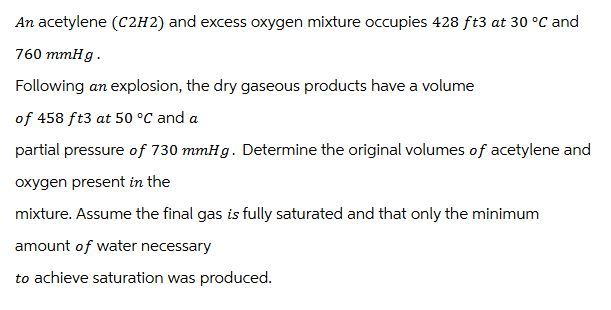 An acetylene (C2H2) and excess oxygen mixture occupies 428 £3 at 30 °C and
760 mmHg .
Following an explosion, the dry gaseous products have a volume
of 458 ft3 at 50°C and a
partial pressure of 730 mmHg. Determine the original volumes of acetylene and
oxygen present in the
mixture. Assume the final gas is fully saturated and that only the minimum
amount of water necessary
to achieve saturation was produced.
This is AI generated Response.
Asked by: Francis
Created at: 2025-12-28 23:13:06
Asked by: Francis
Created at: 2025-12-28 23:13:06
Final Answer:
Rendered
Raw Text
Did you like this answer?
Let's break down the problem step by step:
---
## **Given Data**
- **Initial Mixture:** Acetylene (C₂H₂) + excess O₂
- Volume = \( V_1 = 428 \) ft³
- \( T_1 = 30^\circ C = 303.15 \) K
- \( P_1 = 760 \) mmHg = 1 atm
- **After Explosion (Dry Products):**
- Volume = \( V_2 = 458 \) ft³
- \( T_2 = 50^\circ C = 323.15 \) K
- Partial pressure = \( P_2 = 730 \) mmHg
The gas is **fully saturated** with water vapor.
---
### **Step 1: Write the Combustion Reaction**
The combustion of acetylene:
\[
2C_2H_2 + 5O_2 \rightarrow 4CO_2 + 2H_2O
\]
Let \( x \) be the initial moles of acetylene and \( y \) be the initial moles of oxygen.
\[
C_2H_2 + \frac{5}{2} O_2 \rightarrow 2CO_2 + H_2O
\]
---
### **Step 2: Calculate Initial Moles of Gas**
Using the ideal gas law:
\[
PV = nRT
\]
Where \( R = .0821 \) (L·atm)/(mol·K), but we'll work in ft³ and atm. Let's use:
\[
R = .7302 \ \text{(ft}^3\cdot\text{atm})/(\text{mol}\cdot\text{K})
\]
For initial conditions:
\[
P_1 V_1 = n_1 R T_1
\]
\[
n_1 = \frac{P_1 V_1}{R T_1}
\]
\[
n_1 = \frac{1 \times 428}{.7302 \times 303.15}
\]
\[
n_1 = \frac{428}{221.522}
\]
\[
n_1 \approx 1.933~\text{mol}
\]
But this value seems off for such a large volume; let's check units. 1 ft³ ≈ 28.316 L.
Convert 428 ft³ to liters:
\[
428 \times 28.316 = 12121.25~\text{L}
\]
Now use \( R = .0821 \) L·atm/(mol·K):
\[
n_1 = \frac{1 \times 12121.25}{.0821 \times 303.15}
= \frac{12121.25}{24.891}
\approx 487.3~\text{mol}
\]
---
### **Step 3: Moles of Final Dry Gas**
- \( V_2 = 458~\text{ft}^3 = 12968.73~\text{L} \)
- \( T_2 = 323.15~\text{K} \)
- \( P_2 = 730~\text{mmHg} = .9618~\text{atm} \)
\[
n_2 = \frac{P_2 V_2}{R T_2}
\]
\[
n_2 = \frac{.9618 \times 12968.73}{.0821 \times 323.15}
= \frac{12469.31}{26.554}
\approx 470~\text{mol}
\]
---
### **Step 4: Account for Water Vapor**
The final gas is **saturated with water vapor** at 50°C.
- Vapor pressure of water at 50°C ≈ **92.5 mmHg**.
So, the total pressure is 730 mmHg, **including** water vapor. Thus, the partial pressure of *dry* gas:
\[
P_{\text{dry}} = 730 - 92.5 = 637.5~\text{mmHg} = .839~\text{atm}
\]
Now, recalculate the moles of *dry* products:
\[
n_{\text{dry}} = \frac{.839 \times 12968.73}{.0821 \times 323.15}
= \frac{10882.63}{26.554}
\approx 410~\text{mol}
\]
---
### **Step 5: Gaseous Product Composition**
#### Combustion Reaction (per \( x \) moles acetylene):
\[
C_2H_2 + \frac{5}{2} O_2 \rightarrow 2 CO_2 + H_2O
\]
Let \( x \) = moles of C₂H₂, \( y \) = moles of O₂.
- Each mole of C₂H₂ uses 2.5 moles O₂, produces 2 moles CO₂ and 1 mole H₂O.
After reaction:
- Remaining O₂ = \( y - 2.5x \)
- CO₂ = \( 2x \)
- H₂O = \( x \) (but only the amount needed to saturate the gas at 50°C)
The *dry* products: CO₂ and O₂.
So,
\[
n_{\text{dry}} = 2x + (y - 2.5x) = y - .5x
\]
From step 4: \( n_{\text{dry}} = 410 \) mol
\[
y - .5x = 410 \tag{1}
\]
---
### **Step 6: Water Vapor Formed**
Let \( x \) = moles C₂H₂, so \( x \) moles H₂O formed, but only enough remains to saturate the gas.
Calculate the moles of water vapor in the final volume:
- Partial pressure of H₂O = 92.5 mmHg = .1217 atm
- Volume = 12968.73 L
- Temp = 323.15 K
\[
n_{\text{H}_2\text{O}} = \frac{P_{\text{H}_2\text{O}} \cdot V_2}{R T_2}
= \frac{.1217 \times 12968.73}{.0821 \times 323.15}
= \frac{1577.73}{26.554}
\approx 59.5~\text{mol}
\]
So, only 59.5 mol of the formed water remains as vapor.
---
### **Step 7: Total Initial Moles**
From Step 2, initial total moles:
\[
n_1 = x + y = 487.3~\text{mol}
\tag{2}
\]
---
### **Step 8: Solve the Equations**
From above:
1. \( y - .5x = 410 \)
2. \( x + y = 487.3 \)
Subtract (1) from (2):
\[
(x + y) - (y - .5x) = 487.3 - 410
\]
\[
x + y - y + .5x = 77.3
\]
\[
1.5x = 77.3
\]
\[
x = \frac{77.3}{1.5} = 51.53
\]
Now, \( y = 487.3 - x = 487.3 - 51.53 = 435.77 \)
---
### **Step 9: Convert Moles to Volumes (at Initial Condition)**
At STP (or initial conditions), use ideal gas law:
\[
V = \frac{nRT}{P}
\]
Here,
- \( R = .0821 \) L·atm/(mol·K)
- \( T = 303.15 \) K
- \( P = 1 \) atm
For C₂H₂:
\[
V_{C_2H_2} = \frac{51.53 \times .0821 \times 303.15}{1} = 1283.6~\text{L}
\]
\[
= \frac{1283.6}{28.316} = 45.34~\text{ft}^3
\]
For O₂:
\[
V_{O_2} = \frac{435.77 \times .0821 \times 303.15}{1} = 10850.~\text{L}
\]
\[
= \frac{10850.}{28.316} = 383.2~\text{ft}^3
\]
---
## **Final Answer**
### **Original Volumes at 30°C and 760 mmHg:**
- **Acetylene (\(C_2H_2\)):**
\(\boxed{45.3~\text{ft}^3}\)
- **Oxygen (\(O_2\)):**
\(\boxed{383.2~\text{ft}^3}\)
---
### **Summary of Steps**
1. Wrote the balanced chemical equation.
2. Used ideal gas law to find total initial and final moles.
3. Accounted for water vapor saturation in the final state.
4. Set up and solved simultaneous equations for moles of each gas.
5. Converted moles to original volumes.
---
If you need detailed unit conversions or further clarification on any step, let me know!
📢 Instructions:
- Ask anything relatd to above question only.
- For new Question goto :