 VIPSolutions
Give step-by-step solution with explanation and final answer:Summary of Requirements for the Semi - Batch Reactor Project (Chemical Engineering - Mathematical Modeling Course) Student Requirements 1. Reaction Modeling Write the reaction ree expression. Derive the moe balance equations for components A, B, Can Din a semi- batch reactor. 2. Numerical Solution Salve the derived balance equations using at east one numerical method Euler Method Fourth - Order Runge-Kutta (RK) Method The solution may be implemented using Excel or Python, with brief and clear explanation ofthe applied steps. (Optional) Compare th resus obtain from Euler and RK# methods or investigate the effect of th time step size. 3. Graphical Representation Plo the concentration profiles of: CACC ACCA) CBC) CBB CCYC_CICC() and CDC DHCD) Over th time interval rom 0 to 500 seconds: All graphs must include. propery labeled axes with units and be cisrly readable. +. Interpretation of Results (Mandatory) Explain why the concentrations fA. 8, and C change with time in the observed manner Discuss the physical reason why the concentration of component B increases only to a mite extent despite continuous feeding. Describe how the reaction ate changes with ime, supported by. calculations or graphical results. 4 Important Note: Studies tha include only calculations without physical interpretation and ciscussion wil nt receive ull ret. Project Question The reversible liquid phase production reaction given below takes place in asemi- batch reactor: A+B C+ DA + B rightarrow C + DA +B C+ D tis known that the reaction is an elementary reaction. The production reaction is carried out in semi batch reactor at constant temperature. tilly the reactor contains 5 dm 3 of solution with an A concentration of 0.05 mol/dm 3, Component 8, with a concentration of 0025 mol/dm 3, i fed into the reactor at a volumetric flow rete of 0.05 dm 3/s. Given tht the specific reaction rate constant is k = 2.2 m3 (ml.), answer the following: a. Determine the expressions descriing the Sime - dependent concentrations of reactant A and product C. b. Plotthe concentration profiles of al components ove the time terval [0-500]
Question:
Give step-by-step solution with explanation and final answer: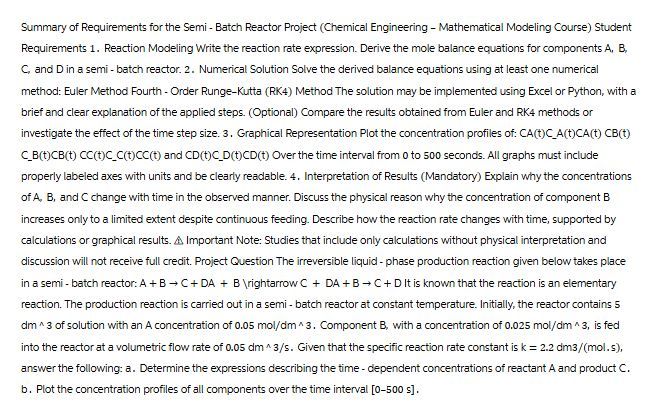 Summary of Requirements for the Semi - Batch Reactor Project (Chemical Engineering - Mathematical Modeling Course) Student
Requirements 1. Reaction Modeling Write the reaction ree expression. Derive the moe balance equations for components A, B,
Can Din a semi- batch reactor. 2. Numerical Solution Salve the derived balance equations using at east one numerical
method Euler Method Fourth - Order Runge-Kutta (RK) Method The solution may be implemented using Excel or Python, with
brief and clear explanation ofthe applied steps. (Optional) Compare th resus obtain from Euler and RK# methods or
investigate the effect of th time step size. 3. Graphical Representation Plo the concentration profiles of: CACC ACCA) CBC)
CBB CCYC_CICC() and CDC DHCD) Over th time interval rom 0 to 500 seconds: All graphs must include.
propery labeled axes with units and be cisrly readable. +. Interpretation of Results (Mandatory) Explain why the concentrations
fA. 8, and C change with time in the observed manner Discuss the physical reason why the concentration of component B
increases only to a mite extent despite continuous feeding. Describe how the reaction ate changes with ime, supported by.
calculations or graphical results. 4 Important Note: Studies tha include only calculations without physical interpretation and
ciscussion wil nt receive ull ret. Project Question The reversible liquid phase production reaction given below takes place
in asemi- batch reactor: A+B C+ DA + B rightarrow C + DA +B C+ D tis known that the reaction is an elementary
reaction. The production reaction is carried out in semi batch reactor at constant temperature. tilly the reactor contains 5
dm 3 of solution with an A concentration of 0.05 mol/dm 3, Component 8, with a concentration of 0025 mol/dm 3, i fed
into the reactor at a volumetric flow rete of 0.05 dm 3/s. Given tht the specific reaction rate constant is k = 2.2 m3 (ml.),
answer the following: a. Determine the expressions descriing the Sime - dependent concentrations of reactant A and product C.
b. Plotthe concentration profiles of al components ove the time terval [0-500]
Asked by: Francis
Created at: 2025-12-28 19:15:15
Final Answer:
📢 Instructions:
- Ask anything relatd to above question only.
- For new Question goto :