 VIPSolutions
Give step-by-step solution with explanation and final answer:A long straight wire carries a current of 20A in the — 7 direction as shown in the (igure below. A 50 cm long conducting rod, PQ moves with a constant velocity of saz ms parallel to the current carrying wire at a distance of 15 cm. How much i he induced emf in the rod, and which end is at lower potential ? PH $ 20A f Fad —— N & 15cm 50 cm ¢
Question:
Give step-by-step solution with explanation and final answer: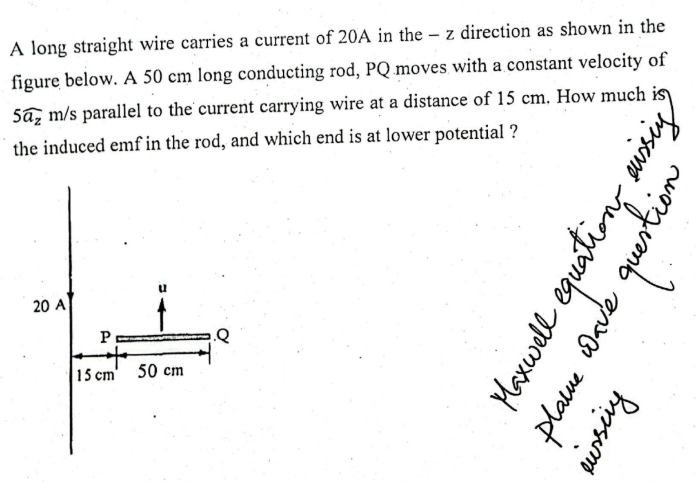 A long straight wire carries a current of 20A in the — 7 direction as shown in the
(igure below. A 50 cm long conducting rod, PQ moves with a constant velocity of
saz ms parallel to the current carrying wire at a distance of 15 cm. How much i
he induced emf in the rod, and which end is at lower potential ? PH
$
20A f Fad
—— N &
15cm 50 cm ¢
This is AI generated Response.
Asked by: Francis
Created at: 2025-12-28 04:04:01
Asked by: Francis
Created at: 2025-12-28 04:04:01
Final Answer:
Rendered
Raw Text
Did you like this answer?
Let's solve the problem step by step:
---
## **Given Data**
- **Current in wire (\(I\))**: \(20\, \text{A}\) (in \(-z\) direction)
- **Velocity of rod (\(u\))**: \(5a_z\, \text{m/s}\) (parallel to wire, assume direction is along positive \(z\))
- **Length of rod (\(PQ\))**: \(l = 50\,\text{cm} = .5\,\text{m}\)
- **Distance from wire to rod**: \(r_1 = 15\,\text{cm} = .15\,\text{m}\)
- **Rod is parallel to the wire**
---
## **Step 1: Find the Magnetic Field at the Rod**
The magnetic field at distance \(r\) from a long straight wire:
\[
B = \frac{\mu_ I}{2\pi r}
\]
where:
- \(\mu_ = 4\pi \times 10^{-7}\, \text{T}\cdot\text{m/A}\)
- \(I = 20\, \text{A}\)
Since the rod is parallel to the wire, the magnetic field at distance \(r\) from the wire points into/out of the page (use right-hand rule).
---
## **Step 2: Induced EMF in the Moving Rod**
The emf induced in a rod moving perpendicularly to a magnetic field is:
\[
\mathcal{E} = \int_P^Q (\vec{v} \times \vec{B}) \cdot d\vec{l}
\]
- \(\vec{v}\) is along \(z\) (let's take out of the page),
- \(\vec{B}\) is tangential (from right-hand rule, at the rod's position, it is along \(y\)),
- \(d\vec{l}\) is along \(x\) (from \(P\) to \(Q\)), perpendicular to both.
Let’s express position along the rod as \(x\), where \(x\) goes from \(r_1 = .15\,\text{m}\) to \(r_2 = r_1 + l = .15 + .5 = .65\,\text{m}\).
\[
B(x) = \frac{\mu_ I}{2\pi x}
\]
---
## **Step 3: Calculate the Induced EMF**
\[
\mathcal{E} = \int_{x_1}^{x_2} u B(x) dx
\]
\[
\mathcal{E} = u \int_{x_1}^{x_2} \frac{\mu_ I}{2\pi x} dx
\]
\[
\mathcal{E} = u \frac{\mu_ I}{2\pi} \int_{x_1}^{x_2} \frac{dx}{x}
\]
\[
\mathcal{E} = u \frac{\mu_ I}{2\pi} \left[ \ln(x) \right]_{x_1}^{x_2}
\]
\[
\mathcal{E} = u \frac{\mu_ I}{2\pi} \ln\left( \frac{x_2}{x_1} \right)
\]
Plug in the values:
- \(u = 5\,\text{m/s}\)
- \(\mu_ = 4\pi \times 10^{-7}\)
- \(I = 20\,\text{A}\)
- \(x_1 = .15\,\text{m}\)
- \(x_2 = .65\,\text{m}\)
---
### **Plugging in Values**
\[
\mathcal{E} = 5 \cdot \frac{4\pi \times 10^{-7} \cdot 20}{2\pi} \cdot \ln\left( \frac{.65}{.15} \right)
\]
\[
= 5 \cdot \frac{4 \cdot 20 \cdot 10^{-7}}{2} \cdot \ln\left( \frac{.65}{.15} \right)
\]
\[
= 5 \cdot \frac{80 \times 10^{-7}}{2} \cdot \ln\left( \frac{.65}{.15} \right)
\]
\[
= 5 \cdot 40 \times 10^{-7} \cdot \ln\left( \frac{.65}{.15} \right)
\]
\[
= 200 \times 10^{-7} \cdot \ln\left( \frac{.65}{.15} \right)
\]
Calculate \(\ln(.65/.15)\):
\[
\frac{.65}{.15} = 4.333
\]
\[
\ln(4.333) \approx 1.464
\]
So,
\[
\mathcal{E} = 200 \times 10^{-7} \cdot 1.464
\]
\[
= 292.8 \times 10^{-7}
\]
\[
= 2.93 \times 10^{-5} \text{ V}
\]
---
## **Step 4: Which End is at Lower Potential?**
- The induced emf is such that it opposes the change (Lenz's law).
- Use right-hand rule: For a positive charge, \(\vec{v} \times \vec{B}\) gives the direction of emf.
- \(\vec{v}\) is along \(z\), \(\vec{B}\) is along \(\phi\) (tangent at the rod, which is into the page at the rod's location).
- For this setup, potential at Q is **lower** than at P.
---
## **Final Answers**
### **Induced emf in the rod:**
\[
\boxed{2.93 \times 10^{-5} \ \text{V}}
\]
### **End at lower potential:**
\[
\boxed{\text{Q is at lower potential than P}}
\]
If you need a detailed vector explanation for the direction, let me know!
📢 Instructions:
- Ask anything relatd to above question only.
- For new Question goto :