 VIPSolutions
Give step-by-step solution with explanation and final answer: give me 1st question answer.5 d is directed along the positive « 1. The addition of the two vectors below has a magnitude of 00 Ib and is d 7 ici i Na Final your work submission). If Fg =750 Ib, determine the magnitude of F4 in Ib and then achieve this Fp. yA Fy A 9 I Fg In the Answer Box below, enter your answer for part (b) the magnitude (no "+" or ** required) of F (in Ib) Answer 1. The ad in i of th Se t rs 5 on fs ) magnit rey 1 2X Ib and is directed along the positive x axis. Dr fie = n- 1 Fg = 7501, determine (b) the magnitude of Fa in Ib and then (c) in Newtons. Finally find achieve this Fr vA
Question:
Give step-by-step solution with explanation and final answer:
give me 1st question answer.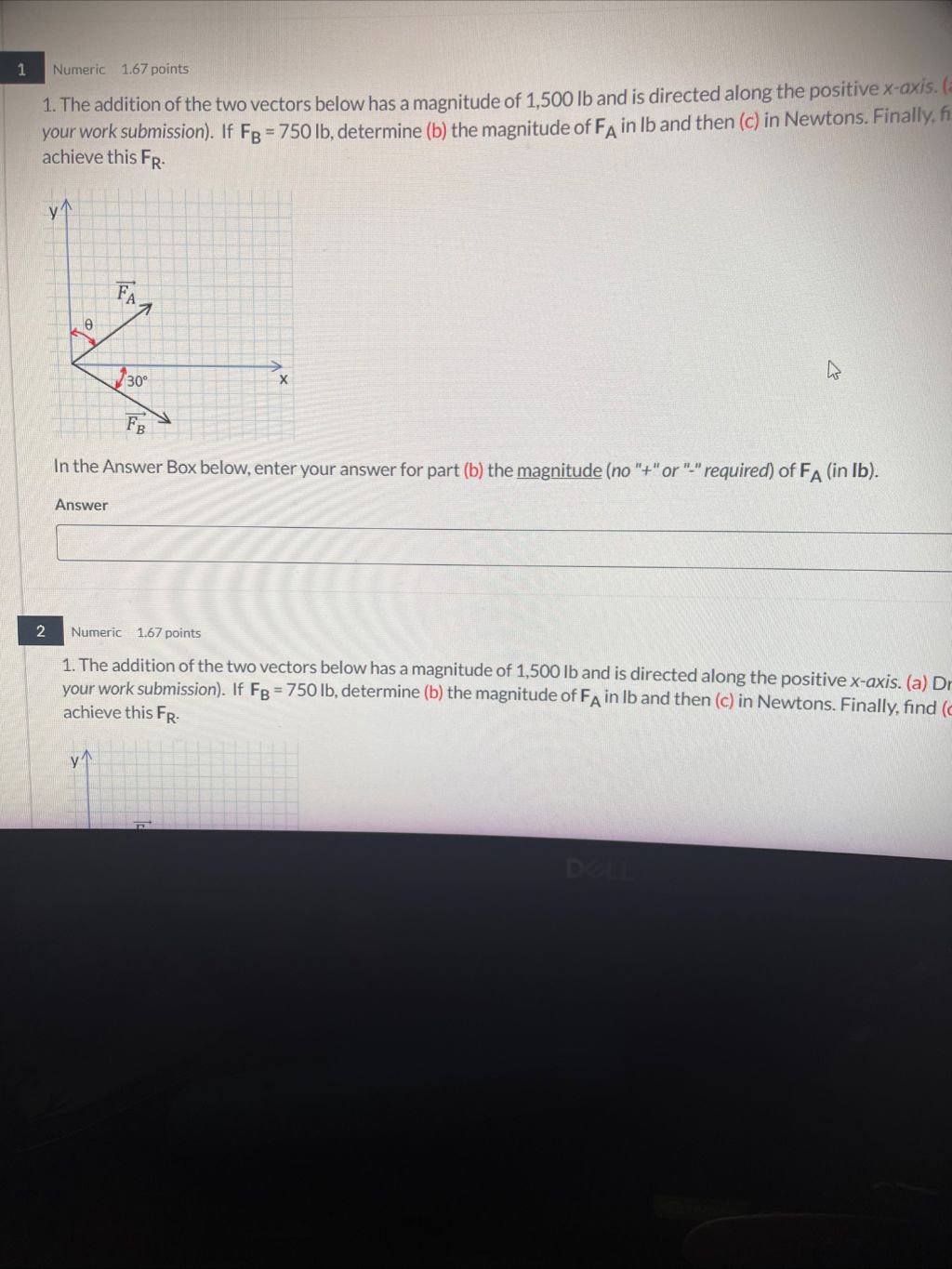 5 d is directed along the positive «
1. The addition of the two vectors below has a magnitude of 00 Ib and is d 7 ici i Na Final
your work submission). If Fg =750 Ib, determine the magnitude of F4 in Ib and then
achieve this Fp.
yA
Fy
A
9
I
Fg
In the Answer Box below, enter your answer for part (b) the magnitude (no "+" or ** required) of F (in Ib)
Answer
1. The ad in i of th Se t rs 5 on fs ) magnit rey 1 2X Ib and is directed along the positive x axis. Dr
fie = n- 1 Fg = 7501, determine (b) the magnitude of Fa in Ib and then (c) in Newtons. Finally find
achieve this Fr
vA
This is AI generated Response.
Asked by: Francis
Created at: 2025-12-28 02:32:52
Asked by: Francis
Created at: 2025-12-28 02:32:52
Final Answer:
Rendered
Raw Text
Did you like this answer?
Let's break down and solve the problem step-by-step.
---
## **Given:**
- Magnitude of resultant vector, \( F_R = 150 \) lb (along positive x-axis)
- Magnitude of \( F_B = 750 \) lb (30° below the x-axis)
- Need to find the magnitude of \( F_A \) (in lb), where \( F_A \) is at an unknown angle θ above the x-axis.
---
## **Step 1: Express Vectors in Component Form**
### \( F_B \):
- \( F_B \) makes a **30° angle below the x-axis**.
- x-component: \( F_{Bx} = F_B \cos(30^\circ) \)
- y-component: \( F_{By} = F_B \sin(-30^\circ) = -F_B \sin(30^\circ) \)
### \( F_A \):
- Let the angle θ be above the x-axis.
- x-component: \( F_{Ax} = F_A \cos(\theta) \)
- y-component: \( F_{Ay} = F_A \sin(\theta) \)
---
## **Step 2: Write Resultant Components**
Since the resultant is along the **positive x-axis**, the y-component must be **zero**:
- \( F_{Rx} = F_{Ax} + F_{Bx} = 150 \) lb
- \( F_{Ry} = F_{Ay} + F_{By} = \)
---
## **Step 3: Setup the Equations**
### **Y-component:**
\[
F_{Ay} + F_{By} =
\]
\[
F_A \sin(\theta) - F_B \sin(30^\circ) =
\]
\[
F_A \sin(\theta) = F_B \sin(30^\circ)
\]
### **X-component:**
\[
F_{Ax} + F_{Bx} = 150
\]
\[
F_A \cos(\theta) + F_B \cos(30^\circ) = 150
\]
---
## **Step 4: Substitute and Solve**
From the y-component:
\[
F_A \sin(\theta) = 750 \times .5 = 375
\]
\[
F_A \sin(\theta) = 375
\]
\[
\sin(\theta) = \frac{375}{F_A}
\]
Now for the x-component:
\[
F_A \cos(\theta) + 750 \times \frac{\sqrt{3}}{2} = 150
\]
\[
F_A \cos(\theta) + 750 \times .866 = 150
\]
\[
F_A \cos(\theta) + 649.52 = 150
\]
\[
F_A \cos(\theta) = 150 - 649.52 = 850.48
\]
\[
\cos(\theta) = \frac{850.48}{F_A}
\]
---
## **Step 5: Use \(\sin^2(\theta) + \cos^2(\theta) = 1\)**
\[
\left(\frac{375}{F_A}\right)^2 + \left(\frac{850.48}{F_A}\right)^2 = 1
\]
\[
\frac{375^2 + 850.48^2}{F_A^2} = 1
\]
\[
375^2 + 850.48^2 = F_A^2
\]
\[
140625 + 723316.63 = F_A^2
\]
\[
863941.63 = F_A^2
\]
\[
F_A = \sqrt{863941.63} \approx 929.5 \text{ lb}
\]
---
## **Final Answer**
### **The magnitude of \( F_A \) is:**
\[
\boxed{929.5 \text{ lb}}
\]
---
### **Summary Table**
| Quantity | Value |
|-------------|---------------|
| \( F_A \) | 929.5 lb |
Let me know if you also need the answer in Newtons or the value of θ!
📢 Instructions:
- Ask anything relatd to above question only.
- For new Question goto :