 VIPSolutions
Give step-by-step solution with explanation and final answer:
Question:
Give step-by-step solution with explanation and final answer: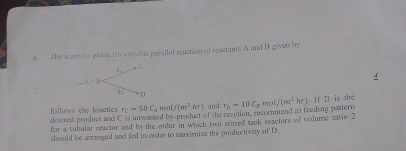
This is AI generated Response.
Asked by: Francis
Created at: 2025-12-27 19:04:14
Asked by: Francis
Created at: 2025-12-27 19:04:14
Final Answer:
Rendered
Raw Text
Did you like this answer?
Let's break down and solve the problem step by step.
---
## **Problem Statement**
> There are two first-order, irreversible, parallel reactions of reactants A and B given by:
>
> ```
> A ──> D
> \
> └─> C
> ```
>
> Follows the kinetics:
> - \( r_D = 50C_A \) mol/(m³·hr)
> - \( r_C = 10C_A \) mol/(m³·hr)
>
> If **D** is the desired product and **C** is the undesired by-product, recommend:
> 1. Feeding pattern for a tubular reactor.
> 2. The order in which two stirred tank reactors of volume ratio 2 should be arranged and fed to maximize the productivity of D.
---
## **Step 1: Understand the Reactions and Kinetics**
Both reactions are first-order and occur in parallel:
- \( A \to D \) with rate constant \( k_D = 50 \) hr\(^{-1}\)
- \( A \to C \) with rate constant \( k_C = 10 \) hr\(^{-1}\)
## **Step 2: Tubular Reactor (Plug Flow Reactor, PFR)**
### **Selectivity & Productivity**
- **Selectivity** is defined as the ratio of the rate of formation of D to C:
\[
S = \frac{r_D}{r_C} = \frac{k_D}{k_C} = \frac{50}{10} = 5
\]
(This is constant since both are first-order and parallel.)
#### **Feeding Pattern**
- For parallel reactions where the desired product has a higher rate constant, **high concentration of A favors the desired product D**.
- For a PFR, the concentration of A decreases along the length of the reactor.
- **Thus, using a high initial concentration of A (i.e., feed all A at once) will maximize D formation.**
- **No benefit to feeding A gradually or in stages.**
**Recommendation:**
**Feed all reactant A at the inlet (single-point feed) to maximize productivity of D.**
---
## **Step 3: Two CSTRs (Continuous Stirred Tank Reactors) in Series**
Given:
- Two reactors of volume ratio 2 (let's call them \( V_1 \) and \( V_2 \), with \( V_1 = 2V_2 \) or vice versa).
### **Which Arrangement Maximizes D?**
For parallel reactions, **high concentration of A favors D** (since \( k_D > k_C \)). In a CSTR, the exit concentration is lower than in a PFR for the same conversion.
- **To maximize D:** Put the **smaller reactor first**. This gives higher A concentration in the first reactor, maximizing the rate of desired reaction.
Let:
- \( V_1 = 2V \), \( V_2 = V \) (total volume = 3V)
- Two possible arrangements:
- **Case 1:** Feed to small reactor first (\( V \)), then to big reactor (\( 2V \))
- **Case 2:** Feed to big reactor first (\( 2V \)), then to small reactor (\( V \))
#### **General Rule**
For parallel reactions, **put the smaller reactor first**.
---
## **Step 4: Final Answers**
### **1. Feeding Pattern for Tubular Reactor**
- **Feed all reactant at once (single-point feed at the inlet).**
- **Do not use distributed or staged feed.**
### **2. Order of Two CSTRs**
- **Arrange the smaller reactor first, followed by the larger one, to maximize the productivity of D.**
- **So, feed should enter the reactor of volume V first, then go to the reactor of volume 2V.**
---
## **Summary Table**
| Reactor Type | Feeding/Arrangement Recommendation |
|---------------------|-------------------------------------------------------------|
| Tubular (PFR) | Single-point feed at inlet |
| Two CSTRs (V:2V) | Smaller reactor (V) first, then larger reactor (2V) |
---
### **Reasoning**
- For parallel first-order reactions with desired product having higher k, keep A's concentration high as long as possible.
- Smaller CSTR first keeps A higher in early stage, maximizing D.
---
**If you need a detailed calculation for the CSTRs, let me know!**
📢 Instructions:
- Ask anything relatd to above question only.
- For new Question goto :