VIPSolutions logo ✨ VIPSolutions

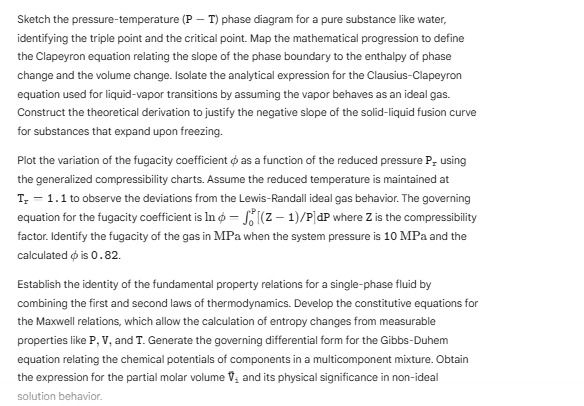
Give step-by-step solution with explanation and final answer:Sketch the pressure-temperature (P — T) phase diagram for pure substance ike water, identifying the triple point and the critical point. Map the mathematical progression to define the Clapeyron equation relating the slope of the phase boundary to the enthalpy of phase: change and the volume change. Isolate the analytical expression or the Clausius-Clapayron equation used for liguid-vapor transitions by assuming the vapor behaves as an deal gas. Construct the theoretical derivation to justify the negative siope of the solic-figud fusion curve for substances that expand upon freezing. Plot th variation of the fugacity coefficient ¢ 5 a function of the reduced pressure Py using the generalized compressibilty chart. Assume the reduced temperatura f maintained at T. — 1.110 observe the deviations from the Lowis-Randall ideal gas behavior. The governing equation for the fugacity coefficient is In é — [7[(Z — 1)/P dP where Z is the compressibility factor identify the fugacity of the gas in MPa when the system pressure i 10 MPa and the calculated $50.82. Establish the identity of the fundamental property relations for a single-phase fluid by combining the first and second laws of thermodynamics. Develop the constitutive equations for the Mawel relations, which allow the calculation of entropy changes from measurable properties ie P,V, and T. Generate the governing difercntia form for the Gibbs-Duhem equation relating the chemical potentials of components in multicomponent mixture. Obtain the expression for the partial masar volume T and its physical significance in non-deal

Question:

Give step-by-step solution with explanation and final answer:Uploaded ImageSketch the pressure-temperature (P — T) phase diagram for pure substance ike water, identifying the triple point and the critical point. Map the mathematical progression to define the Clapeyron equation relating the slope of the phase boundary to the enthalpy of phase: change and the volume change. Isolate the analytical expression or the Clausius-Clapayron equation used for liguid-vapor transitions by assuming the vapor behaves as an deal gas. Construct the theoretical derivation to justify the negative siope of the solic-figud fusion curve for substances that expand upon freezing. Plot th variation of the fugacity coefficient ¢ 5 a function of the reduced pressure Py using the generalized compressibilty chart. Assume the reduced temperatura f maintained at T. — 1.110 observe the deviations from the Lowis-Randall ideal gas behavior. The governing equation for the fugacity coefficient is In é — [7[(Z — 1)/P dP where Z is the compressibility factor identify the fugacity of the gas in MPa when the system pressure i 10 MPa and the calculated $50.82. Establish the identity of the fundamental property relations for a single-phase fluid by combining the first and second laws of thermodynamics. Develop the constitutive equations for the Mawel relations, which allow the calculation of entropy changes from measurable properties ie P,V, and T. Generate the governing difercntia form for the Gibbs-Duhem equation relating the chemical potentials of components in multicomponent mixture. Obtain the expression for the partial masar volume T and its physical significance in non-deal
This is AI generated Response.
Asked by: vemuri swathi
Created at: 2025-12-26 11:11:04

Final Answer:

Rendered Raw Text
Did you like this answer?
Let's break down and address each section step by step: --- # 1. **Sketch the P–T Phase Diagram and Identify Key Points** ## **a. Phase Diagram for Water** - **Axes:** Pressure (P, y-axis), Temperature (T, x-axis). - **Key Features:** - **Triple Point:** The point where solid, liquid, and gas phases coexist. For water: T ≈ .01°C, P ≈ .611 kPa. - **Critical Point:** The endpoint of the liquid-gas equilibrium line. For water: T ≈ 374°C, P ≈ 22.06 MPa. - **Sublimation Line:** Solid ↔ Gas. - **Fusion Line:** Solid ↔ Liquid. - **Vaporization Line:** Liquid ↔ Gas. --- # 2. **Clausius-Clapeyron Equation Derivation** The Clausius-Clapeyron equation describes the slope of a phase boundary: \[ \frac{dP}{dT} = \frac{\Delta S}{\Delta V} \] Since \(\Delta S = \frac{\Delta H}{T}\) (from thermodynamics), \[ \frac{dP}{dT} = \frac{\Delta H}{T \Delta V} \] - **ΔH:** Enthalpy change (latent heat) of phase transition. - **ΔV:** Volume change across the phase boundary. For liquid-vapor (assuming vapor is ideal gas): \[ \Delta V \approx V_{gas} = \frac{RT}{P} \] So, \[ \frac{dP}{dT} = \frac{\Delta H}{T \cdot \frac{RT}{P}} = \frac{P \Delta H}{RT^2} \] Isolate: \[ \frac{d \ln P}{dT} = \frac{\Delta H}{RT^2} \] --- # 3. **Negative Slope of Solid-Liquid Line for Water** - Most substances: Solid is denser than liquid, so ΔV (V_liquid - V_solid) < , giving a positive slope. - Water: Ice is less dense than liquid water (expands on freezing), so ΔV > , **negative slope** in P–T phase diagram for solid-liquid equilibrium. --- # 4. **Fugacity Coefficient Variation (ϕ) Using Compressibility Charts** The fugacity coefficient (\(\phi\)) quantifies deviations from ideal gas behavior: \[ \ln \phi = \int_^P \frac{(Z - 1)}{P} dP \] - \(Z\): Compressibility factor (\(Z = \frac{PV}{RT}\)) - For a reduced temperature \(T_r = 1\), use generalized compressibility charts to find \(Z\) at various reduced pressures (\(P_r\)). **Given:** - \(P = 10\, \text{MPa}\) - \(\phi = .82\) - Find fugacity (\(f\)): \[ f = \phi P = .82 \times 10\, \text{MPa} = 8.2\, \text{MPa} \] --- # 5. **Fundamental Property Relations & Maxwell Relations** **First Law:** \(dU = TdS - PdV\) **Second Law:** \(dS = \frac{\delta Q}{T}\) **Combined:** \[ dU = TdS - PdV \] \[ dH = dU + PdV + VdP = TdS + VdP \] \[ dA = dU - TdS = -SdT - PdV \] \[ dG = dH - TdS = -SdT + VdP \] **Maxwell Relations:** From \(dG = -SdT + VdP\): \(\left(\frac{\partial S}{\partial P}\right)_T = -\left(\frac{\partial V}{\partial T}\right)_P\) --- # 6. **Gibbs-Duhem Equation and Partial Molar Property** **Gibbs-Duhem:** \[ \sum n_i d\mu_i = \] For a mixture, relates changes in chemical potentials (\(\mu_i\)). **Partial Molar Volume (\(\overline{V}_i\)):** \[ \overline{V}_i = \left(\frac{\partial V}{\partial n_i}\right)_{T,P,n_{j \neq i}} \] **Physical Significance:** It represents the change in total volume when an infinitesimal amount of component \(i\) is added, keeping T, P, and other \(n_j\) constant. In non-ideal solutions, \(\overline{V}_i\) can deviate significantly from the molar volume of pure \(i\). --- ## **Summary Table** | Step | Key Equations / Concepts | |----------------------------------------|----------------------------------------------------------------------------------------------------| | Phase Diagram | Triple & critical points, negative fusion line slope for H₂O | | Clausius-Clapeyron | \(\frac{dP}{dT} = \frac{\Delta H}{T \Delta V}\); for vaporization: \(\frac{d \ln P}{dT} = \frac{\Delta H}{RT^2}\) | | Fugacity Calculation | \(f = \phi P\); for \(P=10\, \text{MPa}, \phi=.82\): \(f=8.2\, \text{MPa}\) | | Fundamental Relations & Maxwell | \(dU = TdS - PdV\); \(dG = -SdT + VdP\); Maxwell relations | | Gibbs-Duhem & Partial Molar Volume | \(\sum n_i d\mu_i = \); \(\overline{V}_i = (\partial V/\partial n_i)_{T,P,n_{j \neq i}}\) | --- ## **Final Answers (Key Points)** - **Fugacity at \(P = 10\, \text{MPa}\), \(\phi = .82\):** \(f = 8.2\, \text{MPa}\) - **Partial molar volume \(\overline{V}_i\):** \(\overline{V}_i = \left(\frac{\partial V}{\partial n_i}\right)_{T,P,n_{j \neq i}}\) Let me know if you need a specific diagram or further mathematical details!

📢 Instructions:

  • Ask anything relatd to above question only.
  • For new Question goto :

Study Help, Fast Answers

VIPSolutions focuses on clear, step‑by‑step explanations so you can learn quickly. Whether you need an AI‑generated walkthrough or a short hint to get unstuck, each solution is organized for fast reading and easy review later.

Search similar questions, compare approaches, and bookmark the best answers for revision. Our goal is simple: quick, reliable study help that feels natural—not noisy.