This is AI generated Response.
Asked by: Mallikarjun
Created at: 2025-12-26 08:56:50
Final Answer:
RenderedRaw Text
Did you like this answer?
Let's solve the table step by step for a GC capillary column, considering one parameter changed at a time. We'll use the symbols:
- **+** : Increase
- **** : Little or no change
- **–** : Decrease
Here’s a breakdown of each change:
---
## 1. **Increase in Column Length**
- **Speed of separation**: **Decreases** (takes longer for analytes to elute) → **–**
- **Column capacity**: **Increases** (can hold more sample) → **+**
- **Retention factor, k**: **No change** (k is independent of length) → ****
- **Selectivity factor, α**: **No change** (α is independent of length) → ****
- **Effective plate number, N**: **Increases** (N is proportional to column length) → **+**
---
## 2. **Increase in Column Diameter**
- **Speed of separation**: **Increases** (lower resistance, faster flow) → **+**
- **Column capacity**: **Increases** (more space for stationary phase) → **+**
- **Retention factor, k**: **No change** (k is independent of diameter) → ****
- **Selectivity factor, α**: **No change** (α is independent of diameter) → ****
- **Effective plate number, N**: **Decreases** (wider columns generally have lower efficiency) → **–**
---
## 3. **Increase in Film Thickness**
- **Speed of separation**: **Decreases** (slower mass transfer, band broadening) → **–**
- **Column capacity**: **Increases** (more stationary phase, higher capacity) → **+**
- **Retention factor, k**: **Increases** (analytes spend more time in stationary phase) → **+**
- **Selectivity factor, α**: **May increase or stay same (slight effect)** → **/+,** but most often ****
- **Effective plate number, N**: **Decreases** (mass transfer is less efficient) → **–**
---
## **Final Table**
| **Parameter Modified** | **Speed of separation** | **Column capacity** | **Retention factor, k** | **Selectivity factor, α** | **Effective plate number, N** |
|-----------------------------|:----------------------:|:------------------:|:----------------------:|:------------------------:|:-----------------------------:|
| Increase in column length | – | + | | | + |
| Increase in column diameter | + | + | | | – |
| Increase in film thickness | – | + | + | | – |
---
### **Explanation**
- **Column length** mainly affects analysis time and efficiency.
- **Column diameter** affects capacity and efficiency.
- **Film thickness** impacts retention and efficiency due to mass transfer effects.
If you have any specific point you'd like more details on, let me know!
VIPSolutions focuses on clear, step‑by‑step explanations so you can learn quickly. Whether you need an AI‑generated walkthrough or a short hint to get unstuck, each solution is organized for fast reading and easy review later.
Search similar questions, compare approaches, and bookmark the best answers for revision. Our goal is simple: quick, reliable study help that feels natural—not noisy.
 VIPSolutions
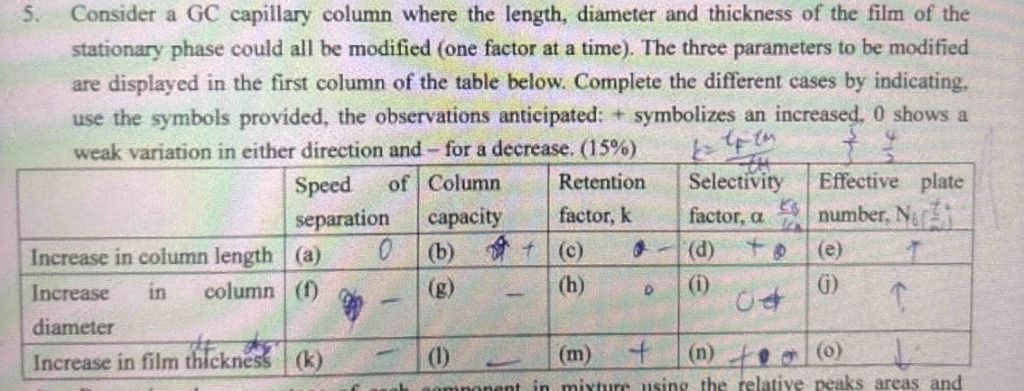 5. Consider a GC capillary column where the length, diameter and thickness of the film of the
stationary phase could all be modified (one factor at a time). The three parameters to be modified
are displayed in the first column of the table below. Complete the different cases by indicating,
use the symbols provided, the observations anticipated: + symbolizes an increased, 0 shows a
© weak variation in either direction and — for a decrease. (15%) sl &
separation | capacity factor, k factor, a £3 | number, Nor %
Tocrease in column length [0 0 |®) _#£|@ #-f@ Tole T |
=
| diameter Ta ak SET .
| Faccense in fim Sil [02 010 il @® HT reale | |
ee vam TERT TIMESCALE ae, Ra Se Lolariun nanks areas And