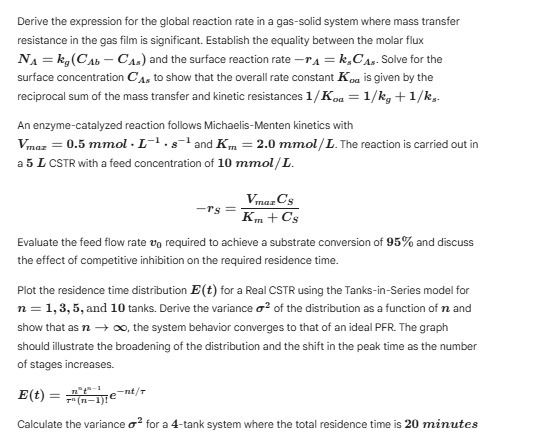
Give step-by-step solution with explanation and final answer:Dsrive the expression fr the glo reaction rte in a gas-50ld system where mass transfer
resistance nthe gas fim is significant. Establish the equalty between the molar lux
Ng = ky(Cuas — Ca.) and the surface reaction rate —14 = k, Cas. Solve for the
surface concentration C5, 10 show tht the oveal rate constant K given by the
reciprocal sum of the mass transfer and kinetic resistances 1/Koq = 1/ky + 1/k,.
An nzyme-catazed reaction follows Michasts- Menten Kinet with
Viner = 0.5 mmol - L™* + 5 and K.,, = 2.0 mmol/L. The reaction is carried out in
25 L CSTR with a feed concentration of 10 mmol/L.
_ Vis
TK. +0Cs
Evaluate the feed flow rate vy required to achieve a substrate conversion of 95% and discuss
the effect of competitive nhbitn on the required residence time
Plot the residence time distribution E(t) for a Real CSTR using the Tanks-in-Series model for
n =1,3,5,and 10 tanks. Derive the variance &2 of the distribution as a function of n and
show that 3 1 — Co, th system bhavior comierges otha of an’deal PR. The graph
Should strats the broadening of the distibtion and te sift nth pesk time as the number
of stages increases.
B(t) = #pme
Calculate the variance or for a 4-tank system where the total residence time is 20 minutes
Question:
Give step-by-step solution with explanation and final answer:Dsrive the expression fr the glo reaction rte in a gas-50ld system where mass transfer
resistance nthe gas fim is significant. Establish the equalty between the molar lux
Ng = ky(Cuas — Ca.) and the surface reaction rate —14 = k, Cas. Solve for the
surface concentration C5, 10 show tht the oveal rate constant K given by the
reciprocal sum of the mass transfer and kinetic resistances 1/Koq = 1/ky + 1/k,.
An nzyme-catazed reaction follows Michasts- Menten Kinet with
Viner = 0.5 mmol - L™* + 5 and K.,, = 2.0 mmol/L. The reaction is carried out in
25 L CSTR with a feed concentration of 10 mmol/L.
_ Vis
TK. +0Cs
Evaluate the feed flow rate vy required to achieve a substrate conversion of 95% and discuss
the effect of competitive nhbitn on the required residence time
Plot the residence time distribution E(t) for a Real CSTR using the Tanks-in-Series model for
n =1,3,5,and 10 tanks. Derive the variance &2 of the distribution as a function of n and
show that 3 1 — Co, th system bhavior comierges otha of an’deal PR. The graph
Should strats the broadening of the distibtion and te sift nth pesk time as the number
of stages increases.
B(t) = #pme
Calculate the variance or for a 4-tank system where the total residence time is 20 minutes
This is AI generated Response.
Asked by: vemuri swathi
Created at: 2025-12-23 18:49:16
Final Answer:
RenderedRaw Text
Did you like this answer?
Let's solve each part step-by-step:
---
## **1. Gas-Solid System: Derivation of Global Reaction Rate**
### **Given:**
- Molar flux in gas film: \( N_A = k_g(C_{Ab} - C_{As}) \)
- Surface reaction rate: \( -r_A = k_s C_{As} \)
### **Step 1: Set Molar Flux = Surface Reaction Rate**
At steady state, the rate at which A arrives at the surface = rate at which A reacts:
\[
N_A = -r_A
\]
\[
k_g(C_{Ab} - C_{As}) = k_s C_{As}
\]
### **Step 2: Solve for Surface Concentration \( C_{As} \)**
\[
k_g C_{Ab} - k_g C_{As} = k_s C_{As}
\]
\[
k_g C_{Ab} = (k_g + k_s) C_{As}
\]
\[
C_{As} = \frac{k_g}{k_g + k_s} C_{Ab}
\]
### **Step 3: Expression for Overall Rate Constant \( K_{oa} \)**
Overall (observable) reaction rate:
\[
N_A = k_g (C_{Ab} - C_{As}) = k_g \left(C_{Ab} - \frac{k_g}{k_g + k_s} C_{Ab}\right)
\]
\[
= k_g C_{Ab} \left(1 - \frac{k_g}{k_g + k_s}\right)
= k_g C_{Ab} \frac{k_s}{k_g + k_s}
\]
\[
N_A = K_{oa} C_{Ab}
\]
where
\[
K_{oa} = \frac{k_g k_s}{k_g + k_s}
\]
Or, in terms of resistances:
\[
\frac{1}{K_{oa}} = \frac{1}{k_g} + \frac{1}{k_s}
\]
---
## **2. Enzyme-Catalyzed Reaction in a CSTR**
### **Given:**
- \( V_{max} = .5 \) mmol·L\(^{-1}\)·s\(^{-1}\)
- \( K_m = 2. \) mmol/L
- Feed concentration, \( C_{A} = 10 \) mmol/L
- Reactor volume, \( V = 5 \) L
- Desired conversion, \( X = .95 \)
- Michaelis-Menten rate: \( -r_S = \frac{V_{max}C_S}{K_m + C_S} \)
### **Step 1: Material Balance for CSTR**
At steady state,
\[
\text{Input} - \text{Output} + \text{Generation} =
\]
\[
F C_{A} - F C_{A} - r_S V =
\]
\[
F(C_{A} - C_{A}) = r_S V
\]
Let \( v_ = F \) (feed flow rate).
### **Step 2: Express \( C_{A} \) in Terms of Conversion**
\[
X = \frac{C_{A} - C_{A}}{C_{A}} \implies C_{A} = C_{A}(1 - X)
\]
Given \( X = .95 \), \( C_{A} = 10 \times .05 = .5 \) mmol/L
### **Step 3: Substitute into the Balance**
\[
v_ (C_{A} - C_A) = r_S V
\]
\[
v_ (10 - .5) = \frac{V_{max} \cdot .5}{K_m + .5} \cdot 5
\]
\[
v_ \cdot 9.5 = \frac{.5 \times .5}{2. + .5} \cdot 5
\]
\[
= \frac{.25}{2.5} \cdot 5 = .1 \cdot 5 = .5 \text{ mmol/s}
\]
\[
v_ = \frac{.5}{9.5} \approx .0526 \text{ L/s}
\]
**Final answer:**
\[
\boxed{v_ \approx .0526~\text{L/s}}
\]
**Competitive inhibition:** Competitive inhibition increases the apparent \( K_m \), reducing the rate at a given substrate concentration, which **increases the required residence time** for the same conversion.
---
## **3. Plotting Residence Time Distribution and Variance**
### **Given:**
- \( E(t) = \frac{n^n}{(n-1)! \tau} t^{n-1} e^{-nt/\tau} \)
- Residence time \( \tau \)
- Variance for \( n \) tanks: \( \sigma^2 = \frac{\tau^2}{n} \)
### **Step 1: Variance for 4-Tank System with \(\tau = 20\) min**
\[
\sigma^2 = \frac{\tau^2}{n} = \frac{20^2}{4} = \frac{400}{4} = 100~\text{min}^2
\]
**Final answer:**
\[
\boxed{\sigma^2 = 100~\text{min}^2}
\]
---
## **Summary Table**
| Part | Answer |
|------|--------|
| Gas-solid system overall rate | \( \frac{1}{K_{oa}} = \frac{1}{k_g} + \frac{1}{k_s} \) |
| CSTR feed flow for 95% conversion | \( v_ \approx .0526~\text{L/s} \) |
| Variance, 4 tanks, 20 min total | \( \sigma^2 = 100~\text{min}^2 \) |
---
If you need the RTD plots or a more detailed discussion on competitive inhibition, let me know!
VIPSolutions focuses on clear, step‑by‑step explanations so you can learn quickly. Whether you need an AI‑generated walkthrough or a short hint to get unstuck, each solution is organized for fast reading and easy review later.
Search similar questions, compare approaches, and bookmark the best answers for revision. Our goal is simple: quick, reliable study help that feels natural—not noisy.
 VIPSolutions
 Dsrive the expression fr the glo reaction rte in a gas-50ld system where mass transfer
resistance nthe gas fim is significant. Establish the equalty between the molar lux
Ng = ky(Cuas — Ca.) and the surface reaction rate —14 = k, Cas. Solve for the
surface concentration C5, 10 show tht the oveal rate constant K given by the
reciprocal sum of the mass transfer and kinetic resistances 1/Koq = 1/ky + 1/k,.
An nzyme-catazed reaction follows Michasts- Menten Kinet with
Viner = 0.5 mmol - L™* + 5 and K.,, = 2.0 mmol/L. The reaction is carried out in
25 L CSTR with a feed concentration of 10 mmol/L.
_ Vis
TK. +0Cs
Evaluate the feed flow rate vy required to achieve a substrate conversion of 95% and discuss
the effect of competitive nhbitn on the required residence time
Plot the residence time distribution E(t) for a Real CSTR using the Tanks-in-Series model for
n =1,3,5,and 10 tanks. Derive the variance &2 of the distribution as a function of n and
show that 3 1 — Co, th system bhavior comierges otha of an’deal PR. The graph
Should strats the broadening of the distibtion and te sift nth pesk time as the number
of stages increases.
B(t) = #pme
Calculate the variance or for a 4-tank system where the total residence time is 20 minutes