 VIPSolutions
Give step-by-step solution with explanation and final answer:In stream reforming of ethane the following reaction occurs C2Hs + 2H20 > 2CO + 5H Consider the situation in which gaseous ethane and water vapor diffuse through a gas film of thickness L, to the surface of nickel catalyst where they react to form gaseous CO and H> which diffuse back through the gas film. The mole fraction of ethane at the catalyst surface is y; and y; on the gas side of the film. The gaseous concentration is C (ideal gas) and the diffusivity of ethane in the mixture is Dam. Derive an equation for the flux of ethane, Na.
Question:
Give step-by-step solution with explanation and final answer: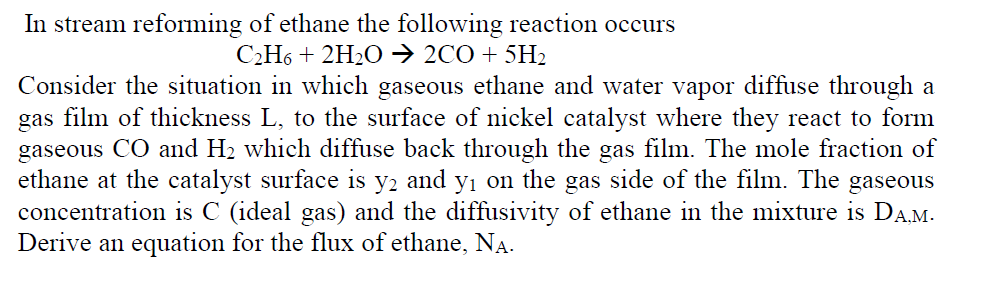 In stream reforming of ethane the following reaction occurs
C2Hs + 2H20 > 2CO + 5H
Consider the situation in which gaseous ethane and water vapor diffuse through a
gas film of thickness L, to the surface of nickel catalyst where they react to form
gaseous CO and H> which diffuse back through the gas film. The mole fraction of
ethane at the catalyst surface is y; and y; on the gas side of the film. The gaseous
concentration is C (ideal gas) and the diffusivity of ethane in the mixture is Dam.
Derive an equation for the flux of ethane, Na.
This is AI generated Response.
Asked by: singaluri krishna kumari
Created at: 2025-12-22 01:32:53
Asked by: singaluri krishna kumari
Created at: 2025-12-22 01:32:53
Final Answer:
Rendered
Raw Text
Did you like this answer?
Let's break down the problem and derive the equation for the flux of ethane (\( N_A \)).
---
## **Step 1: Identify the Diffusing Species**
- **A (C₂H₆, Ethane):** Diffusing toward the catalyst and consumed.
- **B (H₂O):** Also consumed at the surface.
- **C (CO) and D (H₂):** Produced at the surface and diffuse back.
We focus on **ethane (A)**.
---
## **Step 2: Stoichiometry and Fluxes**
Reaction:
\[
\text{C}_2\text{H}_6 + 2\text{H}_2\text{O} \rightarrow 2\text{CO} + 5\text{H}_2
\]
Let:
- \( N_A \): Molar flux of C₂H₆ **toward** the surface (consumed)
- \( N_C \): Molar flux of CO **away from** the surface (produced)
- \( N_D \): Molar flux of H₂ **away from** the surface (produced)
From stoichiometry:
- 1 mol C₂H₆ consumed → 2 mol CO and 5 mol H₂ produced
So, for every \( N_A \) moles of C₂H₆ that diffuse in,
- \( N_C = -2N_A \) (CO, negative sign because away from the surface)
- \( N_D = -5N_A \) (H₂, negative sign because away from the surface)
The **total molar flux** in the z-direction:
\[
N_{total} = N_A + N_B + N_C + N_D
\]
But only A, C, D are considered here (since B is water vapor and can be a non-diffusing component or in excess).
---
## **Step 3: Stefan-Maxwell Equation (for equimolar counterdiffusion with net flux)**
In this problem, for a gas film of thickness \( L \), the flux of ethane is affected by the counter-diffusion of CO and H₂. The net flux of all gases is **not zero** because more moles are produced than consumed (1 mol C₂H₆ + 2 mol H₂O → 2 mol CO + 5 mol H₂: 3 mol in, 7 mol out).
**Total moles in = 3**, **Total moles out = 7**
Net increase in moles per mole ethane reacted: \( 7 - 3 = 4 \)
---
## **Step 4: Find the Flux Equation**
For **species A** (ethane):
From Fick's Law with a net flux (non-equimolar):
\[
N_A = -D_{A,M} C \frac{dy_A}{dz} + y_A N_{total}
\]
Where:
- \( D_{A,M} \): Diffusivity of A in mixture
- \( C \): Total molar concentration (ideal gas)
- \( y_A \): Mole fraction of A
- \( N_{total} \): Total molar flux (sum of fluxes of all components)
### **Find \( N_{total} \) in Terms of \( N_A \):**
From stoichiometry (per 1 mol C₂H₆ consumed):
\[
\text{C}_2\text{H}_6 + 2\text{H}_2\text{O} \rightarrow 2\text{CO} + 5\text{H}_2
\]
- 1 mol C₂H₆ disappears (\( N_A \))
- 2 mol H₂O disappears (\( N_B \))
- 2 mol CO forms (\( N_C \))
- 5 mol H₂ forms (\( N_D \))
If the flux of A is \( N_A \), the fluxes are proportional to stoichiometric coefficients:
\[
\frac{N_A}{-1} = \frac{N_B}{-2} = \frac{N_C}{2} = \frac{N_D}{5}
\]
So,
- \( N_B = 2 N_A \)
- \( N_C = -2 N_A \)
- \( N_D = -5 N_A \)
Total molar flux:
\[
N_{total} = N_A + N_B + N_C + N_D = N_A + 2 N_A - 2 N_A - 5 N_A = (N_A + 2N_A) - (2N_A + 5N_A) = 3N_A - 7N_A = -4N_A
\]
But this seems off: Let's check with the sign convention.
- \( N_A \): toward surface, **positive**
- \( N_B \): toward surface, **positive**
- \( N_C \): **away** from surface, **negative**
- \( N_D \): **away** from surface, **negative**
So:
\[
N_{total} = N_A + N_B + N_C + N_D = N_A + N_B + (-N_C) + (-N_D)
\]
But if we use the direction convention (toward the surface **positive**):
If \( N_A \) is **positive** toward the surface, then \( N_C \) and \( N_D \) are **negative** (move away from the surface).
So:
\[
N_{total} = N_A + N_B + N_C + N_D
\]
But, using stoichiometry:
- \( N_A = -\nu_A r \)
- \( N_B = -\nu_B r \)
- \( N_C = \nu_C r \)
- \( N_D = \nu_D r \)
Where \( r \) is the rate per area.
So,
\[
N_{total} = N_A + N_B + N_C + N_D = -\nu_A r - \nu_B r + \nu_C r + \nu_D r = (\nu_C + \nu_D - \nu_A - \nu_B) r
\]
\[
= (2 + 5 - 1 - 2) r = (7 - 3) r = 4 r
\]
But \( N_A = - r \to r = -N_A \), so
\[
N_{total} = 4 (-N_A) = -4 N_A
\]
---
## **Step 5: Integrate the Flux Equation**
The general equation:
\[
N_A = -D_{A,M} C \frac{dy_A}{dz} + y_A N_{total}
\]
But \( N_{total} = -4 N_A \) (from above):
\[
N_A = -D_{A,M} C \frac{dy_A}{dz} + y_A (-4 N_A)
\]
\[
N_A + 4 y_A N_A = -D_{A,M} C \frac{dy_A}{dz}
\]
\[
N_A (1 + 4 y_A) = -D_{A,M} C \frac{dy_A}{dz}
\]
\[
N_A = \frac{ -D_{A,M} C }{1 + 4 y_A} \frac{dy_A}{dz}
\]
Integrate both sides from \( z= \) to \( z=L \) (film thickness), with \( y_A = y_1 \) at \( z= \) (gas side), and \( y_A = y_2 \) at \( z=L \) (catalyst surface):
\[
\int_{y_1}^{y_2} (1 + 4 y_A) dy_A = - \int_^L \frac{N_A}{D_{A,M} C} dz
\]
\[
\left[ y_A + 2 y_A^2 \right]_{y_1}^{y_2} = - \frac{N_A L}{D_{A,M} C}
\]
\[
(y_2 + 2 y_2^2) - (y_1 + 2 y_1^2) = - \frac{N_A L}{D_{A,M} C}
\]
Solve for \( N_A \):
\[
N_A = - \frac{D_{A,M} C}{L} \left[ (y_2 + 2 y_2^2) - (y_1 + 2 y_1^2) \right]
\]
or
\[
\boxed{
N_A = \frac{D_{A,M} C}{L} \left[ (y_1 + 2 y_1^2) - (y_2 + 2 y_2^2) \right]
}
\]
---
## **Final Answer**
### **Flux of Ethane (\(N_A\))**
\[
\boxed{
N_A = \frac{D_{A,M} C}{L} \left[ (y_1 + 2 y_1^2) - (y_2 + 2 y_2^2) \right]
}
\]
**Where:**
- \( N_A \): Flux of ethane (mol/(area·time))
- \( D_{A,M} \): Diffusivity of ethane in mixture (m²/s)
- \( C \): Total molar concentration of gas (mol/m³)
- \( L \): Film thickness (m)
- \( y_1, y_2 \): Mole fractions of ethane at gas side and catalyst side, respectively
---
### **Explanation**
- The equation accounts for the net generation of moles due to reaction stoichiometry (increase by 4 per mole ethane).
- The extra term \( 2y^2 \) in the bracket comes from integrating the non-equimolar counter-diffusion effect.
Let me know if you need a diagram or more explanation!
📢 Instructions:
- Ask anything relatd to above question only.
- For new Question goto :