 VIPSolutions
Give step-by-step solution with explanation and final answer:A fluid flows through the gap between two flat plates. The distance between the two plates is 2B and the gap is filled with fiber matrix. The flow can be approximated as one-dimensional (only V, Vx=0, Vy=0). V, depends on y only and can be described by the following equation: 2: a =-£ Vz+u ve dz K dy where P is the pressure, p is the fluid viscosity and K describes the effect of fiber matrix. The pressure is a function of z only and dp/dz=C (C is constant). The no slip boundary conditions on the plates should be satisfied. (1) IfK/B*>>1, simplify the above equation and find V-. (2) If K/B3
Question:
Give step-by-step solution with explanation and final answer: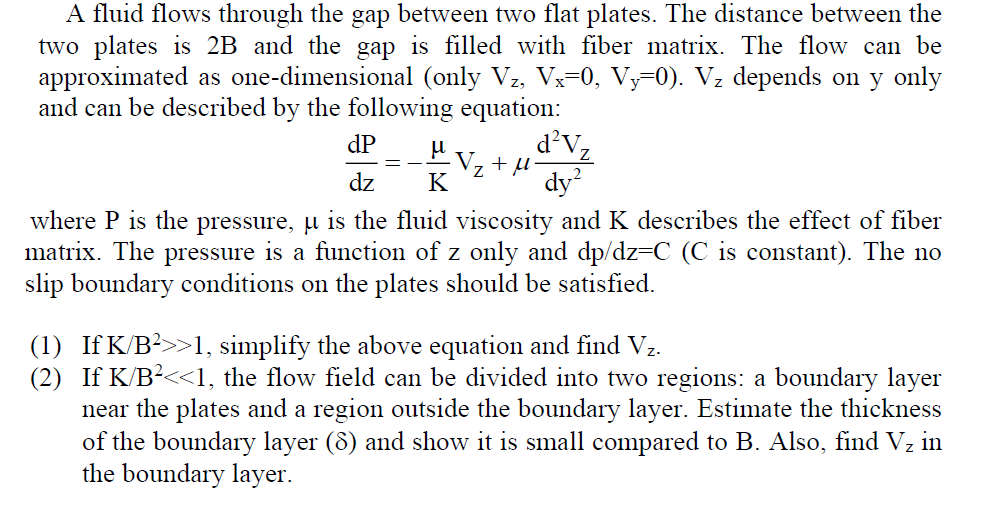 A fluid flows through the gap between two flat plates. The distance between the
two plates is 2B and the gap is filled with fiber matrix. The flow can be
approximated as one-dimensional (only V, Vx=0, Vy=0). V, depends on y only
and can be described by the following equation:
2:
a =-£ Vz+u ve
dz K dy
where P is the pressure, p is the fluid viscosity and K describes the effect of fiber
matrix. The pressure is a function of z only and dp/dz=C (C is constant). The no
slip boundary conditions on the plates should be satisfied.
(1) IfK/B*>>1, simplify the above equation and find V-.
(2) If K/B3
This is AI generated Response.
Asked by: Mallikarjun
Created at: 2025-12-22 01:31:15
Asked by: Mallikarjun
Created at: 2025-12-22 01:31:15
Final Answer:
Rendered
Raw Text
Did you like this answer?
Let's break down the problem step by step:
---
## **Given Equation**
\[
\frac{dP}{dz} = -\frac{\mu}{K} V_z + \mu \frac{d^2 V_z}{dy^2}
\]
Where:
- \( P \): Pressure
- \( \mu \): Fluid viscosity
- \( K \): Fiber matrix effect (permeability)
- \( V_z \): Velocity in \( z \) direction (function of \( y \) only)
- \( y \): Coordinate perpendicular to the plates (\(-B \leq y \leq B\))
- \( \frac{dP}{dz} = C \): Constant
No-slip boundary conditions: \( V_z(\pm B) = \).
---
## **1. Case I: \( K/B^2 \gg 1 \) (Permeability is large)**
### **Simplification**
If \( K/B^2 \gg 1 \), then \( \frac{\mu}{K} V_z \) is much **smaller** than \( \mu \frac{d^2 V_z}{dy^2} \).
So, neglect \( \frac{\mu}{K} V_z \):
\[
\frac{dP}{dz} = \mu \frac{d^2 V_z}{dy^2}
\]
\[
C = \mu \frac{d^2 V_z}{dy^2}
\]
\[
\frac{d^2 V_z}{dy^2} = \frac{C}{\mu}
\]
### **Integrate Twice**
1st integration:
\[
\frac{d V_z}{dy} = \frac{C}{\mu} y + A
\]
2nd integration:
\[
V_z(y) = \frac{C}{2\mu} y^2 + A y + B
\]
### **Apply Boundary Conditions**
\( V_z(\pm B) = \):
At \( y = B \):
\[
= \frac{C}{2\mu} B^2 + A B + B
\]
At \( y = -B \):
\[
= \frac{C}{2\mu} B^2 - A B + B
\]
Subtract the two equations:
\[
= [\frac{C}{2\mu} B^2 + A B ] - [\frac{C}{2\mu} B^2 - A B ] = 2AB
\implies A =
\]
Plug back in:
\[
= \frac{C}{2\mu} B^2 + B
\implies B = -\frac{C}{2\mu} B^2
\]
So:
\[
V_z(y) = \frac{C}{2\mu} (y^2 - B^2)
\]
### **Final Answer for Case 1:**
\[
\boxed{V_z(y) = \frac{C}{2\mu} (y^2 - B^2)}
\]
---
## **2. Case II: \( K/B^2 \ll 1 \) (Permeability is small)**
Here, \( \frac{\mu}{K} V_z \) dominates, except near the boundaries where the no-slip condition must be satisfied. This gives rise to a **boundary layer** of thickness \( \delta \).
### **Outer Region (Away from Boundaries):**
Neglect the second derivative term:
\[
\frac{dP}{dz} = -\frac{\mu}{K} V_z
\implies V_z = -\frac{K}{\mu} \frac{dP}{dz} = -\frac{K}{\mu} C
\]
So, in the bulk:
\[
V_z = V_{z,} = -\frac{K}{\mu} C
\]
### **Boundary Layer Near Plates (\( y \approx \pm B \)):**
Here, the second derivative term is important to match the no-slip condition.
- Let \( y = B - \eta \) where \( \eta \ll B \) (near upper plate).
- The boundary layer thickness \( \delta \) is found by balancing the two terms:
\[
\frac{\mu}{K} V_z \sim \mu \frac{d^2 V_z}{dy^2}
\]
Estimate \( \frac{d^2 V_z}{dy^2} \sim \frac{V_z}{\delta^2} \):
\[
\frac{\mu}{K} V_z \sim \mu \frac{V_z}{\delta^2}
\implies \frac{1}{K} \sim \frac{1}{\delta^2}
\implies \delta \sim \sqrt{K}
\]
Since \( K/B^2 \ll 1 \implies \delta \ll B \).
### **Boundary Layer Equation:**
Rescale close to the wall: \( \eta = B - y \), \( \eta \sim \delta \):
\[
C = -\frac{\mu}{K} V_z + \mu \frac{d^2 V_z}{d\eta^2}
\]
Or,
\[
\frac{d^2 V_z}{d\eta^2} - \frac{1}{K} V_z = -\frac{C}{\mu}
\]
This is a nonhomogeneous linear ODE.
#### **General Solution:**
Homogeneous part: \( \frac{d^2 V_z}{d\eta^2} - \frac{1}{K} V_z = \)
Solution: \( V_z^h = A e^{\eta/\sqrt{K}} + B e^{-\eta/\sqrt{K}} \)
Particular solution: \( V_z^p = \text{constant} = V_{z,} = -\frac{K}{\mu} C \)
So,
\[
V_z(\eta) = A e^{\eta/\sqrt{K}} + B e^{-\eta/\sqrt{K}} - \frac{K}{\mu} C
\]
### **Boundary Conditions:**
At the wall (\( \eta = \)), \( V_z = \):
\[
= A + B - \frac{K}{\mu} C
\]
Far from the wall (\( \eta \rightarrow \infty \)), \( V_z \rightarrow V_{z,} = -\frac{K}{\mu} C \).
But as \( \eta \rightarrow \infty \), \( e^{\eta/\sqrt{K}} \) diverges, so set \( A = \):
So,
\[
V_z(\eta) = B e^{-\eta/\sqrt{K}} - \frac{K}{\mu} C
\]
As \( \eta \to \infty \), \( V_z \to -\frac{K}{\mu} C \).
At \( \eta = \):
\[
= B - \frac{K}{\mu} C \implies B = \frac{K}{\mu} C
\]
So,
\[
V_z(\eta) = \frac{K}{\mu} C \left[e^{-\eta/\sqrt{K}} - 1\right]
\]
Or, in terms of \( y \):
\[
\boxed{
V_z(y) = -\frac{K}{\mu} C \left[1 - \exp\left(-\frac{B-y}{\sqrt{K}}\right)\right] \quad \text{(near } y = B\text{)}
}
\]
And similarly near \( y = -B \):
\[
\boxed{
V_z(y) = -\frac{K}{\mu} C \left[1 - \exp\left(-\frac{B+y}{\sqrt{K}}\right)\right] \quad \text{(near } y = -B\text{)}
}
\]
---
### **Summary**
#### **(1) If \( K/B^2 \gg 1 \):**
\[
\boxed{V_z(y) = \frac{C}{2\mu}(y^2 - B^2)}
\]
#### **(2) If \( K/B^2 \ll 1 \):**
- **Thickness of boundary layer:** \( \boxed{\delta \sim \sqrt{K}} \ll B \)
- **Velocity in the boundary layer near the wall:**
\[
\boxed{
V_z(y) = -\frac{K}{\mu} C \left[1 - \exp\left(-\frac{B-y}{\sqrt{K}}\right)\right]
}
\]
- **Outside boundary layer:** \( V_z = -\frac{K}{\mu} C \)
---
Let me know if you need a plot or further explanation!
📢 Instructions:
- Ask anything relatd to above question only.
- For new Question goto :