 VIPSolutions
Give step-by-step solution with explanation and final answer:For a binary system with a constant molar concentration C. (1) If the molar average velocity, V*=0, what is the relation between n, and ng? (n, and ny are the mass flux of A and B relative to stationary coordinates). (11) If V¥=0, and at a certain point 3C =Cp. what is the relation between Vo and VB? (Va and Vp are the velocity of A and B relative to stationary coordinates). (iii) If V*=constant and n,=0, which of the following are independent of CA? n,. Va, Jg* (JB™ is the molar flux of B relative to the molar average velocity).
Question:
Give step-by-step solution with explanation and final answer: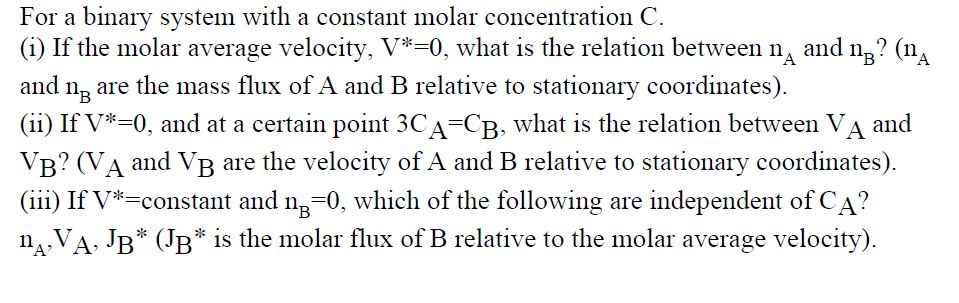 For a binary system with a constant molar concentration C.
(1) If the molar average velocity, V*=0, what is the relation between n, and ng? (n,
and ny are the mass flux of A and B relative to stationary coordinates).
(11) If V¥=0, and at a certain point 3C =Cp. what is the relation between Vo and
VB? (Va and Vp are the velocity of A and B relative to stationary coordinates).
(iii) If V*=constant and n,=0, which of the following are independent of CA?
n,. Va, Jg* (JB™ is the molar flux of B relative to the molar average velocity).
This is AI generated Response.
Asked by: vemuri swathi
Created at: 2025-12-22 01:18:03
Asked by: vemuri swathi
Created at: 2025-12-22 01:18:03
Final Answer:
Rendered
Raw Text
Did you like this answer?
Let's solve each part step by step:
---
## **(i) If the molar average velocity, V\*, = , what is the relation between nₐ and n_B?**
**Definitions:**
- \( n_A \): Mass flux of A relative to stationary coordinates (mol/(m²·s))
- \( n_B \): Mass flux of B relative to stationary coordinates
- \( V_A \), \( V_B \): Velocities of A and B
- \( C_A \), \( C_B \): Molar concentrations of A and B
- \( C = C_A + C_B \): Total molar concentration (constant)
- **Molar average velocity:**
\[
V^* = \frac{C_A V_A + C_B V_B}{C}
\]
**Given:** \( V^* = \)
\[
= \frac{C_A V_A + C_B V_B}{C}
\]
\[
C_A V_A + C_B V_B =
\]
\[
C_A V_A = - C_B V_B
\]
But,
\[
n_A = C_A V_A
\]
\[
n_B = C_B V_B
\]
So,
\[
n_A = -n_B
\]
### **Final Relation:**
\[
\boxed{n_A = -n_B}
\]
---
## **(ii) If V\* = , and at a certain point 3C_A = C_B, what is the relation between V_A and V_B?**
From part (i):
\[
C_A V_A + C_B V_B =
\]
Given: \( 3C_A = C_B \implies C_B = 3C_A \)
Substitute:
\[
C_A V_A + 3C_A V_B =
\]
\[
V_A + 3V_B =
\]
\[
V_A = -3V_B
\]
### **Final Relation:**
\[
\boxed{V_A = -3 V_B}
\]
---
## **(iii) If V\* = constant and n_B = , which of the following are independent of C_A?**
We need to check for \( n_A \), \( V_A \), and \( J_B^* \).
### **Given:**
- \( V^* \): constant
- \( n_B = \)
### **Step 1: Write expressions**
- \( n_A = C_A V_A \)
- \( n_B = C_B V_B = \implies V_B = \) (since \( C_B \ne \))
- \( V^* = \frac{C_A V_A + C_B V_B}{C} \)
- Since \( V_B = \):
\[
V^* = \frac{C_A V_A}{C}
\implies V_A = \frac{V^* C}{C_A}
\]
#### **Check each variable:**
- **n_A:**
\[
n_A = C_A V_A = C_A \left(\frac{V^* C}{C_A}\right) = V^* C
\]
**Independent of \( C_A \)**
- **V_A:**
\[
V_A = \frac{V^* C}{C_A}
\]
**Depends on \( C_A \)**
- **J_B\^*** (Molar flux of B relative to molar average velocity):
\[
J_B^* = n_B - C_B V^* = - C_B V^* = -C_B V^*
\]
**Depends on \( C_B \), which is \( C - C_A \), so it depends on \( C_A \)**
### **Final Answers:**
\[
\boxed{
n_A \text{ is independent of } C_A; \quad V_A \text{ and } J_B^* \text{ depend on } C_A.
}
\]
---
## **Summary Table**
| Part | Final Answer |
|------|--------------|
| (i) | \( n_A = -n_B \) |
| (ii) | \( V_A = -3V_B \) |
| (iii)| Only \( n_A \) is independent of \( C_A \) |
📢 Instructions:
- Ask anything relatd to above question only.
- For new Question goto :