Give step-by-step solution with explanation and final answer:’
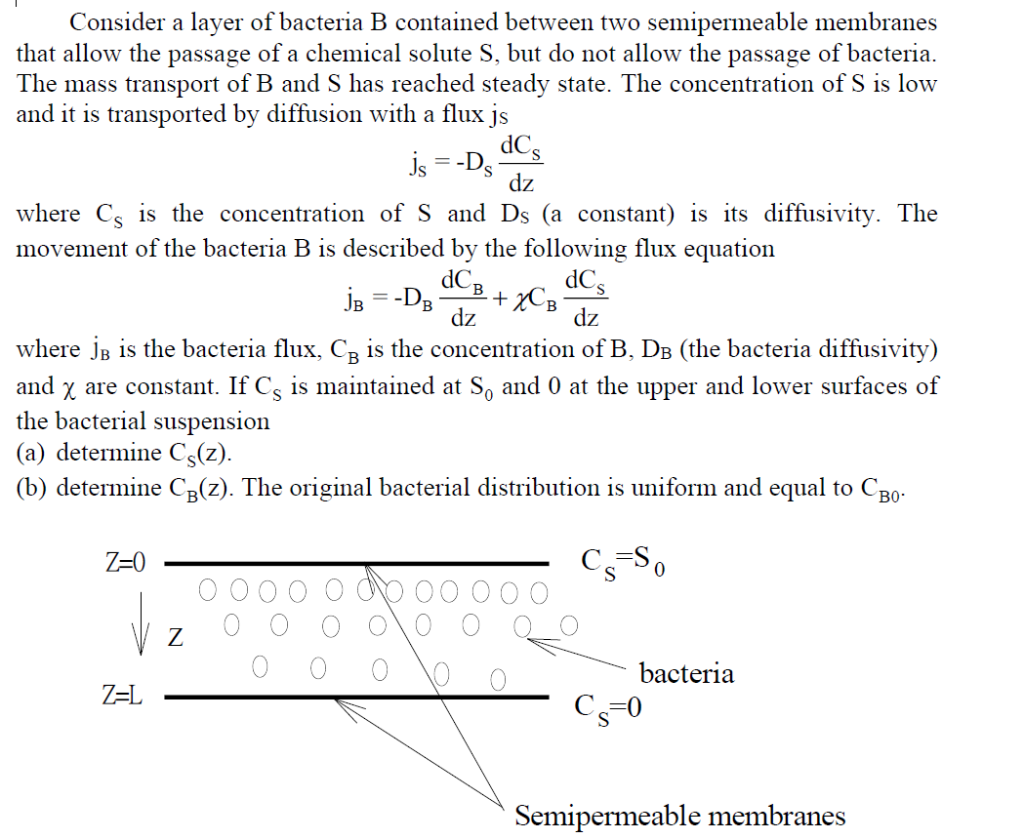
Consider a layer of bacteria B contained between two semipermeable membranes
that allow the passage of a chemical solute S, but do not allow the passage of bacteria.
The mass transport of B and S has reached steady state. The concentration of S is low
and it is transported by diffusion with a flux js
. dC
Js=-Ds—>
'S Ss dz
where Cg is the concentration of S and Ds (a constant) is its diffusivity. The
movement of the bacteria B is described by the following flux equation
. dCy L dC
Js =-Dg——+ Cs —
® ® dz dz
where jg is the bacteria flux, C 5 1s the concentration of B., Ds (the bacteria diffusivity)
and y are constant. If Cg is maintained at S; and 0 at the upper and lower surfaces of
the bacterial suspension
(a) determine Cy(z).
(b) determine Cg(z). The original bacterial distribution is uniform and equal to Cg.
7=0 - - \— C $s 0
0000 OOD ) (
| 2 ) OO 0 O\U ( LO
co oo ~—
: ~~ .
. O 0 © ) 0 bacteria
C 0
Semipermeable membranes
Question:
Give step-by-step solution with explanation and final answer:
This is AI generated Response. Asked by: vemuri swathi Created at: 2025-12-22 01:00:56
Did you like this answer?
👍 0
👎 0
Let's solve the problem step by step:
---
## (a) **Determine \( C_S(z) \)**
Given:
- Steady-state diffusion of solute S:
\[
j_S -D_Sfrac{d_S}{dz \]
Boundary conditions:
\( C_S(z=) = S_ \)
\( C_S(z=L) = \)
At steady state, \( j_S \) is constant (does not depend on \( z \)).
So, integrate:
\[
j_S = -D_S \frac{dC_S}{dz} \implies \frac{dC_S}{dz} = -\frac{j_S}{D_S}
\]
Integrate with respect to \( z \):
\[
C_S(z) = -\frac{j_S}{D_S} z + A
\]
Find constants using boundary conditions:
- At \( z= \): \( C_S() = S_ \implies A = S_ \)
- At \( z=L \): \( C_S(L) = \implies = -\frac{j_S}{D_S}L + S_ \implies j_S = \frac{D_S S_}{L} \)
So,
\[
C_S(z) = S_ \left(1 - \frac{z}{L}\right)
\]
---
## (b) **Determine \( C_B(z) \)**
Bacterial flux equation (at steady state, \( j_B = \) since bacteria cannot cross boundaries):
\[
j_B = -D_B \frac{dC_B}{dz} + \chi C_B \frac{dC_S}{dz}
\]
Set \( j_B = \):
\[
= -D_B \frac{dC_B}{dz} + \chi C_B \frac{dC_S}{dz}
\implies \frac{dC_B}{dz} = \frac{\chi}{D_B} C_B \frac{dC_S}{dz}
\]
This is a first-order linear ODE. Rearranging:
\[
\frac{1}{C_B} \frac{dC_B}{dz} = \frac{\chi}{D_B} \frac{dC_S}{dz}
\]
Integrate both sides with respect to \( z \):
\[
\int \frac{1}{C_B} dC_B = \frac{\chi}{D_B} \int \frac{dC_S}{dz} dz
\]
\[
\ln C_B = \frac{\chi}{D_B} C_S + C_1
\]
Exponentiate both sides:
\[
C_B(z) = A \exp\left(\frac{\chi}{D_B} C_S(z)\right)
\]
Where \( A = e^{C_1} \) is a constant. Use the conservation of total bacteria:
If the original distribution is uniform and equal to \( C_{B} \), then the total number of bacteria is conserved:
\[
\int_^L C_B(z) dz = C_{B} L
\]
Substitute \( C_S(z) \):
\[
C_B(z) = A \exp\left[\frac{\chi}{D_B} S_ \left(1 - \frac{z}{L}\right)\right]
\]
Let \( \alpha = \frac{\chi}{D_B} S_ \):
\[
C_B(z) = A \exp\left[\alpha \left(1 - \frac{z}{L}\right)\right]
\]
To find \( A \):
\[
\int_^L C_B(z) dz = A \int_^L \exp\left[\alpha \left(1 - \frac{z}{L}\right)\right] dz = C_{B} L
\]
Let \( u = 1 - \frac{z}{L} \implies dz = -L du \), as \( z = \rightarrow u = 1, z = L \rightarrow u = \):
\[
= A L \int_1^ e^{\alpha u} (-du) = A L \int_^1 e^{\alpha u} du = A L \left[\frac{e^{\alpha u}}{\alpha}\right]_^1
\]
\[
= A L \frac{e^{\alpha} - 1}{\alpha}
\]
Set equal to \( C_{B} L \):
\[
A \frac{e^{\alpha} - 1}{\alpha} = C_{B}
\implies A = \frac{C_{B} \alpha}{e^{\alpha} - 1}
\]
---
## **Final Answers**
### **(a) Solute concentration profile:**
\[
\boxed{C_S(z) = S_ \left(1 - \frac{z}{L}\right)}
\]
---
### **(b) Bacteria concentration profile:**
Let \( \alpha = \frac{\chi}{D_B} S_ \):
\[
\boxed{
C_B(z) = \frac{C_{B} \alpha}{e^{\alpha} - 1} \exp\left[\alpha \left(1 - \frac{z}{L}\right)\right]
}
\]
where \( C_{B} \) is the initial (uniform) bacteria concentration.
📢 Instructions:
Ask anything relatd to above question only.
For new Question goto :
🚀 Submit (-0.25 Credits🪙)
Study Help, Fast Answers
VIPSolutions focuses on clear, step‑by‑step explanations so you can learn quickly. Whether you need an AI‑generated walkthrough or a short hint to get unstuck, each solution is organized for fast reading and easy review later.
Search similar questions, compare approaches, and bookmark the best answers for revision. Our goal is simple: quick, reliable study help that feels natural—not noisy.
 VIPSolutions
 ’
Consider a layer of bacteria B contained between two semipermeable membranes
that allow the passage of a chemical solute S, but do not allow the passage of bacteria.
The mass transport of B and S has reached steady state. The concentration of S is low
and it is transported by diffusion with a flux js
. dC
Js=-Ds—>
'S Ss dz
where Cg is the concentration of S and Ds (a constant) is its diffusivity. The
movement of the bacteria B is described by the following flux equation
. dCy L dC
Js =-Dg——+ Cs —
® ® dz dz
where jg is the bacteria flux, C 5 1s the concentration of B., Ds (the bacteria diffusivity)
and y are constant. If Cg is maintained at S; and 0 at the upper and lower surfaces of
the bacterial suspension
(a) determine Cy(z).
(b) determine Cg(z). The original bacterial distribution is uniform and equal to Cg.
7=0 - - \— C $s 0
0000 OOD ) (
| 2 ) OO 0 O\U ( LO
co oo ~—
: ~~ .
. O 0 © ) 0 bacteria
C 0
Semipermeable membranes