 VIPSolutions
Give step-by-step solution with explanation and final answer:Proton, Bramposty (exit planch) [3 - -Duven - OF curv Charcgre Cenveraim | 7.7, - iL i Origen Liggonon | (Pete Zo) = Gr ) RU+tbten volmer Kine—eg £= Ou [emp (GF) erp =F ] Lor (C522) 1 ( ) Enercon, balance | ; LE Vv - (KvT) Sdn | Roehion | : =i id 5 SCoine. ead caupied n valinoan POE! 7a A Lorie, 2 Prodict Coinnant Hen dr E Bundy 2H Serer i 5 ppmiia mambrant SITE
Question:
Give step-by-step solution with explanation and final answer: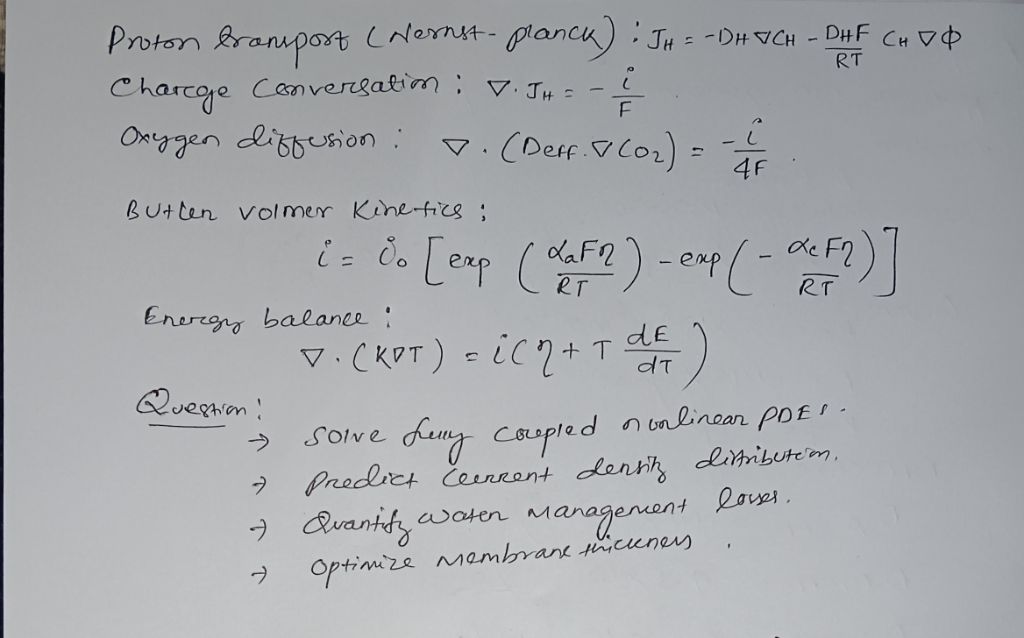 Proton, Bramposty (exit planch) [3 - -Duven - OF curv
Charcgre Cenveraim | 7.7, - iL i
Origen Liggonon | (Pete Zo) = Gr )
RU+tbten volmer Kine—eg
£= Ou [emp (GF) erp =F ]
Lor (C522) 1 ( )
Enercon, balance | ; LE
Vv - (KvT) Sdn |
Roehion | :
=i id 5 SCoine. ead caupied n valinoan POE!
7a A Lorie,
2 Prodict Coinnant Hen dr
E Bundy 2H Serer i
5 ppmiia mambrant SITE
This is AI generated Response.
Asked by: vemuri swathi
Created at: 2025-12-21 23:27:35
Asked by: vemuri swathi
Created at: 2025-12-21 23:27:35
Final Answer:
Rendered
Raw Text
Did you like this answer?
Let's break down the coupled equations and address the **step-by-step solution** for the posed questions:
---
# **Governing Equations**
### 1. **Proton Transport (Nernst-Planck):**
\[
J_H = -D_H \nabla C_H - \frac{D_H F}{RT} C_H \nabla \Phi
\]
### 2. **Charge Conservation:**
\[
\nabla \cdot J_H = -\frac{i}{F}
\]
### 3. **Oxygen Diffusion:**
\[
\nabla \cdot (D_{\text{eff}} \nabla (CO_2)) = -\frac{i}{4F}
\]
### 4. **Butler-Volmer Kinetics:**
\[
i = i_ \left[ \exp \left( \frac{\alpha_a F \eta}{RT} \right) - \exp \left( -\frac{\alpha_c F \eta}{RT} \right) \right]
\]
### 5. **Energy Balance:**
\[
\nabla \cdot (k \nabla T) = i^2 (\eta + T \frac{dE}{dT})
\]
---
# **Step-by-Step Solution**
## **Step 1: Solve the Coupled Nonlinear PDEs**
### **a. Discretize the Domain**
- Use finite difference, finite volume, or finite element methods.
- Define boundary conditions (e.g., concentrations, potentials at interfaces).
### **b. Iterative Solution**
- Guess initial values for \( C_H, \Phi, T, CO_2 \).
- At each time/iteration:
- Update \( J_H \) using the Nernst-Planck equation.
- Update \( i \) from Butler-Volmer given overpotential \( \eta \).
- Update concentrations using diffusion equations.
- Update temperature using the energy balance.
- Repeat until convergence (solution doesn't change significantly).
---
## **Step 2: Predict Current Density Distribution**
- From the converged solution, extract \( i \) as a function of position (usually along membrane thickness).
- Plot \( i(x) \) or \( i(y) \) based on geometry.
---
## **Step 3: Quantify Water Management Losses**
- The water content affects \( D_H \) and thus \( J_H \).
- Calculate water fluxes, osmotic drag, and back-diffusion.
- Compute losses due to:
- **Electro-osmotic Drag:** Water carried with protons.
- **Back Diffusion:** Water moving from cathode to anode.
- Use the solved profiles for \( C_H \), \( T \), and \( CO_2 \) to evaluate water content and its transport.
---
## **Step 4: Optimize Membrane Thickness**
- Repeat the above procedure for different membrane thicknesses.
- For each thickness:
- Solve the system.
- Calculate total current density, losses (ohmic, mass transport, water management).
- Find the thickness that maximizes performance (current density, efficiency) while minimizing losses.
---
# **Summary Table**
| Step | Equation | Variable Solved | Physical Meaning |
|------|----------|-----------------|------------------------|
| 1 | Nernst-Planck + Charge Conservation | \( C_H, \Phi \) | Proton transport |
| 2 | Oxygen Diffusion | \( CO_2 \) | Oxygen concentration |
| 3 | Butler-Volmer | \( i \) | Local current density |
| 4 | Energy Balance | \( T \) | Temperature profile |
| 5 | Analysis | Water flux, losses | Water management |
| 6 | Optimization | - | Membrane thickness |
---
# **Final Answer**
To solve the system:
1. **Discretize the governing equations** using a numerical method.
2. **Iteratively solve** for proton concentration, potential, oxygen concentration, current density, and temperature.
3. **Extract current density distribution** from the solution.
4. **Quantify water management losses** by analyzing water flux and related losses.
5. **Optimize membrane thickness** by simulation and parametric study to maximize performance.
**This process yields:**
- The spatial distribution of current density.
- Water management metrics.
- Optimized membrane thickness for best fuel cell performance.
---
**If you want a worked example with numbers or code, please specify the parameters and I can provide a more detailed numerical solution!**
📢 Instructions:
- Ask anything relatd to above question only.
- For new Question goto :