Give step-by-step solution with explanation and final answer:Figure 4 shows a “chevron” actuator (top view). It consists of two anchors on the left and
right, which are attached to the substrate, plus a movable shuttle supported by slightly
angled beams. When a current passes from one anchor to the other, the beams heat up and
expand, resulting in a displacement of the shuttle. Let's assume the dimensions are as
follows: Spacing between the anchor and shuttle of | = 100 um, 8 = 15°, aSi = 2.6 ppm/
K. a. The entire structure undergoes a change in temperature due to a current passing
through it. Give an equation for the length of an individual beam as a function of
temperature Ib(T). b. Calculate the total displacement d(T) of the shuttle when the change
in temperature is 100 K. Ignore any curvature the actuating beams may experience. c. If the
actuator had 1/3 as many supporting beams, how would the maximum displacement
change? d. How would the force change? e. Where would an object need to be placed to
feel the maximum amount of force from the actuator applied on it? Why?
Question:
Give step-by-step solution with explanation and final answer:Figure 4 shows a “chevron” actuator (top view). It consists of two anchors on the left and
right, which are attached to the substrate, plus a movable shuttle supported by slightly
angled beams. When a current passes from one anchor to the other, the beams heat up and
expand, resulting in a displacement of the shuttle. Let's assume the dimensions are as
follows: Spacing between the anchor and shuttle of | = 100 um, 8 = 15°, aSi = 2.6 ppm/
K. a. The entire structure undergoes a change in temperature due to a current passing
through it. Give an equation for the length of an individual beam as a function of
temperature Ib(T). b. Calculate the total displacement d(T) of the shuttle when the change
in temperature is 100 K. Ignore any curvature the actuating beams may experience. c. If the
actuator had 1/3 as many supporting beams, how would the maximum displacement
change? d. How would the force change? e. Where would an object need to be placed to
feel the maximum amount of force from the actuator applied on it? Why?
This is AI generated Response.
Asked by: Mallikarjun
Created at: 2025-12-21 07:16:37
Final Answer:
RenderedRaw Text
Did you like this answer?
Let's break down the chevron actuator problem step-by-step:
---
## **Given Data**
- Spacing between anchor and shuttle, \( l = 100 \) μm
- Angle, \( \theta = 15^\circ \)
- Thermal expansion coefficient (Si), \( \alpha_{Si} = 2.6 \) ppm/K \( = 2.6 \times 10^{-6} \) /K
- Temperature change, \( \Delta T = 100 \) K
---
## **a. Equation for the Length of an Individual Beam as a Function of Temperature**
The original length of the beam (at reference temperature) is \( l_b() \).
Change in length due to temperature (\( \Delta T \)):
\[
l_b(T) = l_b() \left[ 1 + \alpha_{Si} \Delta T \right]
\]
Where:
- \( l_b(T) \): Length at temperature \( T \)
- \( l_b() \): Original length at reference temperature
For a chevron actuator, the original length is:
\[
l_b() = \frac{l}{\cos\theta}
\]
So,
\[
l_b(T) = \frac{l}{\cos\theta} \left[ 1 + \alpha_{Si} \Delta T \right]
\]
---
## **b. Total Displacement \( d(T) \) of the Shuttle for \( \Delta T = 100 \) K**
Displacement occurs **horizontally** (along \( l \)), and it's the projection of the expansion along the shuttle direction.
**Expansion per beam:**
\[
\Delta l_b = l_b() \cdot \alpha_{Si} \Delta T
\]
**Horizontal component:**
\[
d(T) = \Delta l_b \cdot \cos\theta
\]
\[
d(T) = l_b() \cdot \alpha_{Si} \Delta T \cdot \cos\theta
\]
But \( l_b() = \frac{l}{\cos\theta} \):
\[
d(T) = \left( \frac{l}{\cos\theta} \right) \cdot \alpha_{Si} \Delta T \cdot \cos\theta
\]
\[
d(T) = l \cdot \alpha_{Si} \Delta T
\]
**Plug in values:**
\[
d(T) = 100 \times 10^{-6} \text{ m} \cdot 2.6 \times 10^{-6} \cdot 100
\]
\[
d(T) = 100 \times 2.6 \times 100 \times 10^{-12} \text{ m}
\]
\[
d(T) = 26000 \times 10^{-12} \text{ m}
\]
\[
d(T) = 2.6 \times 10^{-8} \text{ m}
\]
\[
d(T) = 26 \text{ nm}
\]
---
## **c. If the Actuator Had 1/3 as Many Supporting Beams, How Would Maximum Displacement Change?**
**Displacement** formula does **not** depend on the number of beams (as each beam's expansion contributes equally). So, **maximum displacement stays the same**.
---
## **d. How Would the Force Change?**
Force is distributed among the beams. Fewer beams means each beam must support more force.
- If there are 1/3 as many beams, the **force per beam increases by a factor of 3** (assuming displacement is the same and the shuttle is rigid).
- **Total actuator force decreases by a factor of 1/3**, since there is less total cross-sectional area to push.
---
## **e. Where Would an Object Need to Be Placed to Feel the Maximum Amount of Force from the Actuator? Why?**
**Answer:**
An object should be placed **in line with the shuttle, at the point of contact where the shuttle moves and transmits force to the object** (i.e., directly in front of the shuttle along the actuation axis).
**Why:**
The force is maximized at the shuttle because that's where all the beams' forces are summed and transferred. Any point off the shuttle or away from the direct line of motion will experience less force due to component losses or leverage effects.
---
## **Summary Table**
| Part | Answer |
|------|--------|
| a | \( l_b(T) = \frac{l}{\cos\theta}[1 + \alpha_{Si} \Delta T] \) |
| b | \( d(T) = l \cdot \alpha_{Si} \Delta T = 26\, \mathrm{nm} \) |
| c | Maximum displacement remains the same |
| d | Maximum force decreases by a factor of 1/3 |
| e | Place object directly in front of the shuttle for maximum force, as all beam forces sum there |
---
Let me know if you need further clarifications or calculations!
VIPSolutions focuses on clear, step‑by‑step explanations so you can learn quickly. Whether you need an AI‑generated walkthrough or a short hint to get unstuck, each solution is organized for fast reading and easy review later.
Search similar questions, compare approaches, and bookmark the best answers for revision. Our goal is simple: quick, reliable study help that feels natural—not noisy.
 VIPSolutions
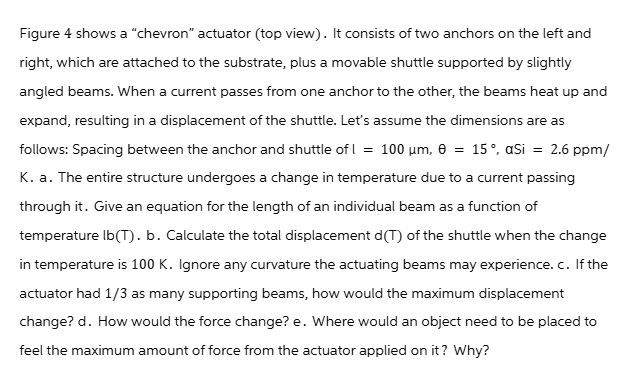 Figure 4 shows a “chevron” actuator (top view). It consists of two anchors on the left and
right, which are attached to the substrate, plus a movable shuttle supported by slightly
angled beams. When a current passes from one anchor to the other, the beams heat up and
expand, resulting in a displacement of the shuttle. Let's assume the dimensions are as
follows: Spacing between the anchor and shuttle of | = 100 um, 8 = 15°, aSi = 2.6 ppm/
K. a. The entire structure undergoes a change in temperature due to a current passing
through it. Give an equation for the length of an individual beam as a function of
temperature Ib(T). b. Calculate the total displacement d(T) of the shuttle when the change
in temperature is 100 K. Ignore any curvature the actuating beams may experience. c. If the
actuator had 1/3 as many supporting beams, how would the maximum displacement
change? d. How would the force change? e. Where would an object need to be placed to
feel the maximum amount of force from the actuator applied on it? Why?