 VIPSolutions
Give step-by-step solution with explanation and final answer:BERR a aa Sa MRS 8 WA LAW OWAALIUL A GallilUd,. 7 9.3. Consider the following batch growth data: BR Sh 10 rie ssiloneas 4 ole Time X 12 dXldt dP/dt h ol g/l ¢/l-h ¢/l-h —_— A 0 03
Question:
Give step-by-step solution with explanation and final answer: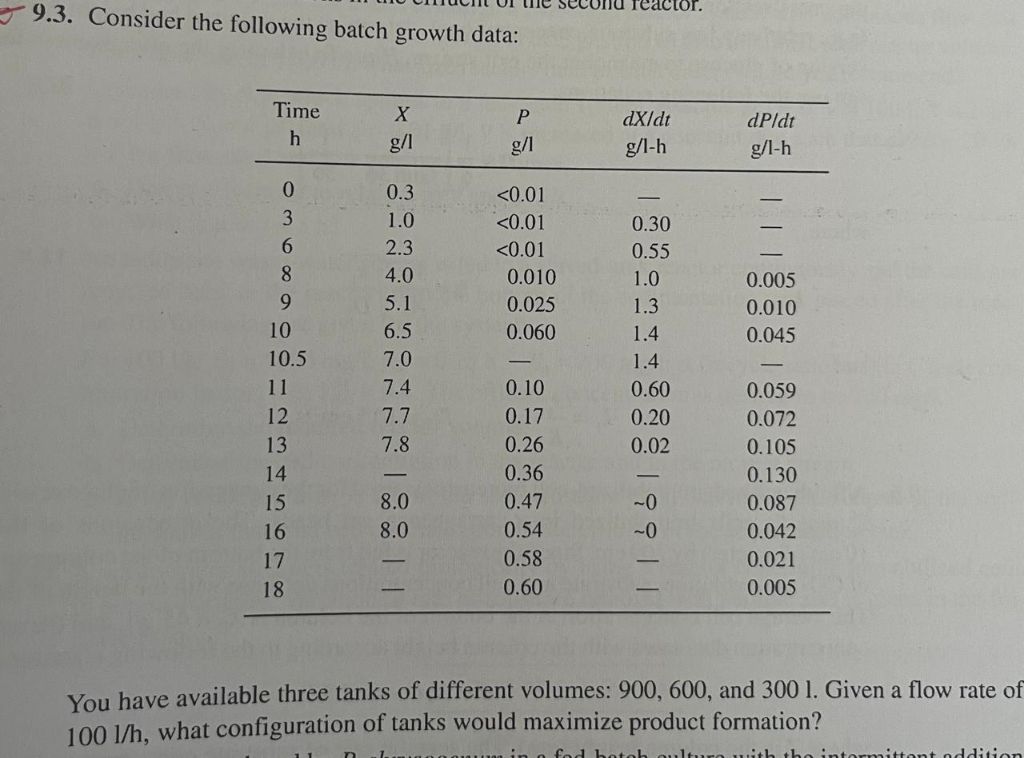 BERR a aa Sa MRS 8 WA LAW OWAALIUL A GallilUd,.
7 9.3. Consider the following batch growth data:
BR Sh 10 rie ssiloneas 4 ole
Time X 12 dXldt dP/dt
h ol g/l ¢/l-h ¢/l-h
—_— A
0 03
This is AI generated Response.
Asked by: vemuri swathi
Created at: 2025-12-20 22:28:42
Asked by: vemuri swathi
Created at: 2025-12-20 22:28:42
Final Answer:
Rendered
Raw Text
Did you like this answer?
Let's break down the solution step by step based on the **batch growth data** and the reactor configuration question:
---
## **Step 1: Analyze the Batch Growth Data**
Let's summarize what the data tells us:
| Time (h) | X (g/l) | P (g/l) | dX/dt (g/l·h) | dP/dt (g/l·h) |
|----------|---------|---------|---------------|---------------|
| | .3 | <.01 | — | — |
| 3 | 1. | <.01 | .30 | — |
| 6 | 2.3 | <.01 | .55 | — |
| 8 | 4. | .010 | 1. | .005 |
| 9 | 5.1 | .025 | 1.3 | .010 |
| 10 | 6.5 | .060 | 1.4 | .045 |
| 10.5 | 7. | .10 | 1.4 | — |
| 11 | 7.4 | .10 | .60 | .059 |
| 12 | 7.7 | .17 | .20 | .072 |
| 13 | 7.8 | .26 | .02 | .105 |
| 14 | — | .36 | — | .130 |
| 15 | 8. | .47 | ~ | .087 |
| 16 | 8. | .54 | ~ | .042 |
| 17 | — | .58 | — | .021 |
| 18 | — | .60 | — | .005 |
Where:
- **X** = Biomass concentration
- **P** = Product concentration
- **dX/dt** = Biomass production rate
- **dP/dt** = Product formation rate
---
## **Step 2: Find Maximum Product Formation Rate**
From the table, the **maximum dP/dt** is:
- At 14 h: **dP/dt = .130 g/l·h**
---
## **Step 3: Understand the Reactor Configuration Question**
You have **three tanks**:
- 900 L
- 600 L
- 300 L
**Feed flow rate = 100 L/h**
You are to **configure the tanks (in series)** to maximize product formation.
---
## **Step 4: Reactor Theory Consideration**
**For product formation:**
- Maximum product formation rate (dP/dt) occurs after the maximum biomass growth rate.
- Ideally, you want most of the flow to be at the **maximum dP/dt** stage.
**CSTRs in Series:**
- **First tank:** High substrate, mostly growth phase.
- **Last tank(s):** Lower substrate, higher product formation.
**To maximize product, you want:**
1. **First tank**: Large enough for growth, leading into the production phase.
2. **Subsequent tanks**: Hold cells in conditions with high product formation rate.
---
## **Step 5: Calculate Residence Time**
**Total volume = 900 + 600 + 300 = 180 L**
**Total residence time** = Total volume / Flow rate
= 180 L / 100 L/h = **18 hours**
This matches the batch time data (up to 18 h).
---
## **Step 6: Assign Volumes to Maximize Product Formation**
- **Growth phase** (max dX/dt): ~ to 10.5 h
- **Production phase** (max dP/dt): 10.5 h onward (peak at 14 h)
**Fraction of total time at max dP/dt:**
- Peak dP/dt at 14 h (out of 18 h total):
\( \frac{14}{18} \approx .78 \)
You want the **largest tank(s) at the stage with highest dP/dt**.
### **Best Configuration:**
- Use the **smallest tank for the growth phase** (early phase, up to ~10.5 h).
- Use the **largest tanks for product formation** (late phase, after 10.5 h).
#### **Specific Assignment:**
- **First tank (growth phase):** 300 L
Residence time = 300 L / 100 L/h = **3 h**
- **Second tank (transition):** 600 L
Residence time = 600 L / 100 L/h = **6 h**
- **Third tank (production phase):** 900 L
Residence time = 900 L / 100 L/h = **9 h**
So, from entry to exit:
- -3 h: 1st tank
- 3-9 h: 2nd tank
- 9-18 h: 3rd tank (this covers the peak dP/dt period!)
---
## **Step 7: Final Answer**
### **To maximize product formation:**
**Configuration:**
**Feed → 300 L tank → 600 L tank → 900 L tank → Product**
- This setup ensures that most of the cell mass spends the longest time (9 h) in the stage where product formation rate is highest.
---
## **Summary Table**
| Tank Volume (L) | Residence Time (h) | Stage |
|-----------------|--------------------|-------------------|
| 300 | 3 | Growth |
| 600 | 6 | Transition |
| 900 | 9 | Product formation |
---
### **Final Answer**
> **Arrange the tanks in order: 300 L → 600 L → 900 L (in series), with a flow rate of 100 L/h. This maximizes the time spent at the highest product formation rate, thus maximizing overall product formation.**
📢 Instructions:
- Ask anything relatd to above question only.
- For new Question goto :