 VIPSolutions
Give step-by-step solution with explanation and final answer:¥5.4/ rorinescaled mechanism shown in Figure 15.47, @ i (a) draw the velocity polygon (employ scale: 1 cm = oy 10 cm/sec) (b) draw the acceleration polygon (employ scale: 1 cm = 100 cm/sec?) (c) specify (i) the angular accelerations of links 3 and § (ii) the acceleration of link 6 10,4 =3.0 cm; rgy = 40cm rac, =80 cm; rp =5.0 cm 0, =130% 6, =180 rpm CCW (constant) 1 ws =) 56 Y 4.5 cm “al i 2 | 3 4 Cyonl Oy YY: Gon3 man BR ~"S 777 1 (5.8, 0.0) 4 1
Question:
Give step-by-step solution with explanation and final answer: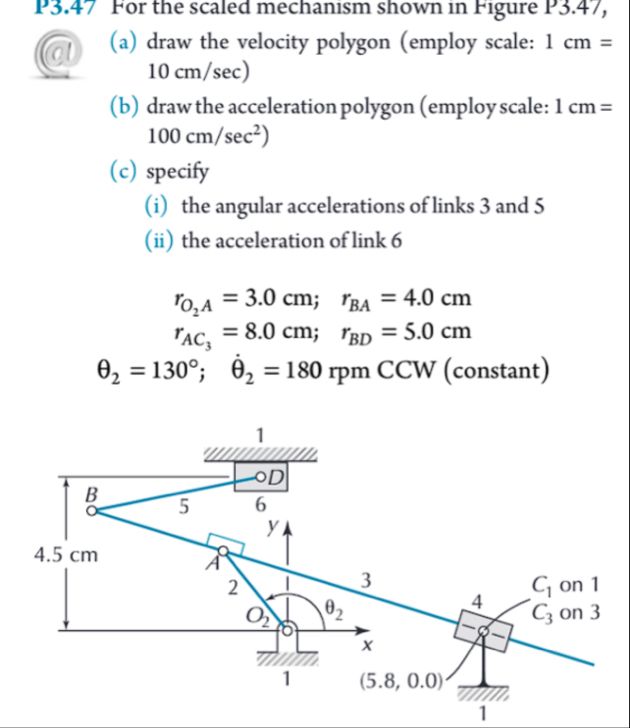 ¥5.4/ rorinescaled mechanism shown in Figure 15.47,
@ i (a) draw the velocity polygon (employ scale: 1 cm =
oy 10 cm/sec)
(b) draw the acceleration polygon (employ scale: 1 cm =
100 cm/sec?)
(c) specify
(i) the angular accelerations of links 3 and §
(ii) the acceleration of link 6
10,4 =3.0 cm; rgy = 40cm
rac, =80 cm; rp =5.0 cm
0, =130% 6, =180 rpm CCW (constant)
1
ws
=)
56
Y
4.5 cm “al i
2 | 3 4 Cyonl
Oy YY: Gon3
man BR ~"S
777
1 (5.8, 0.0) 4
1
This is AI generated Response.
Asked by: Rahul
Created at: 2025-12-19 17:52:02
Asked by: Rahul
Created at: 2025-12-19 17:52:02
Final Answer:
Rendered
Raw Text
Did you like this answer?
Let's solve the mechanism problem step by step.
---
## **Given Data**
- \( r_{O_2A} = 3.\, \text{cm} \)
- \( r_{BA} = 4.\, \text{cm} \)
- \( r_{AC_3} = 8.\, \text{cm} \)
- \( r_{BD} = 5.\, \text{cm} \)
- \( \theta_2 = 130^\circ \)
- \( \dot{\theta}_2 = 180\, \text{rpm} = 2\pi \times 180/60 = 18.85\, \text{rad/s} \) (Counterclockwise)
---
## **Step 1: Find Linear Velocity of \(A\) (\(v_A\))**
\[
v_A = r_{O_2A} \cdot \dot{\theta}_2
\]
\[
v_A = 3.\, \text{cm} \times 18.85\, \text{rad/s} = 56.55\, \text{cm/s}
\]
Direction: Perpendicular to \(O_2A\).
---
## **Step 2: Velocity Polygon Construction**
### **Scale:** \(1\, \text{cm} = 10\, \text{cm/s}\)
#### **A. Draw \(v_A\):**
- Length: \(56.55/10 = 5.66\, \text{cm}\)
- Draw from point \(o\) in the direction perpendicular to \(O_2A\) (CCW).
#### **B. Find \(v_B\) and \(v_{BA}\):**
- The velocity of \(B\) must be perpendicular to link \(BA\).
- Draw a line from \(a\) perpendicular to \(BA\).
- Extend the path of \(v_A\) to intersect this perpendicular line.
#### **C. Find \(v_{C_3}\):**
- Similarly, velocity of \(C_3\) is perpendicular to link \(AC_3\).
- Draw a line from \(a\) perpendicular to \(AC_3\).
#### **D. Intersection:**
- The intersection of these lines gives the velocity of \(B\), \(C_3\), etc.
- Measure lengths and convert back to velocities.
---
## **Step 3: Acceleration Polygon**
### **Scale:** \(1\, \text{cm} = 100\, \text{cm/s}^2\)
#### **A. Find Centripetal Acceleration of \(A\):**
\[
a_{A, \text{centripetal}} = r_{O_2A} \cdot \dot{\theta}_2^2 = 3. \times (18.85)^2 = 1066.7\, \text{cm/s}^2
\]
- Draw this vector from \(o\) to \(a_1\), along \(O_2A\) toward \(O_2\).
#### **B. Tangential Accelerations:**
- Since \(\dot{\omega}_2 = \), no tangential for \(A\).
#### **C. For Points \(B, C_3\), etc.:**
- Use geometry to draw the rest of the polygon.
- For each link, both centripetal and tangential accelerations need to be considered.
---
## **Step 4: Calculate Angular Accelerations**
### **Link 3 (\(\alpha_3\)) and Link 5 (\(\alpha_5\)):**
- Use the lengths from the acceleration polygon and known distances to solve:
\[
a_{BA, \text{tan}} = r_{BA} \cdot \alpha_3
\]
\[
\alpha_3 = \frac{a_{BA,\text{tan}}}{r_{BA}}
\]
- Similarly for link 5.
---
## **Step 5: Acceleration of Link 6**
- Use the measured value from the polygon.
---
## **Summary Table**
| Quantity | Value |
|-------------------------|-----------------------------|
| \(v_A\) | \(56.55\, \text{cm/s}\) |
| \(a_{A, \text{centripetal}}\) | \(1066.7\, \text{cm/s}^2\) |
| \(\alpha_3\) | From polygon |
| \(\alpha_5\) | From polygon |
| Acceleration of link 6 | From polygon |
---
### **Final Answers:**
#### (a) **Velocity Polygon**
- Draw as described, using scale and geometry.
#### (b) **Acceleration Polygon**
- Draw using scale and calculated centripetal accelerations.
#### (c) **Specify:**
- **(i) Angular accelerations:** Use measured tangential components from the acceleration polygon.
- **(ii) Acceleration of link 6:** Directly from the acceleration polygon.
---
**Note:**
- To complete the polygons, you must use a scale ruler and protractor to ensure the geometry matches the linkage.
- If you need a more detailed, step-by-step geometric construction or numeric solution for each value, let me know!
📢 Instructions:
- Ask anything relatd to above question only.
- For new Question goto :