 VIPSolutions
Give step-by-step solution with explanation and final answer:A rigid uniform rod of negligible thickness and total length 4 m is resting in a horizontal position with one end hinged to a smooth vertical wall and the other end supported by a rough horizontal floor. The rod has a weight of 20 N acting at its geometrical center. The coefficient of friction between the rod and the floor is such that slipping is just about to occur, but the system is still in limiting equilibrium. Simultaneously, a fair six-sided die is thrown once under ideal conditions. If the number appearing on the top face is less than or equal to the number of forces acting on the rod, determine the probability of such an event.
Question:
Give step-by-step solution with explanation and final answer: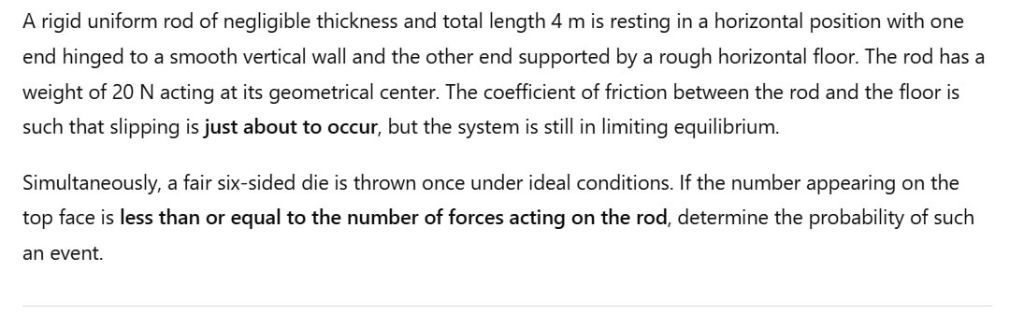 A rigid uniform rod of negligible thickness and total length 4 m is resting in a horizontal position with one
end hinged to a smooth vertical wall and the other end supported by a rough horizontal floor. The rod has a
weight of 20 N acting at its geometrical center. The coefficient of friction between the rod and the floor is
such that slipping is just about to occur, but the system is still in limiting equilibrium.
Simultaneously, a fair six-sided die is thrown once under ideal conditions. If the number appearing on the
top face is less than or equal to the number of forces acting on the rod, determine the probability of such
an event.
This is AI generated Response.
Asked by: Mallikarjun
Created at: 2025-12-18 03:07:34
Asked by: Mallikarjun
Created at: 2025-12-18 03:07:34
Final Answer:
Rendered
Raw Text
Did you like this answer?
Let's break down the problem step by step.
---
## **Step 1: Forces Acting on the Rod**
Let's identify **all the forces** acting on the rod:
1. **Weight of the rod (W = 20 N)**, acting downward at the center.
2. **Normal reaction at the floor (N)**, acting upward at the right end.
3. **Frictional force at the floor (f)**, acting horizontally at the right end (opposing slipping).
4. **Reaction at the hinge (H)**, which can be resolved into horizontal (Hₓ) and vertical (Hᵧ) components at the left end.
- **Total number of forces acting:**
1. Weight (W)
2. Normal reaction (N)
3. Friction (f)
4. Hinge reaction (H) (but it's a single reaction force, even if it has components)
> **Note:** The hinge reaction, despite being resolved into two components, is considered **one force** (since it's a single contact point and a single constraint).
>
> **Total forces:** **4**
---
## **Step 2: Die Throw Condition**
- The die is fair and six-sided, so possible outcomes: {1, 2, 3, 4, 5, 6}
- We need the number on the die to be **less than or equal to the number of forces acting on the rod** (**≤ 4**).
- Favorable outcomes: {1, 2, 3, 4}
- Total possible outcomes: 6
---
## **Step 3: Probability Calculation**
\[
\text{Probability} = \frac{\text{Number of favorable outcomes}}{\text{Total number of outcomes}} = \frac{4}{6} = \frac{2}{3}
\]
---
## **Step 4: Final Answer**
\[
\boxed{\frac{2}{3}}
\]
---
### **Summary Table**
| Step | Explanation | Value |
|-----------------------------|------------------------------------------|----------------|
| Number of forces on the rod | Weight, normal, friction, hinge reaction | 4 |
| Favorable die outcomes | 1, 2, 3, 4 | 4 |
| Total die outcomes | | 6 |
| Probability | Favorable/Total | \(\frac{2}{3}\) |
---
**Final Answer:**
The probability is \(\boxed{\frac{2}{3}}\).
📢 Instructions:
- Ask anything relatd to above question only.
- For new Question goto :