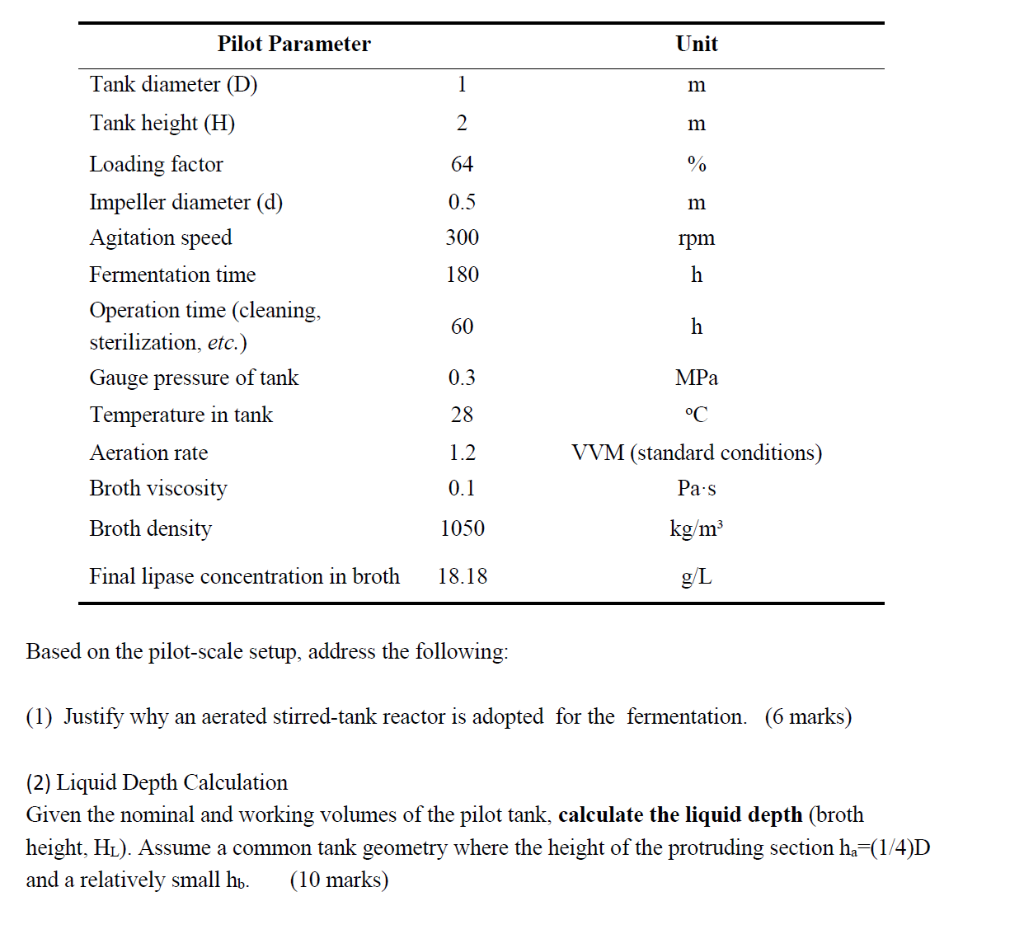
Give step-by-step solution with explanation and final answer:Pilot Parameter Unit
Tank diameter (D) 1 m
Tank height (H) 2 m
Loading factor 64 %
Impeller diameter (d) 0.5 m
Agitation speed 300 pm
Fermentation time 180 h
ation ti leant
Operation ime (cleaning, 60 h
sterilization, erc.)
Gauge pressure of tank 03 MPa
Temperature in tank 28 °C
Aeration rate 12 VVM (standard conditions)
Broth viscosity 0.1 Pas
Broth density 1050 kg/m?
Final lipase concentration in broth ~~ 18.18 gL
Based on the pilot-scale setup, address the following:
(1) Justify why an aerated stirred-tank reactor is adopted for the fermentation. (6 marks)
(2) Liquid Depth Calculation
Given the nominal and working volumes of the pilot tank, calculate the liquid depth (broth
height. Hr). Assume a common tank geometry where the height of the protruding section h,=(1/4)D
and a relatively small hy. (10 marks)
Question:
Give step-by-step solution with explanation and final answer:Pilot Parameter Unit
Tank diameter (D) 1 m
Tank height (H) 2 m
Loading factor 64 %
Impeller diameter (d) 0.5 m
Agitation speed 300 pm
Fermentation time 180 h
ation ti leant
Operation ime (cleaning, 60 h
sterilization, erc.)
Gauge pressure of tank 03 MPa
Temperature in tank 28 °C
Aeration rate 12 VVM (standard conditions)
Broth viscosity 0.1 Pas
Broth density 1050 kg/m?
Final lipase concentration in broth ~~ 18.18 gL
Based on the pilot-scale setup, address the following:
(1) Justify why an aerated stirred-tank reactor is adopted for the fermentation. (6 marks)
(2) Liquid Depth Calculation
Given the nominal and working volumes of the pilot tank, calculate the liquid depth (broth
height. Hr). Assume a common tank geometry where the height of the protruding section h,=(1/4)D
and a relatively small hy. (10 marks)
This is AI generated Response.
Asked by: vemuri swathi
Created at: 2025-12-18 00:59:06
Final Answer:
RenderedRaw Text
Did you like this answer?
Let's tackle **Question 2: Liquid Depth Calculation** step by step.
---
## **Step 1: Understand the Problem**
We need to **calculate the liquid depth (broth height, \( H_L \))** in the pilot tank, given:
- Tank diameter, \( D = 1 \) m
- Tank height, \( H = 2 \) m
- Loading factor = 64%
- The tank has a protruding section on top, height \( h_a = \frac{1}{4}D \)
- The rest of the tank is cylindrical
---
## **Step 2: Calculate Protruding Section Height (\( h_a \))**
Given:
\[
h_a = \frac{1}{4} D = \frac{1}{4} \times 1 = .25 \text{ m}
\]
---
## **Step 3: Calculate Total Working (Broth) Volume**
The **loading factor** indicates the fraction of the tank's total volume that is filled with liquid (broth):
\[
\text{Loading factor} = \frac{\text{Working volume}}{\text{Nominal (total) volume}}
\]
### **Calculate Nominal (Total) Volume:**
The tank is a cylinder:
\[
V_{\text{nominal}} = \pi \left(\frac{D}{2}\right)^2 H
\]
Plug in the values:
\[
V_{\text{nominal}} = \pi \left(\frac{1}{2}\right)^2 \times 2 = \pi \times .25 \times 2 = \pi \times .5 \approx 1.57 \text{ m}^3
\]
### **Calculate Working Volume:**
\[
\text{Working volume} = \text{Loading factor} \times V_{\text{nominal}}
\]
\[
\text{Working volume} = .64 \times 1.57 \approx 1.01 \text{ m}^3
\]
---
## **Step 4: Calculate Broth Height (\( H_L \))**
**The working volume is the volume of liquid (broth) in the tank.**
The liquid fills the cylindrical section up to height \( H_L \) (not the entire tank height, since some headspace is needed for gas, foaming, etc.).
\[
\text{Working volume} = \pi \left(\frac{D}{2}\right)^2 H_L
\]
Solve for \( H_L \):
\[
H_L = \frac{\text{Working volume}}{\pi \left(\frac{D}{2}\right)^2}
\]
Plug the numbers in:
\[
H_L = \frac{1.01}{\pi \left(\frac{1}{2}\right)^2}
\]
\[
= \frac{1.01}{\pi \times .25}
\]
\[
= \frac{1.01}{.785}
\]
\[
\approx 1.29 \text{ m}
\]
---
## **Step 5: Check That \( H_L \) Fits in the Tank**
The tank height is 2 m, with a protruding section of \( h_a = .25 \) m, so the cylindrical section is \( H - h_a = 2 - .25 = 1.75 \) m.
Since \( H_L = 1.29 \) m is less than 1.75 m, the calculation is valid.
---
## **Final Answer**
### **Liquid Depth (Broth Height):**
\[
\boxed{H_L \approx 1.29 \text{ m}}
\]
---
### **Summary Table**
| Parameter | Value |
|----------------|-------------|
| Tank diameter | 1 m |
| Tank height | 2 m |
| Protruding top | .25 m |
| Loading factor | 64% |
| Working volume | 1.01 m³ |
| Broth height | 1.29 m |
---
**If you need the justification for the stirred-tank reactor (Question 1), let me know!**
VIPSolutions focuses on clear, step‑by‑step explanations so you can learn quickly. Whether you need an AI‑generated walkthrough or a short hint to get unstuck, each solution is organized for fast reading and easy review later.
Search similar questions, compare approaches, and bookmark the best answers for revision. Our goal is simple: quick, reliable study help that feels natural—not noisy.
 VIPSolutions
 Pilot Parameter Unit
Tank diameter (D) 1 m
Tank height (H) 2 m
Loading factor 64 %
Impeller diameter (d) 0.5 m
Agitation speed 300 pm
Fermentation time 180 h
ation ti leant
Operation ime (cleaning, 60 h
sterilization, erc.)
Gauge pressure of tank 03 MPa
Temperature in tank 28 °C
Aeration rate 12 VVM (standard conditions)
Broth viscosity 0.1 Pas
Broth density 1050 kg/m?
Final lipase concentration in broth ~~ 18.18 gL
Based on the pilot-scale setup, address the following:
(1) Justify why an aerated stirred-tank reactor is adopted for the fermentation. (6 marks)
(2) Liquid Depth Calculation
Given the nominal and working volumes of the pilot tank, calculate the liquid depth (broth
height. Hr). Assume a common tank geometry where the height of the protruding section h,=(1/4)D
and a relatively small hy. (10 marks)