 VIPSolutions
Give step-by-step solution with explanation and final answer:Q18] An automobile engine has an efficiency of 22% and produces 2510 J of work. How much heat [in J] does the engine reject? [A] 7700 [B]3300 [C] 6600 [D] 8900 [E] 8312 1Q19] Two moles of the monoatomic gas argon expand isothermally from an initial volume of Vi = 0.025 m’ to a final volume of Y¢= 0.050 m3. Assume that argon behaves like an ideal gas. Find the heat [in J] supplied to the gas. [A] 3433 [B] 5343 [C]2233 [D] 3322 [E] 5432 [Study different thermodynamic processes, such as, isothermal, isobaric, and isochoric processes] 1Q20] A small plastic container called the coolant reservoir catches the radiator fluid that overflows when an automobile engine becomes hot. The radiator is made of copper, and the coolant has a coefficient of volume expansion p = 4.10*10 (1/°C). If the radiator is filled to its 15-quart capacity when the engine is (6°C), how much overflow [in quarts] will spill into the reservoir when the coolant reaches its operating temperature of 92 °C? [A]0.23 [B]0.55 [C]0.67 [D] 0.32 [E] 0.46 Helpful Information: B (coolant) = 4.10 *10*/°C B (copper) = 5.10 *10%/°C [Study also linear expansion, stress-strain relations] Q13] A calorimeter cup is made from 0.25 kg of aluminum and contains 0.22 kg of water. Initially, the cup and water have a common temperature of 18.5° C. A 0.044-kg mass of unknown material is heated to a temperature of 98.0° C. The temperature of the cup, the water, and the unknown material is 23.0° C after thermal equilibrium is reached. Find the unknown material's specific heat capacity [in J/kg°C]. Helpful Information: heat capacity of water = 4186 J/kg.°C__heat capacity of aluminum = 900 J/kg°C [A] 1601 [B] 1805 [C1563 [D] 1122 [E] 2211 [Almost the same] [Q14] A party balloon contains 60000 cm? of helium. At 27 °C, its internal pressure is 1.10 atm. Find the number of moles of helium in the balloon. [A]2.67 [B]0.95 [c10.73 [D]3.0 [E]33 [Almost the same] [Q15] A gas container with perfect elastic walls contains molecules of oxygen and nitrogen (Oz and Ny). If the RMS speed of the nitrogen gas molecules is 550 m/s, find the temperature [in K] of the gas molecules. [A] 300 [B] 285 [C]385 [D] 336 [E] 410 [Almost the same] [Q16] At a party, 6.00 kg of ice at -5°C is added to a cooler holding 30 kg of water at 20.0°C. When it attains equilibrium, what is the water’s temperature [in C]? Helpful Information: gyue, = 4186 J/kg°C Ls= 333000 J/kg°C Gice,= 2090 J/kg°C [| [B] 9.05 [C] 8.06 [D] 8.08 [E] 1.09 017] Three ropes support a uniform plank of length 2.0 m and mass 30.0 kg. See Figure. Find the tension (T2) [in N] when a 700-N person is d = 0.50 m from the left end. ® 7, ) ) : T too TL 0pm] [A] 501 [B]672 [C]384 [D] 601 [E] 968 [Almost the same] Qn A roller-coaster car of 100 kg shown in the figure is pulled up to point 1, where it is released from rest. If the frictional energy loss between points 1 and 4 is 2000 J, calculate the speed [in m/s] at point 4. . 3 f ATR gD ¥ Pm 4 \ 26m 2 ! 14m A BY 05 SDI 2 WOVE SN aT Zs ET I BR | [A]18.78 [B]17.68 [C] 15.22 [D] 19.82 [E]21.22 [Might Change> Work-KE Theorem and Non-Conservative Force] 108] A child, hunting for his favorite wooden horse, is running on the ground around the edge of a stationary merry- go-round. The angular speed of the child has a constant value of 0.250 rad/s. At the instant the child spots the horse, one-quarter of a turn away, the merry-go-round begins to move (in the direction the child is running) with a constant acceleration of 0.010 rad/s. What is the shortest time it takes for the child to catch up with the horse? [A]5.6 [E174 [C124 [D]4.2 [E] 6.6 19] A string has a linear density of 9.0*10 kg/m that is under a tension of 300 N. The 20.0 cm long string is fixed at both ends and vibrates in the standing wave pattern shown in the drawing. Determine the frequency [in Hz] of the fifth harmonics. [A] 1433 [B] 1634 [C] 2282 [D] 1989 [E] 3214 [Q10] The speed of a transverse wave on a string is 500 m/s, and the wavelength is 0.20 m. The wave's amplitude is 2.5 mm. How much time [in s] is required for a string particle to move through a total distance of 2.0 km? [A180 [B] 50 [C] 100 [D] 120 [E] 40 [Q11] The intensity level of a soccer stadium when all the spectators cheer is 115 dB, One person’s cheering is recorded at a level of 70 dB,.Find the number of spectators in the stadium when the intensity level is 115 [A]90 [B] 29892 [C] 5555 [D] 6543 [Q12] A supergiant star emits a radiant power (in joules per second, or watts) of approximately 4.6*10*> W (or 4.6E32 W). Assuming the supergiant star is a perfect emitter (emissivity e = 1) and spherical (i.e., the radius being 5.5*10'' m). Find the surface temperature of the supergiant star. ces; [B] 5566 K [C14346K [D]2233K [E] none of the above
Question:
Give step-by-step solution with explanation and final answer: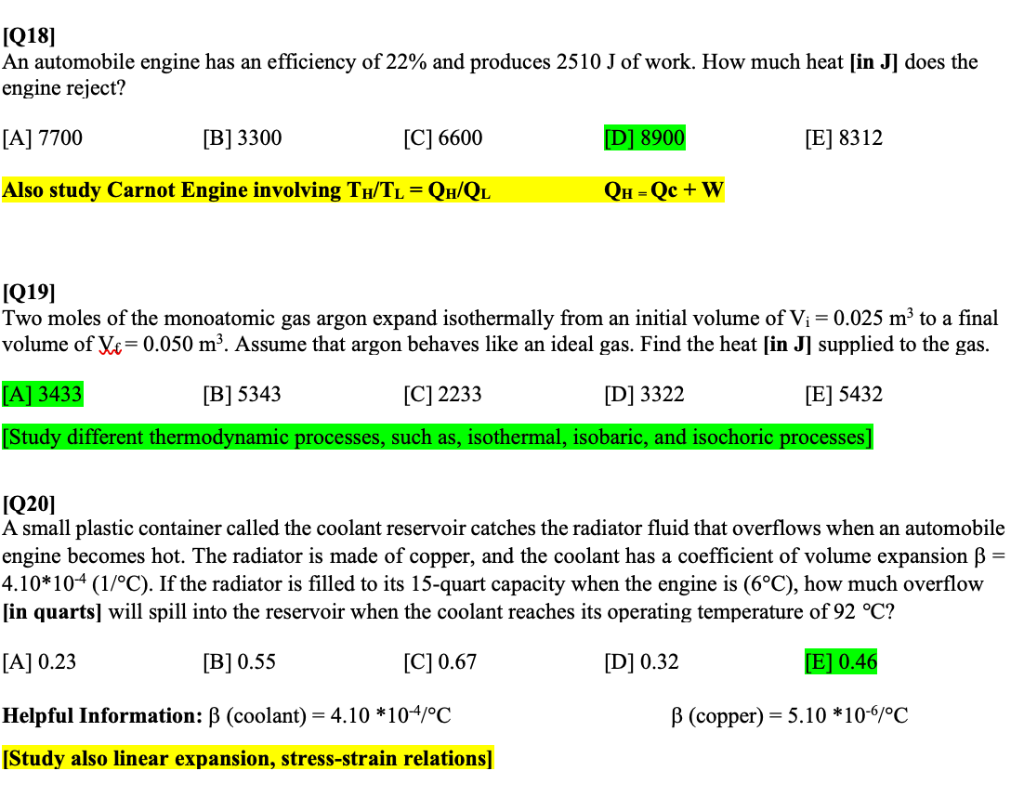
 Q18]
An automobile engine has an efficiency of 22% and produces 2510 J of work. How much heat [in J] does the
engine reject?
[A] 7700 [B]3300 [C] 6600 [D] 8900 [E] 8312
1Q19]
Two moles of the monoatomic gas argon expand isothermally from an initial volume of Vi = 0.025 m’ to a final
volume of Y¢= 0.050 m3. Assume that argon behaves like an ideal gas. Find the heat [in J] supplied to the gas.
[A] 3433 [B] 5343 [C]2233 [D] 3322 [E] 5432
[Study different thermodynamic processes, such as, isothermal, isobaric, and isochoric processes]
1Q20]
A small plastic container called the coolant reservoir catches the radiator fluid that overflows when an automobile
engine becomes hot. The radiator is made of copper, and the coolant has a coefficient of volume expansion p =
4.10*10 (1/°C). If the radiator is filled to its 15-quart capacity when the engine is (6°C), how much overflow
[in quarts] will spill into the reservoir when the coolant reaches its operating temperature of 92 °C?
[A]0.23 [B]0.55 [C]0.67 [D] 0.32 [E] 0.46
Helpful Information: B (coolant) = 4.10 *10*/°C B (copper) = 5.10 *10%/°C
[Study also linear expansion, stress-strain relations]
Q13]
A calorimeter cup is made from 0.25 kg of aluminum and contains 0.22 kg of water. Initially, the cup and water
have a common temperature of 18.5° C. A 0.044-kg mass of unknown material is heated to a temperature of 98.0°
C. The temperature of the cup, the water, and the unknown material is 23.0° C after thermal equilibrium is reached.
Find the unknown material's specific heat capacity [in J/kg°C].
Helpful Information: heat capacity of water = 4186 J/kg.°C__heat capacity of aluminum = 900 J/kg°C
[A] 1601 [B] 1805 [C1563 [D] 1122 [E] 2211
[Almost the same]
[Q14]
A party balloon contains 60000 cm? of helium. At 27 °C, its internal pressure is 1.10 atm. Find the number of
moles of helium in the balloon.
[A]2.67 [B]0.95 [c10.73 [D]3.0 [E]33
[Almost the same]
[Q15]
A gas container with perfect elastic walls contains molecules of oxygen and nitrogen (Oz and Ny). If the RMS
speed of the nitrogen gas molecules is 550 m/s, find the temperature [in K] of the gas molecules.
[A] 300 [B] 285 [C]385 [D] 336 [E] 410
[Almost the same]
[Q16]
At a party, 6.00 kg of ice at -5°C is added to a cooler holding 30 kg of water at 20.0°C. When it attains
equilibrium, what is the water’s temperature [in C]?
Helpful Information: gyue, = 4186 J/kg°C Ls= 333000 J/kg°C Gice,= 2090 J/kg°C
[| [B] 9.05 [C] 8.06 [D] 8.08 [E] 1.09
017]
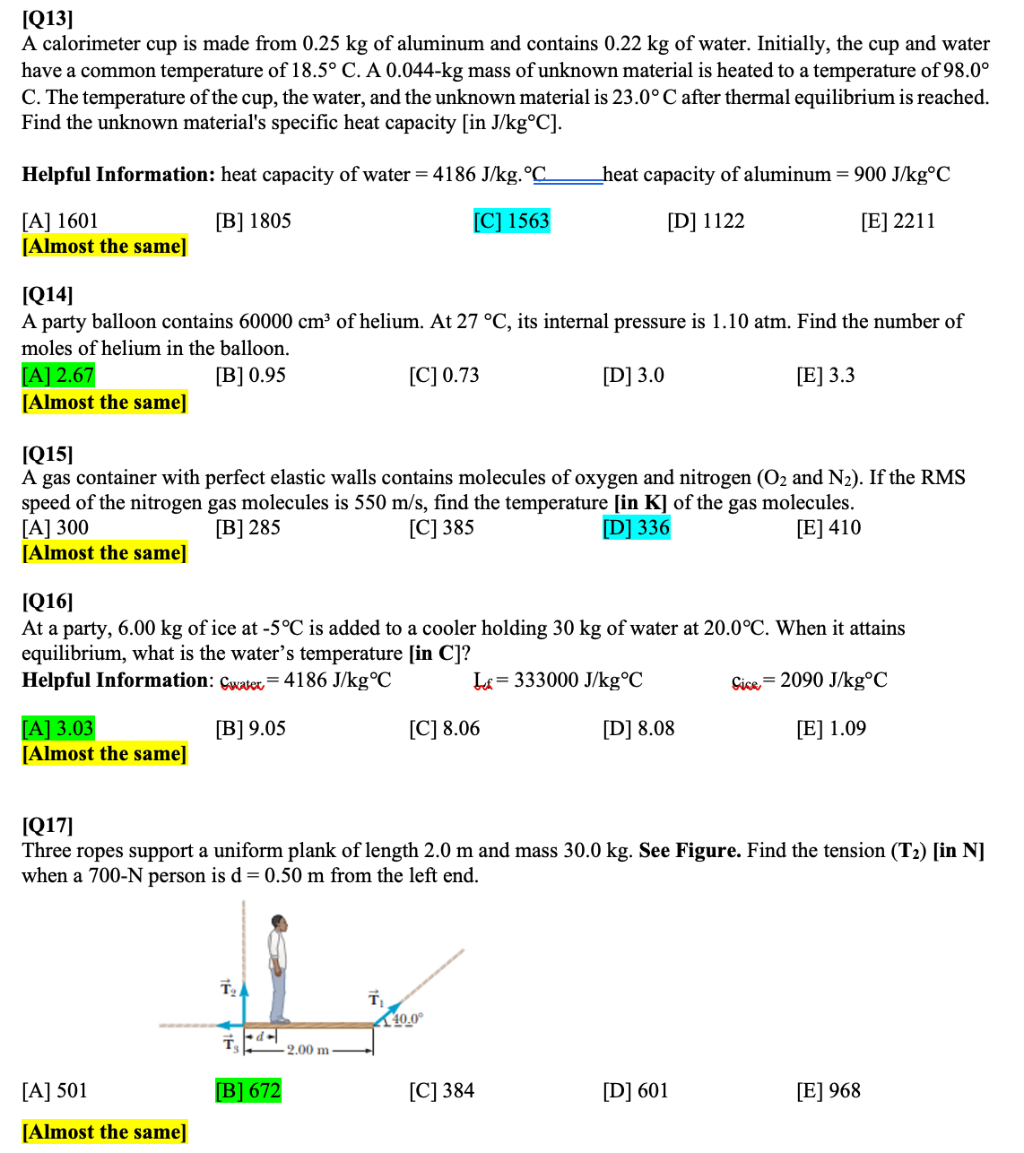
Three ropes support a uniform plank of length 2.0 m and mass 30.0 kg. See Figure. Find the tension (T2) [in N]
when a 700-N person is d = 0.50 m from the left end.
®
7, ) )
: T
too
TL 0pm]
[A] 501 [B]672 [C]384 [D] 601 [E] 968
[Almost the same]
Qn
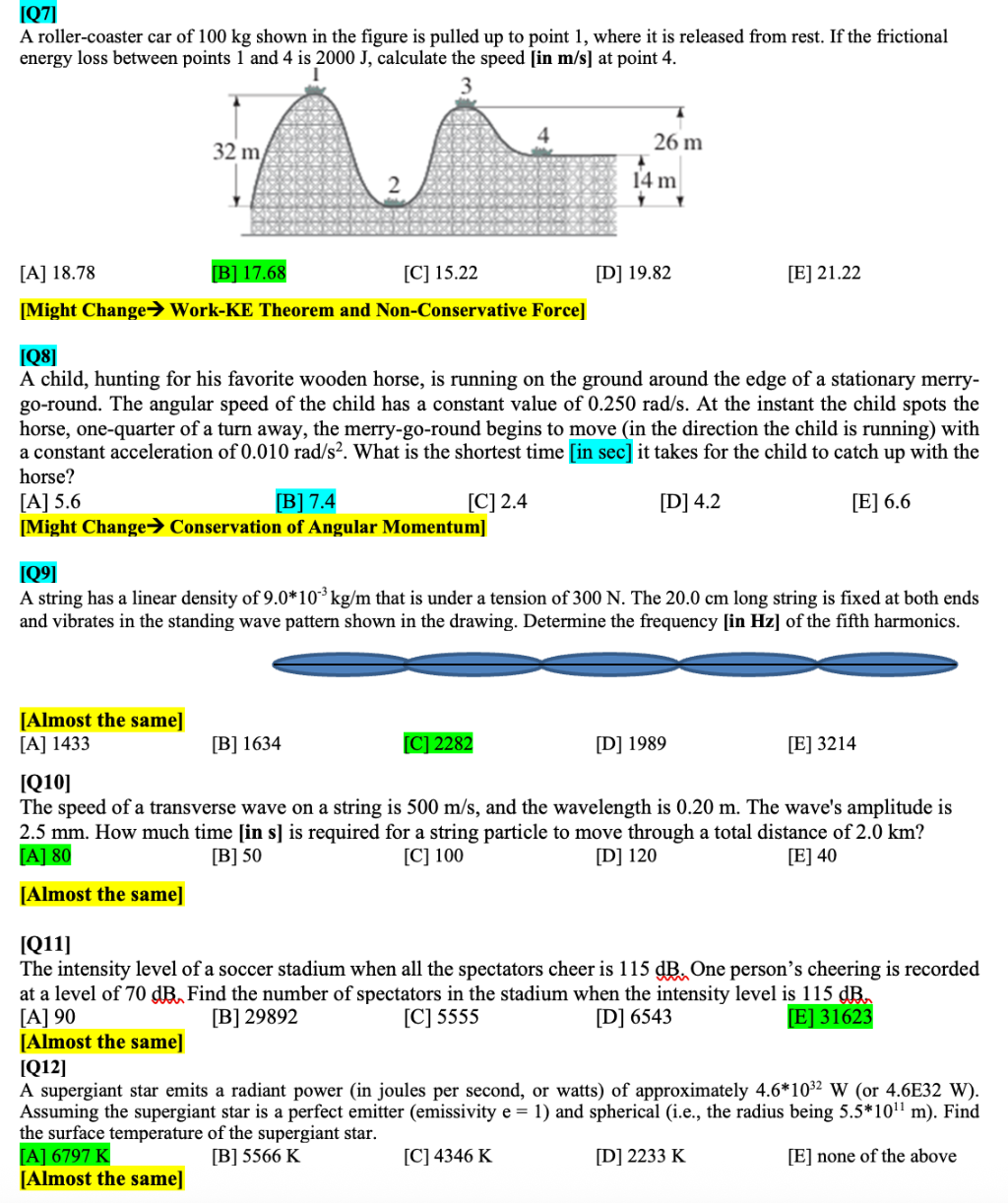
A roller-coaster car of 100 kg shown in the figure is pulled up to point 1, where it is released from rest. If the frictional
energy loss between points 1 and 4 is 2000 J, calculate the speed [in m/s] at point 4.
. 3
f ATR gD ¥
Pm 4 \ 26m
2 ! 14m
A BY 05 SDI 2 WOVE SN aT Zs ET I BR |
[A]18.78 [B]17.68 [C] 15.22 [D] 19.82 [E]21.22
[Might Change> Work-KE Theorem and Non-Conservative Force]
108]
A child, hunting for his favorite wooden horse, is running on the ground around the edge of a stationary merry-
go-round. The angular speed of the child has a constant value of 0.250 rad/s. At the instant the child spots the
horse, one-quarter of a turn away, the merry-go-round begins to move (in the direction the child is running) with
a constant acceleration of 0.010 rad/s. What is the shortest time it takes for the child to catch up with the
horse?
[A]5.6 [E174 [C124 [D]4.2 [E] 6.6
19]
A string has a linear density of 9.0*10 kg/m that is under a tension of 300 N. The 20.0 cm long string is fixed at both ends
and vibrates in the standing wave pattern shown in the drawing. Determine the frequency [in Hz] of the fifth harmonics.
[A] 1433 [B] 1634 [C] 2282 [D] 1989 [E] 3214
[Q10]
The speed of a transverse wave on a string is 500 m/s, and the wavelength is 0.20 m. The wave's amplitude is
2.5 mm. How much time [in s] is required for a string particle to move through a total distance of 2.0 km?
[A180 [B] 50 [C] 100 [D] 120 [E] 40
[Q11]
The intensity level of a soccer stadium when all the spectators cheer is 115 dB, One person’s cheering is recorded
at a level of 70 dB,.Find the number of spectators in the stadium when the intensity level is 115
[A]90 [B] 29892 [C] 5555 [D] 6543
[Q12]
A supergiant star emits a radiant power (in joules per second, or watts) of approximately 4.6*10*> W (or 4.6E32 W).
Assuming the supergiant star is a perfect emitter (emissivity e = 1) and spherical (i.e., the radius being 5.5*10'' m). Find
the surface temperature of the supergiant star.
ces; [B] 5566 K [C14346K [D]2233K [E] none of the above
Asked by: Mallikarjun
Created at: 2025-12-17 23:31:08
Final Answer:
📢 Instructions:
- Ask anything relatd to above question only.
- For new Question goto :