 VIPSolutions
Give step-by-step solution with explanation and final answer:Problem 2 A Form | cr making a tu of radius R, ae Soar 5 Re nee = fom te” god, whch 5 Fa HPI mm rt aa [7 . iin Broa | y Fonte pti Poe & is the car's speed, i is the ||) dn FA Fre PR —) Co A oe ew Ho Ie ne Row 1S mM = 798 kg, = 0.85,and g = 9.81 m/s" J ——— ttt eh fe 1 To or 5 ok pve mi van 8 two om ei ps bed sore?
Question:
Give step-by-step solution with explanation and final answer: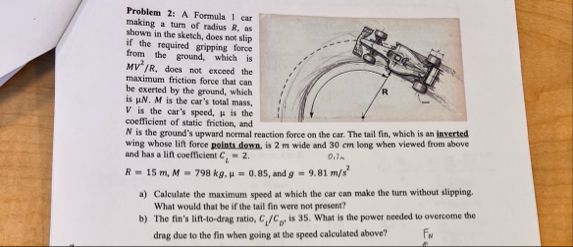 Problem 2 A Form | cr
making a tu of radius R, ae
Soar 5
Re nee =
fom te” god, whch 5 Fa
HPI mm rt aa [7 .
iin Broa | y
Fonte pti
Poe &
is the car's speed, i is the ||)
dn FA
Fre PR —)
Co A oe ew Ho
Ie ne
Row 1S mM = 798 kg, = 0.85,and g = 9.81 m/s"
J ———
ttt eh fe
1 To or 5 ok pve mi van 8
two om ei ps bed sore?
This is AI generated Response.
Asked by: vemuri swathi
Created at: 2025-12-16 23:34:27
Asked by: vemuri swathi
Created at: 2025-12-16 23:34:27
Final Answer:
Rendered
Raw Text
Did you like this answer?
Let's break down the problem step-by-step:
---
## **Given Data**
- **Radius of turn, \( R \) = 15 m**
- **Mass of car, \( M \) = 798 kg**
- **Coefficient of static friction, \( \mu = .85 \)**
- **Gravitational acceleration, \( g = 9.81 \, \text{m/s}^2 \)**
- **Tail fin lift coefficient, \( C_L = 2. \)**
- **Fin width = 2 m, Length = 30 cm = .3 m**
- **\( C_L/C_D = 35 \) (lift-to-drag ratio)**
---
## **(a) Maximum Speed Without Slipping**
#### **Step 1: Forces Involved**
- The car will slip if the frictional force is less than the required centripetal force.
- **Maximum static friction force:**
\[
f_{max} = \mu N
\]
where \( N \) is the normal force.
#### **Step 2: Normal Force Calculation**
- **Without tail fin:** \( N = Mg \)
- **With tail fin:** The tail fin provides additional downward force (lift), \( F_{\text{lift}} \), so
\[
N = Mg + F_{\text{lift}}
\]
#### **Step 3: Centripetal Force Requirement**
\[
\frac{Mv^2}{R} \leq f_{max}
\]
#### **Step 4: With Tail Fin (Lift Downward)**
\[
f_{max} = \mu (Mg + F_{\text{lift}})
\]
\[
\frac{Mv^2}{R} = \mu (Mg + F_{\text{lift}})
\]
\[
v_{max} = \sqrt{ \mu R \left( g + \frac{F_{\text{lift}}}{M} \right) }
\]
#### **Step 5: Calculate \( F_{\text{lift}} \)**
\[
F_{\text{lift}} = \frac{1}{2} \rho v^2 C_L A
\]
- Air density (\( \rho \)), assume \( = 1.225 \, \text{kg/m}^3 \) (standard).
- Area \( A = 2\,\text{m} \times .3\,\text{m} = .6\,\text{m}^2 \).
\[
F_{\text{lift}} = \frac{1}{2} \times 1.225 \times v^2 \times 2. \times .6 = .735 v^2
\]
#### **Step 6: Substitute \( F_{\text{lift}} \) into \( v_{max} \)**
\[
v_{max} = \sqrt{ \mu R \left( g + \frac{.735 v_{max}^2}{M} \right) }
\]
Let \( x = v_{max}^2 \):
\[
x = \mu R \left( g + \frac{.735 x}{M} \right )
\]
\[
x = \mu R g + \mu R \frac{.735 x}{M}
\]
\[
x - \mu R \frac{.735 x}{M} = \mu R g
\]
\[
x \left( 1 - \frac{ \mu R \times .735 }{ M } \right ) = \mu R g
\]
\[
x = \frac{ \mu R g }{ 1 - \frac{ \mu R \times .735 }{ M } }
\]
**Plug in values:**
- \( \mu = .85 \)
- \( R = 15 \)
- \( g = 9.81 \)
- \( M = 798 \)
Calculate denominator:
\[
\frac{\mu R \times .735}{M} = \frac{.85 \times 15 \times .735}{798} = \frac{9.3675}{798} \approx .01174
\]
So,
\[
x = \frac{.85 \times 15 \times 9.81}{1 - .01174}
\]
\[
.85 \times 15 = 12.75
\]
\[
12.75 \times 9.81 = 125.0075
\]
\[
x = \frac{125.0075}{.98826} \approx 126.56
\]
\[
v_{max} = \sqrt{126.56} \approx 11.26 \, \text{m/s}
\]
---
### **If the Tail Fin Were Not Present**
Then \( F_{\text{lift}} = \):
\[
v_{max} = \sqrt{ \mu g R } = \sqrt{ .85 \times 9.81 \times 15 }
\]
\[
.85 \times 9.81 = 8.3385
\]
\[
8.3385 \times 15 = 125.0775
\]
\[
v_{max} = \sqrt{125.08} \approx 11.19\, \text{m/s}
\]
---
#### **Summary (Part a):**
- **With tail fin:** \( v_{max} = 11.26\, \text{m/s} \)
- **Without tail fin:** \( v_{max} = 11.19\, \text{m/s} \)
---
## **(b) Power to Overcome Drag Due to the Fin**
- Lift-to-drag ratio: \( \frac{C_L}{C_D} = 35 \implies C_D = \frac{C_L}{35} = \frac{2}{35} \approx .057 \)
- Drag force:
\[
F_D = \frac{1}{2} \rho v^2 C_D A
\]
\[
= .5 \times 1.225 \times (11.26)^2 \times .057 \times .6
\]
First, \( (11.26)^2 = 126.77 \)
\[
F_D = .5 \times 1.225 \times 126.77 \times .057 \times .6
\]
\[
= .6125 \times 126.77 = 77.65
\]
\[
77.65 \times .057 = 4.426
\]
\[
4.426 \times .6 = 2.656 \, \text{N}
\]
- **Power required:**
\[
P = F_D \times v
\]
\[
= 2.656 \times 11.26 \approx 29.92\, \text{W}
\]
---
## **Final Answers**
### **(a) Maximum speed:**
- **With tail fin:** \( \boxed{11.26 \, \text{m/s}} \)
- **Without tail fin:** \( \boxed{11.19 \, \text{m/s}} \)
### **(b) Power to overcome drag due to the fin:**
- \( \boxed{29.9 \, \text{W}} \) (rounded to 1 decimal place)
📢 Instructions:
- Ask anything relatd to above question only.
- For new Question goto :