 VIPSolutions
Give step-by-step solution with explanation and final answer:I HII El ibe Bg fer by | i Lh ¥ I = J / . ESR TE Hits 2ssubantly Hl An ll dil Hl } A TN it i | I ry hi h i J i | | HK i i | : | | \ A | f/m | ile | il — i im I mo LHRH Ii Al A Ik i me I Hill Lh \ i | I | : i fa | i tl 1 (| I \ | \ | | on i i AH ili ii thi to ii | | fi at HLL WW vee i Ji i il [iT i - A 1 lL ae i | == Rise li [Sond fem aang il Bie
Question:
Give step-by-step solution with explanation and final answer: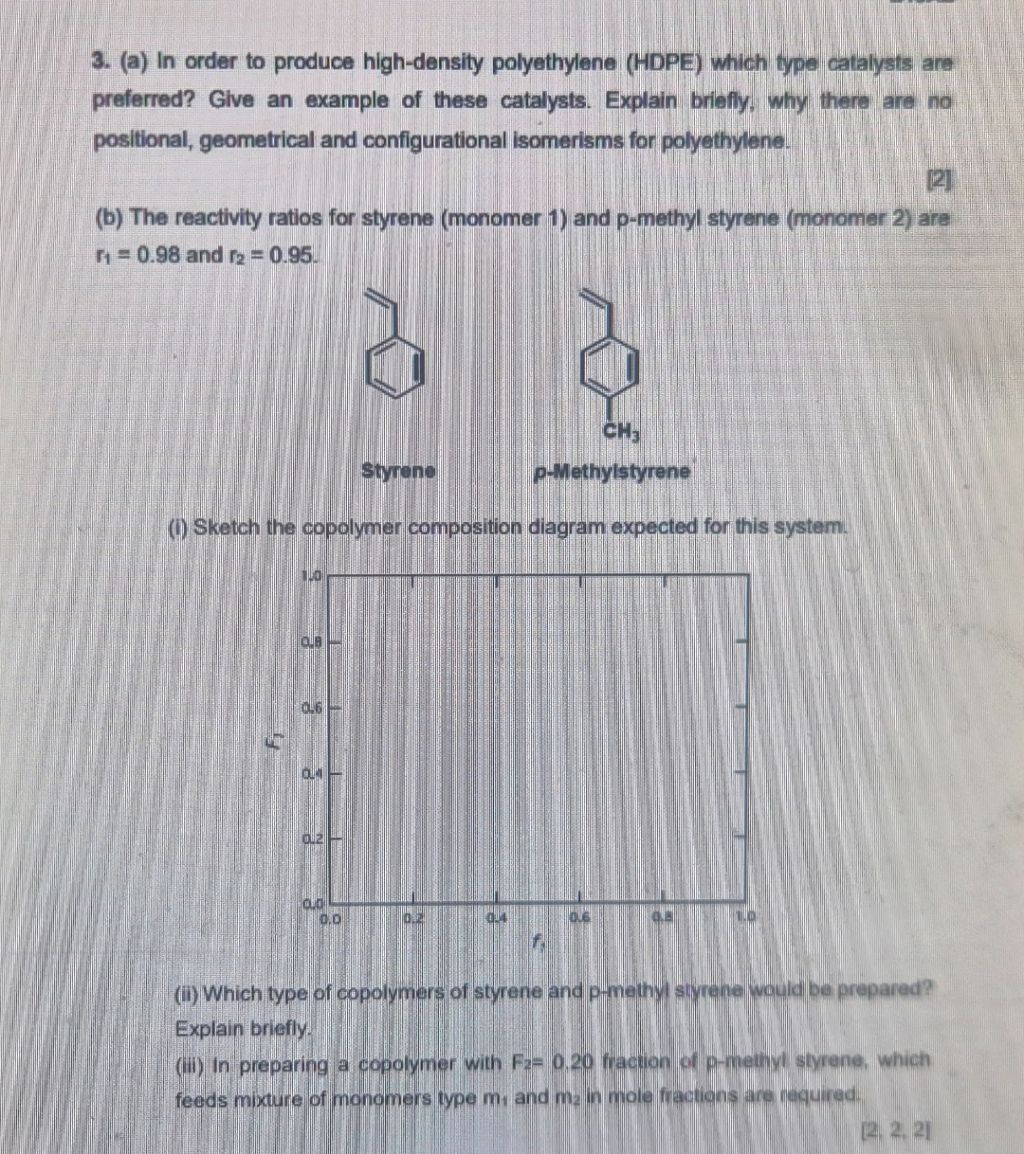 I HII
El ibe Bg fer by | i Lh ¥ I =
J / . ESR TE
Hits 2ssubantly Hl An ll dil Hl } A TN it
i | I ry hi h i J i | | HK i i | : | | \ A |
f/m | ile | il —
i im I mo LHRH Ii Al A Ik
i me I Hill Lh \
i | I | : i fa | i tl 1 (| I \ | \ |
| on i i AH
ili ii thi to
ii | | fi at HLL WW vee
i Ji i il [iT i - A 1
lL ae
i | == Rise
li [Sond fem aang
il Bie
This is AI generated Response.
Asked by: francis
Created at: 2025-12-16 03:53:09
Asked by: francis
Created at: 2025-12-16 03:53:09
Final Answer:
Rendered
Raw Text
Did you like this answer?
Let's break down and answer each part step by step:
---
## **3(a) HDPE Catalysts and Isomerism**
### **Preferred Catalysts for HDPE**
- **Type:** **Ziegler-Natta catalysts** or **metallocene catalysts** are preferred for producing high-density polyethylene (HDPE).
- **Example:** A common Ziegler-Natta catalyst is **TiCl₄ with Al(C₂H₅)₃ (triethylaluminum)**.
### **Why No Isomerism in Polyethylene?**
- **No positional, geometrical, or configurational isomerism** in polyethylene because:
- **Polyethylene structure:** –[CH₂–CH₂]ₙ–
- All carbons in the backbone are identical, each bonded only to hydrogens and other carbons in a linear chain.
- No double bonds (so no cis-trans/geometric isomerism).
- No side groups (so no positional or configurational isomerism).
---
## **3(b) Copolymerization of Styrene and p-Methylstyrene**
### **Given Data**
- **Monomer 1 (Styrene):** \( r_1 = .98 \)
- **Monomer 2 (p-Methylstyrene):** \( r_2 = .95 \)
---
### **(i) Sketch the Copolymer Composition Diagram**
**Reactivity Ratios:** Both \( r_1 \) and \( r_2 \) are close to 1, meaning both monomers have nearly equal tendencies to react with themselves and each other.
**Expected Copolymer Composition Plot:**
- Plot **F₁** (mole fraction of styrene in copolymer) vs. **f₁** (mole fraction of styrene in feed).
- For \( r_1 \approx r_2 \approx 1 \), the plot is **almost a straight line**, indicating near-ideal (random) copolymerization.
**Sketch:**
```plaintext
| \
| \
| \
| \
|_______\
1
```
- **x-axis:** \( f_1 \) (mole fraction of styrene in feed)
- **y-axis:** \( F_1 \) (mole fraction of styrene in copolymer)
- The line is slightly curved but almost diagonal, indicating random incorporation.
---
### **(ii) Type of Copolymers Expected**
- Since \( r_1 \) and \( r_2 \) are both close to 1, **random (statistical) copolymers** are expected.
- **Explanation:** Both monomers react with themselves and each other with nearly equal probability, so the resulting copolymer has a random sequence of styrene and p-methylstyrene units.
---
### **(iii) Feed Composition Calculation**
Given:
- \( F_2 = .20 \) (fraction of p-methylstyrene in copolymer)
- Find **feed composition**: \( f_1 \) and \( f_2 \) (mole fractions of styrene and p-methylstyrene in feed)
#### **Using the Copolymer Composition Equation:**
\[
F_2 = \frac{r_2 f_2^2 + f_1 f_2}{r_1 f_1^2 + 2 f_1 f_2 + r_2 f_2^2}
\]
But it's easier to use the **simplified Mayo–Lewis equation** for two monomers:
\[
\frac{F_2}{F_1} = \frac{f_2}{f_1} \cdot \frac{r_2 f_2 + f_1}{r_1 f_1 + f_2}
\]
Given \( F_2 = .20 \), so \( F_1 = .80 \):
\[
\frac{.20}{.80} = \frac{f_2}{f_1} \cdot \frac{.95 f_2 + f_1}{.98 f_1 + f_2}
\]
\[
.25 = \frac{f_2}{f_1} \cdot \frac{.95 f_2 + f_1}{.98 f_1 + f_2}
\]
Let \( f_2 = x \), \( f_1 = 1 - x \):
\[
.25 = \frac{x}{1 - x} \cdot \frac{.95x + (1-x)}{.98(1-x) + x}
\]
\[
.25 = \frac{x}{1-x} \cdot \frac{.95x + 1 - x}{.98 - .98x + x}
\]
\[
.25 = \frac{x}{1-x} \cdot \frac{1 - .05x}{.98 + .02x}
\]
Now solve for \( x \):
Let’s denote \( x = f_2 \):
\[
.25 = \frac{x(1 - .05x)}{(1-x)(.98 + .02x)}
\]
Cross-multiply:
\[
.25 (1-x)(.98 + .02x) = x(1 - .05x)
\]
Expand:
\[
.25(.98 - .98x + .02x - .02x^2) = x - .05x^2
\]
\[
.245 - .245x + .005x - .005x^2 = x - .05x^2
\]
\[
.245 - .24x - .005x^2 = x - .05x^2
\]
Bring all terms to one side:
\[
.245 - .24x - .005x^2 - x + .05x^2 =
\]
\[
.245 - 1.24x + .045x^2 =
\]
Now solve the quadratic:
\[
.045x^2 - 1.24x + .245 =
\]
Use quadratic formula:
\[
x = \frac{1.24 \pm \sqrt{(-1.24)^2 - 4 \cdot .045 \cdot .245}}{2 \cdot .045}
\]
\[
x = \frac{1.24 \pm \sqrt{1.5376 - .0441}}{.09}
\]
\[
x = \frac{1.24 \pm \sqrt{1.4935}}{.09}
\]
\[
\sqrt{1.4935} \approx 1.222
\]
\[
x_1 = \frac{1.24 + 1.222}{.09} = \frac{2.462}{.09} \approx 27.36
\]
\[
x_2 = \frac{1.24 - 1.222}{.09} = \frac{.018}{.09} \approx .20
\]
Only \( x_2 = .20 \) is a valid mole fraction.
So,
- \( f_2 = .20 \)
- \( f_1 = .80 \)
---
### **Final Answers**
#### **3(a)**
- **Catalysts for HDPE:** Ziegler-Natta or metallocene (e.g., TiCl₄/Al(C₂H₅)₃)
- **No isomerism:** All backbone carbons and hydrogens are identical; no double bonds or side groups.
#### **3(b)**
- **(i) Copolymer composition diagram:** Nearly straight line (random copolymerization).
- **(ii) Type:** Random (statistical) copolymer.
- **(iii) Feed required for \( F_2 = .20 \):**
- \( f_2 = .20 \) (p-methylstyrene)
- \( f_1 = .80 \) (styrene)
---
Let me know if you need the plot explicitly drawn!
📢 Instructions:
- Ask anything relatd to above question only.
- For new Question goto :