 VIPSolutions
Give step-by-step solution with explanation and final answer:3) A batch experiment yields the following data for Cd** adsorption onto B. subtilis: « [Cd**]in solution (mg/L): 1,2, 5,10 « Amount Cd adsorbed per g biomass (mg/g): 0.8, 1.5, 3.0, 4.2 Use the linear form of the Langmuir isotherm to determine K(sorption constant) and Amax(maximum sorption capacity). (/5)
Question:
Give step-by-step solution with explanation and final answer: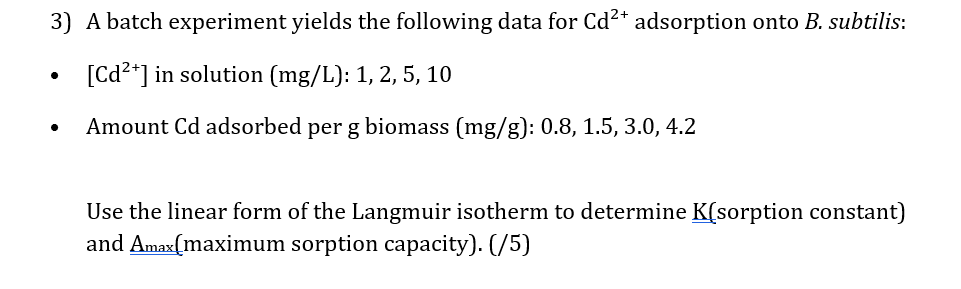 3) A batch experiment yields the following data for Cd** adsorption onto B. subtilis:
« [Cd**]in solution (mg/L): 1,2, 5,10
« Amount Cd adsorbed per g biomass (mg/g): 0.8, 1.5, 3.0, 4.2
Use the linear form of the Langmuir isotherm to determine K(sorption constant)
and Amax(maximum sorption capacity). (/5)
This is AI generated Response.
Asked by: francis
Created at: 2025-12-16 03:44:01
Asked by: francis
Created at: 2025-12-16 03:44:01
Final Answer:
Rendered
Raw Text
Did you like this answer?
Let's solve the question step-by-step using the **Langmuir isotherm** in its **linear form**.
---
## **Step 1: Langmuir Isotherm Linear Form**
The Langmuir isotherm equation is:
\[
q_e = \frac{A_{max} K C_e}{1 + K C_e}
\]
Linear form:
\[
\frac{C_e}{q_e} = \frac{1}{A_{max}K} + \frac{C_e}{A_{max}}
\]
where:
- \( C_e \): equilibrium concentration of adsorbate (mg/L)
- \( q_e \): amount adsorbed per g biomass (mg/g)
- \( K \): Langmuir constant (L/mg)
- \( A_{max} \): maximum adsorption capacity (mg/g)
---
## **Step 2: Organize Data**
| \( C_e \) (mg/L) | \( q_e \) (mg/g) | \( \frac{C_e}{q_e} \) (L/g) |
|------------------|------------------|-----------------------------|
| 1 | .8 | 1/.8 = 1.25 |
| 2 | 1.5 | 2/1.5 = 1.33 |
| 5 | 3. | 5/3. = 1.67 |
| 10 | 4.2 | 10/4.2 ≈ 2.38 |
---
## **Step 3: Plot \( \frac{C_e}{q_e} \) vs \( C_e \) and Linear Regression**
The equation \( \frac{C_e}{q_e} = \frac{1}{A_{max}K} + \frac{C_e}{A_{max}} \) is in the form \( y = mx + b \), where:
- \( y = \frac{C_e}{q_e} \)
- \( x = C_e \)
- Slope \( m = \frac{1}{A_{max}} \)
- Intercept \( b = \frac{1}{A_{max}K} \)
Let's perform linear regression on the data points:
| \( x \) | \( y \) |
|---------|----------|
| 1 | 1.25 |
| 2 | 1.33 |
| 5 | 1.67 |
| 10 | 2.38 |
Find the slope (\( m \)) and intercept (\( b \)) using the least squares method:
#### Calculate Averages
\[
\bar{x} = \frac{1+2+5+10}{4} = 4.5
\]
\[
\bar{y} = \frac{1.25+1.33+1.67+2.38}{4} = 1.6575
\]
#### Calculate Slope \( m \):
\[
m = \frac{\sum (x_i - \bar{x})(y_i - \bar{y})}{\sum (x_i - \bar{x})^2}
\]
\[
= \frac{(1-4.5)(1.25-1.6575) + (2-4.5)(1.33-1.6575) + (5-4.5)(1.67-1.6575) + (10-4.5)(2.38-1.6575)}
{(1-4.5)^2 + (2-4.5)^2 + (5-4.5)^2 + (10-4.5)^2}
\]
Calculate:
- \((1-4.5) = -3.5, (1.25-1.6575) = -.4075, \rightarrow (-3.5)*(-.4075) = 1.426\)
- \((2-4.5) = -2.5, (1.33-1.6575) = -.3275, \rightarrow (-2.5)*(-.3275) = .819\)
- \((5-4.5) = .5, (1.67-1.6575) = .0125, \rightarrow .5*.0125 = .00625\)
- \((10-4.5) = 5.5, (2.38-1.6575) = .7225, \rightarrow 5.5*.7225 = 3.974\)
Sum numerator: \(1.426 + .819 + .00625 + 3.974 = 6.225\)
- \((1-4.5)^2 = 12.25\)
- \((2-4.5)^2 = 6.25\)
- \((5-4.5)^2 = .25\)
- \((10-4.5)^2 = 30.25\)
Sum denominator: \(12.25 + 6.25 + .25 + 30.25 = 49\)
So,
\[
m = \frac{6.225}{49} = .127
\]
#### Intercept \( b \):
\[
b = \bar{y} - m \bar{x} = 1.6575 - (.127 \times 4.5) = 1.6575 - .5715 = 1.086
\]
---
## **Step 4: Solve for \( A_{max} \) and \( K \)**
\[
m = \frac{1}{A_{max}} \implies A_{max} = \frac{1}{m} = \frac{1}{.127} \approx 7.87 \text{ mg/g}
\]
\[
b = \frac{1}{A_{max} K} \implies K = \frac{1}{A_{max} b} = \frac{1}{7.87 \times 1.086} \approx \frac{1}{8.545} \approx .117 \text{ L/mg}
\]
---
## **Step 5: Final Answers**
### **Summary Table**
| Parameter | Value |
|-------------------|-----------------|
| \( K \) | .12 L/mg |
| \( A_{max} \) | 7.9 mg/g |
---
### **Final Answers (rounded to 2 significant figures):**
\[
\boxed{
K = .12\ \text{L/mg}
}
\]
\[
\boxed{
A_{max} = 7.9\ \text{mg/g}
}
\]
---
### **Explanation**
- Plotted \( \frac{C_e}{q_e} \) vs. \( C_e \), used the linear form of Langmuir.
- Used linear regression to find slope and intercept.
- Calculated \( K \) and \( A_{max} \) from slope and intercept.
If you need the plot, let me know!
📢 Instructions:
- Ask anything relatd to above question only.
- For new Question goto :