 VIPSolutions
Give step-by-step solution with explanation and final answer:fae =~» Zo HE El FE 7 9 Baas B20 EEE E 3 3 ay 51 ie 2 us i v é E § | : : f i f 2 i g i 2
Question:
Give step-by-step solution with explanation and final answer: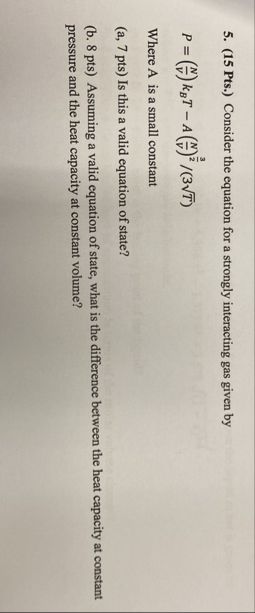 fae =~»
Zo HE
El FE 7 9
Baas B20
EEE E 3 3
ay 51
ie 2
us i
v é
E §
| :
:
f i
f 2
i
g
i
2
This is AI generated Response.
Asked by: Mallikarjun
Created at: 2025-12-16 03:33:00
Asked by: Mallikarjun
Created at: 2025-12-16 03:33:00
Final Answer:
Rendered
Raw Text
Did you like this answer?
Let's break down and solve the given problem step by step.
---
## **Given Equation**
\[
P = \left(\frac{N}{V}\right) k_B T - A \left(\frac{N}{V}\right)^{7/3} (k_B T)^{1/2}
\]
Where:
- \(P\) = pressure
- \(N\) = number of particles
- \(V\) = volume
- \(k_B\) = Boltzmann constant
- \(T\) = temperature
- \(A\) = a small constant
---
## **(a) Is this a valid equation of state?**
**Equation of state:** A relation connecting state variables like \(P\), \(V\), \(T\), and \(N\).
### **Step 1: Form Check**
- The equation relates \(P\), \(N\), \(V\), and \(T\).
- The first term, \(\frac{N}{V} k_B T\), is the ideal gas law.
- The second term introduces an interaction correction.
### **Step 2: Units Check**
- \(\frac{N}{V}\) has units of \(\text{m}^{-3}\) (number density).
- \(k_B T\) has units of energy (\(\text{J}\)).
- \(P\) has units of \(\text{N/m}^2 = \text{J/m}^3\).
#### **First term:**
\[
\left(\frac{N}{V}\right) k_B T \Rightarrow \text{m}^{-3} \times \text{J} = \text{J/m}^3
\]
Correct units for pressure.
#### **Second term:**
\[
A \left(\frac{N}{V}\right)^{7/3} (k_B T)^{1/2}
\]
Let’s check units:
- \(\left(\frac{N}{V}\right)^{7/3}\): \(\text{m}^{-7}\)
- \((k_B T)^{1/2}\): \(\text{J}^{1/2}\)
- \(A\) must have units to make the total units \(\text{J/m}^3\).
So, as long as \(A\) has appropriate units, the equation is dimensionally consistent.
### **Step 3: Physical Meaning**
- The first term is the ideal gas contribution.
- The second (negative) term is a correction, possibly from interactions.
- For high \(T\) or low \(N/V\), the second term becomes negligible, reducing to the ideal gas law.
### **Conclusion**
**Yes, this is a valid equation of state** for a gas with strong interactions, as it generalizes the ideal gas law with a correction term.
---
## **(b) Difference between \(C_P\) and \(C_V\) (using this equation of state):**
### **Step 1: Definitions**
- \(C_V = \left(\frac{\partial Q}{\partial T}\right)_V = \left(\frac{\partial U}{\partial T}\right)_V\)
- \(C_P = \left(\frac{\partial Q}{\partial T}\right)_P\)
For any equation of state:
\[
C_P - C_V = T \left(\frac{\partial P}{\partial T}\right)_V \left(\frac{\partial V}{\partial T}\right)_P
\]
For 1 mole (\(N\) fixed):
\[
C_P - C_V = T \left(\frac{\partial P}{\partial T}\right)_V \left(\frac{\partial V}{\partial T}\right)_P
\]
### **Step 2: Calculate \(\left(\frac{\partial P}{\partial T}\right)_V\)**
Given:
\[
P = n k_B T - A n^{7/3} (k_B T)^{1/2}
\]
Where \(n = \frac{N}{V}\) is constant at constant \(V\).
\[
\left(\frac{\partial P}{\partial T}\right)_V = n k_B - A n^{7/3} \frac{1}{2} (k_B T)^{-1/2} k_B
\]
\[
= n k_B - \frac{A}{2} n^{7/3} k_B (k_B T)^{-1/2}
\]
### **Step 3: Calculate \(\left(\frac{\partial V}{\partial T}\right)_P\)**
At constant \(P\), implicitly differentiate the equation:
\[
P = \frac{N}{V} k_B T - A \left(\frac{N}{V}\right)^{7/3} (k_B T)^{1/2}
\]
Let’s call \(x = \frac{N}{V}\):
\[
P = x k_B T - A x^{7/3} (k_B T)^{1/2}
\]
Solve for \(V\) in terms of \(T\) at constant \(P\):
- This is complex, but for small \(A\), treat second term as perturbation.
For ideal gas (\(A=\)),
\[
x = \frac{P}{k_B T} \rightarrow V = \frac{N k_B T}{P} \implies \left(\frac{\partial V}{\partial T}\right)_P = \frac{N k_B}{P}
\]
With small \(A\), the correction to \(\left(\frac{\partial V}{\partial T}\right)_P\) is small.
### **Step 4: Final Expression for Ideal Gas**
For ideal gas (\(A = \)):
\[
C_P - C_V = N k_B
\]
For this equation (to leading order in \(A\)), the difference is:
\[
C_P - C_V = T \left[ n k_B - \frac{A}{2} n^{7/3} k_B (k_B T)^{-1/2} \right] \left( \frac{N k_B}{P} \right)
\]
Where \(P\) is given by the equation of state.
---
## **Summary / Final Answers**
### **(a)**
**Yes, this is a valid equation of state.**
It generalizes the ideal gas law by including a correction term for interactions, and is dimensionally consistent.
### **(b)**
The difference between the heat capacity at constant pressure and at constant volume is:
\[
C_P - C_V = T \left(\frac{\partial P}{\partial T}\right)_V \left(\frac{\partial V}{\partial T}\right)_P
\]
For this specific equation of state:
\[
C_P - C_V = T \left[ n k_B - \frac{A}{2} n^{7/3} k_B (k_B T)^{-1/2} \right] \left( \frac{N k_B}{P} \right)
\]
where \(n = \frac{N}{V}\), and \(P\) is given by the equation of state.
---
**Let me know if you need more detailed algebra for part (b)!**
📢 Instructions:
- Ask anything relatd to above question only.
- For new Question goto :