 VIPSolutions
Give step-by-step solution with explanation and final answer:wm oo EE > est a Gail 1 2 max LE Exz é Fe ELT Ease & £5 5 2 EE 8 g gz g 8 £ g g g R 2 € a 2 g & g 2 g g [1 ) F] §
Question:
Give step-by-step solution with explanation and final answer: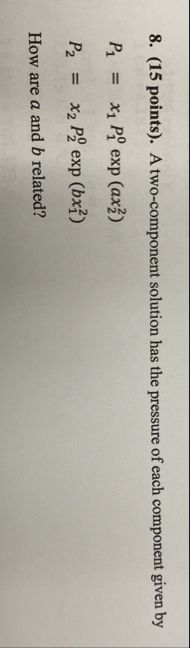 wm oo
EE >
est a
Gail 1
2
max LE
Exz é
Fe
ELT
Ease &
£5 5 2
EE
8
g
gz
g
8
£
g
g
g
R
2
€
a
2
g
&
g
2
g
g
[1
)
F]
§
This is AI generated Response.
Asked by: Mallikarjun
Created at: 2025-12-16 03:11:29
Asked by: Mallikarjun
Created at: 2025-12-16 03:11:29
Final Answer:
Rendered
Raw Text
Did you like this answer?
Let's analyze and solve the problem step by step:
---
## **Given:**
A two-component solution, with pressures of each component:
\[
P_1 = x_1 P_1^ \exp(ax_2^2)
\]
\[
P_2 = x_2 P_2^ \exp(bx_1^2)
\]
Where:
- \( x_1 \) and \( x_2 \) are the mole fractions (\( x_1 + x_2 = 1 \))
- \( P_1^ \), \( P_2^ \) are vapor pressures of pure components
- \( a \) and \( b \) are constants
**Question:**
How are \( a \) and \( b \) related?
---
## **Step 1: Gibbs-Duhem Equation**
For a binary solution at constant T and P, the Gibbs-Duhem equation is:
\[
x_1 d\ln P_1 + x_2 d\ln P_2 =
\]
---
## **Step 2: Calculate \( d\ln P_1 \) and \( d\ln P_2 \) **
### For \( P_1 \):
\[
\ln P_1 = \ln x_1 + \ln P_1^ + a x_2^2
\]
\[
d\ln P_1 = \frac{dx_1}{x_1} + 2a x_2 dx_2
\]
But since \( x_1 + x_2 = 1 \), \( dx_2 = -dx_1 \):
\[
d\ln P_1 = \frac{dx_1}{x_1} + 2a x_2 (-dx_1)
= \frac{dx_1}{x_1} - 2a x_2 dx_1
\]
### For \( P_2 \):
\[
\ln P_2 = \ln x_2 + \ln P_2^ + b x_1^2
\]
\[
d\ln P_2 = \frac{dx_2}{x_2} + 2b x_1 dx_1
\]
\[
= \frac{-dx_1}{x_2} + 2b x_1 dx_1
\]
---
## **Step 3: Substitute into Gibbs-Duhem Equation**
\[
x_1 d\ln P_1 + x_2 d\ln P_2 =
\]
Substitute the results:
\[
x_1\left(\frac{dx_1}{x_1} - 2a x_2 dx_1\right) + x_2\left( \frac{-dx_1}{x_2} + 2b x_1 dx_1 \right) =
\]
\[
(dx_1 - 2a x_1 x_2 dx_1) + (-dx_1 + 2b x_1 x_2 dx_1) =
\]
\[
dx_1 - 2a x_1 x_2 dx_1 - dx_1 + 2b x_1 x_2 dx_1 =
\]
\[
(-2a x_1 x_2 + 2b x_1 x_2) dx_1 =
\]
\[
2(b - a)x_1 x_2 dx_1 =
\]
---
## **Step 4: Solution**
For all \( x_1 \), \( x_2 \):
\[
b - a = \implies a = b
\]
---
## **Final Answer**
\[
\boxed{a = b}
\]
**The parameters \( a \) and \( b \) must be equal for the solution to be thermodynamically consistent.**
📢 Instructions:
- Ask anything relatd to above question only.
- For new Question goto :