 VIPSolutions
Give step-by-step solution with explanation and final answer:A generator of S,=25MVA, V,=7kV, x4=0.6 pu, x4=0.7 pu, serves a load of S=15MVA, 0.8 lagging supplied with voltage of V|=20kV through a transformer of Sp=35MVA, V,,1/V12=7kV/22kV, V,=10% and negligible copper losses, and a line of 3km length, connected to the side of 22kV of the transformer and impedance of Z|,= 2.5+j12 Q/km. Calculate the following: a. Internal synchronous generator voltage b. Loading angle of the synchronous generator
Question:
Give step-by-step solution with explanation and final answer: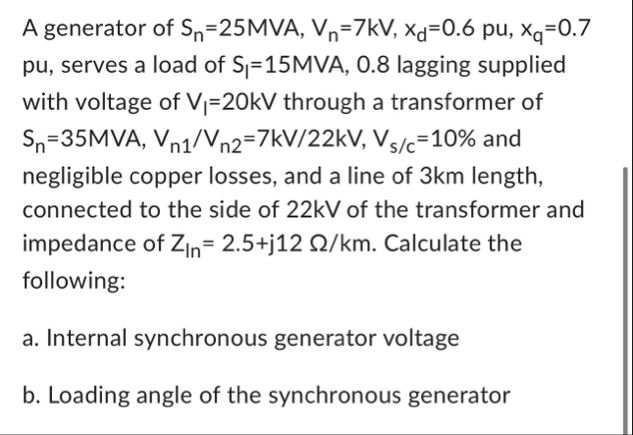 A generator of S,=25MVA, V,=7kV, x4=0.6 pu, x4=0.7
pu, serves a load of S=15MVA, 0.8 lagging supplied
with voltage of V|=20kV through a transformer of
Sp=35MVA, V,,1/V12=7kV/22kV, V,=10% and
negligible copper losses, and a line of 3km length,
connected to the side of 22kV of the transformer and
impedance of Z|,= 2.5+j12 Q/km. Calculate the
following:
a. Internal synchronous generator voltage
b. Loading angle of the synchronous generator
This is AI generated Response.
Asked by: Aman
Created at: 2025-12-15 13:20:51
Asked by: Aman
Created at: 2025-12-15 13:20:51
Final Answer:
Rendered
Raw Text
Did you like this answer?
Let's break down the problem step by step.
---
## **Given Data**
- **Generator:**
\( S_n = 25\,\text{MVA} \), \( V_n = 7\,\text{kV} \), \( x_d = .6\,pu \), \( x_q = .7\,pu \)
- **Load:**
\( S_L = 15\,\text{MVA}, \, pf = .8 \) lagging
Supplied at \( V_L = 20\,\text{kV} \)
- **Transformer:**
\( S_n = 35\,\text{MVA} \), \( V_{n1}/V_{n2} = 7\,\text{kV}/22\,\text{kV} \), \( V_{s/c} = 10\% \) (short-circuit voltage)
Negligible copper losses
- **Transmission Line:**
Length = 3 km, \( Z_{ln} = (2.5 + j12)\,\Omega/\text{km} \)
Connected to 22kV side
---
## **Step 1: Find Load Current**
### **Load Apparent Power**
\[
S_L = 15\,\text{MVA}
\]
\[
\text{Power factor (lagging)} = .8
\]
\[
P = S_L \times pf = 15 \times .8 = 12\,\text{MW}
\]
\[
Q = S_L \times \sin(\cos^{-1}(.8)) = 15 \times .6 = 9\,\text{MVAr}
\]
### **Line-to-Line Voltage at Load**
\[
V_L = 20\,\text{kV}
\]
### **Load Current**
\[
I_L = \frac{S_L}{\sqrt{3} V_L} = \frac{15 \times 10^6}{\sqrt{3} \times 20 \times 10^3}
= \frac{15 \times 10^6}{34,641.016}
\approx 432.8\,\text{A}
\]
---
## **Step 2: Calculate Total Impedance (Transformer + Line)**
### **Transformer:**
\[
\text{Short-circuit voltage} = 10\% \rightarrow Z_{tr} (\text{base 22kV}) = .1 \times \frac{(22,000)^2}{35 \times 10^6}
\]
\[
= .1 \times \frac{484,000,000}{35,000,000}
= .1 \times 13.8286 = 1.38286\,\Omega
\]
### **Line Impedance (3 km):**
\[
Z_{line} = 3 \times (2.5 + j12) = (7.5 + j36)\,\Omega
\]
### **Total Impedance (on 22 kV side):**
\[
Z_{tot,22} = Z_{tr} + Z_{line} = 1.38286 + (7.5 + j36) = (8.88286 + j36)\,\Omega
\]
---
## **Step 3: Refer Everything to Generator Side (7kV Side)**
### **Impedance Transformation Ratio:**
\[
a = \frac{22}{7} = 3.142857
\]
\[
Z_{tot,7} = \frac{Z_{tot,22}}{a^2} = \frac{(8.88286 + j36)}{9.8776} \approx (.899 + j3.645)\,\Omega
\]
---
## **Step 4: Find the Generator Terminal Voltage**
- The voltage at the generator terminal is at 7kV side.
### **Refer Load to Generator Side**
\[
V_{gen,LL} = V_{load,LL} \div a = 20\,\text{kV} \div 3.142857 = 6.367\,\text{kV}
\]
---
## **Step 5: Find Generator Current**
Since load is 15 MVA at 20kV, and current is the same on both sides (for a transformer), so:
\[
I_{gen} = I_L = 432.8\,\text{A}
\]
---
## **Step 6: Find Generator Internal Voltage**
### **Per-Phase Analysis**
- Per-phase voltage at generator terminals:
\( V_{t,ph} = \frac{V_{gen,LL}}{\sqrt{3}} = \frac{6367}{\sqrt{3}} = 3675\,\text{V} \)
- Per-phase current:
\( I_{ph} = \frac{I_{gen}}{1} = 432.8\,\text{A} \) (since it's a Y-connection)
#### **Generator Reactance (on own base):**
\[
x_{d,actual} = x_d \times \frac{V_{n}^2}{S_n} = .6 \times \frac{(7,000)^2}{25 \times 10^6} = .6 \times 1.96 = 1.176\,\Omega
\]
#### **Total Reactance (Add to Step 3 Impedance):**
\[
Z_{total,ph} = Z_{tot,7} + j x_{d,actual} = (.899 + j3.645) + j1.176 = .899 + j4.821\,\Omega
\]
#### **Generator Internal Voltage:**
\[
E = V_{t,ph} + I_{ph} Z_{total,ph}
\]
\[
I_{ph} = 432.8\,\angle -36.87^\circ \,\text{A}
\]
(Power factor angle \( \cos^{-1}(.8) = 36.87^\circ \), lagging, so current lags voltage)
Now,
\[
I_{ph} Z_{total,ph} = 432.8 \angle -36.87^\circ \times (.899 + j4.821)
\]
First, calculate impedance magnitude and angle:
\[
|Z_{total,ph}| = \sqrt{.899^2 + 4.821^2} = \sqrt{.808 + 23.26} = \sqrt{24.068} = 4.906\,\Omega
\]
\[
\theta_{Z} = \arctan\left(\frac{4.821}{.899}\right) = \arctan(5.364) = 79.42^\circ
\]
So,
\[
I_{ph} Z_{total,ph} = 432.8 \times 4.906 \angle (79.42^\circ - 36.87^\circ)
= 2124.9 \angle 42.55^\circ\,\text{V}
\]
- Resolve to rectangular:
- \( 2124.9 \cos(42.55^\circ) = 1564.6\,\text{V} \)
- \( 2124.9 \sin(42.55^\circ) = 1437.9\,\text{V} \)
So,
\[
I_{ph} Z_{total,ph} = 1564.6 + j1437.9\,\text{V}
\]
Add to \( V_{t,ph} \) (which is reference, so \( 3675 + j \)):
\[
E = (3675 + 1564.6) + j1437.9 = 5239.6 + j1437.9\,\text{V}
\]
\[
|E| = \sqrt{5239.6^2 + 1437.9^2}
= \sqrt{27,457,025 + 2,068,570}
= \sqrt{29,525,595}
\approx 5434.6\,\text{V}
\]
---
## **Step 7: Calculate the Loading Angle (\( \delta \))**
\[
\delta = \arctan\left(\frac{1437.9}{5239.6}\right) = \arctan(.2745) = 15.4^\circ
\]
---
## **Final Answers**
### **a. Internal Synchronous Generator Voltage**
\[
\boxed{5435\,\text{V (per phase, rms)}}
\]
### **b. Loading Angle of the Synchronous Generator**
\[
\boxed{15.4^\circ}
\]
---
### **Summary Table**
| Quantity | Value |
|------------------------------------------|--------------|
| Internal generator voltage (per phase) | 5435 V |
| Loading angle (\(\delta\)) | 15.4° |
---
**Let me know if you need further clarification or want the answer in per-unit!**
📢 Instructions:
- Ask anything relatd to above question only.
- For new Question goto :