Give step-by-step solution with explanation and final answer:Gazi University 01.06.2023
ChE 341 Chemical Reaction Engineering
2022-2023 Spring Semester Online Education
Assoc. Prof.Dr. H. Mehmet TASDEMIR
Res. Asst. Okay Serkan ANGI
-Show each step clearly in your derivations required in the solution of each problem.
- DO NOT USE the final equations directly from your textbook.
x ;
Simpson's Rule [rea = sl Af 426 + af +f]
X h
R: 1.987cal/molK, 0.082 L.atm/mol K, 8.314 J/mol.K
MIDTERM 2
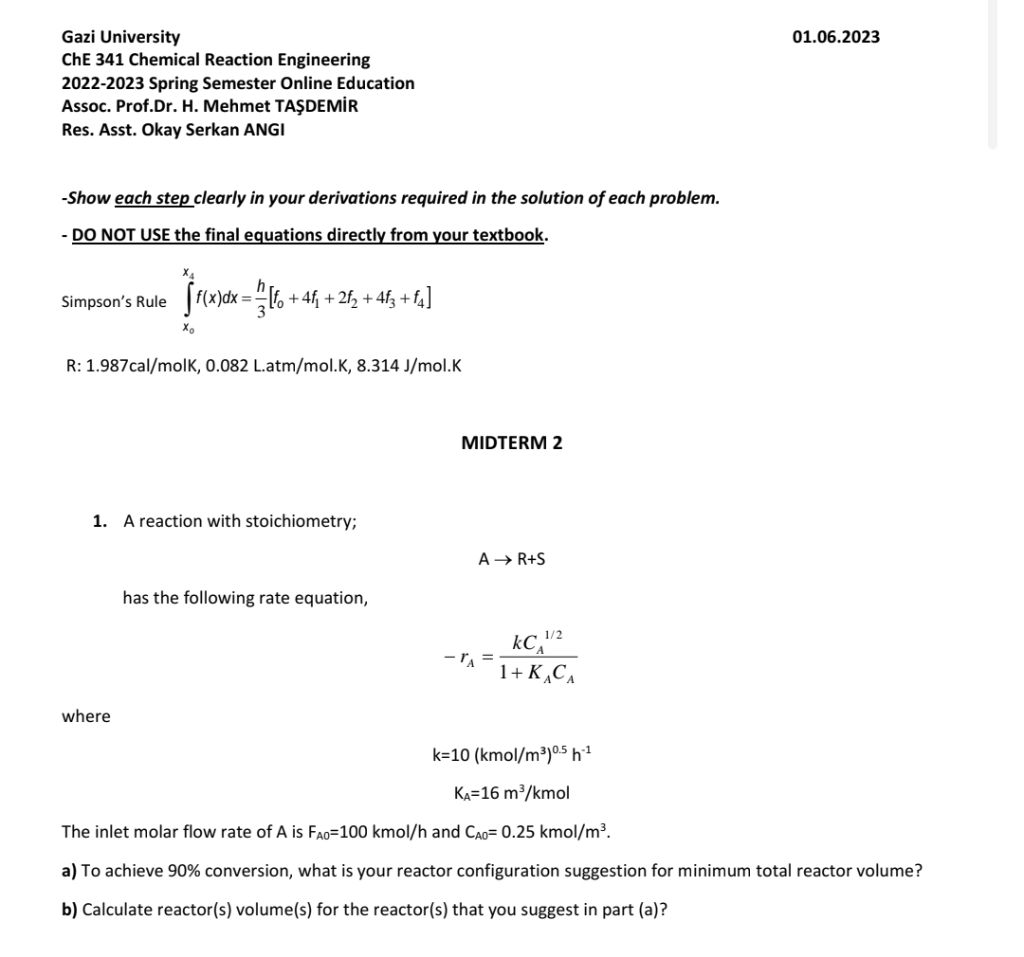
1. Areaction with stoichiometry;
A> R+S
has the following rate equation,
kc,”
pW
1+K,C,
where
k=10 (kmol/m?)°S h*
Ka=16 m*/kmol
The inlet molar flow rate of A is Fa;=100 kmol/h and Cao= 0.25 kmol/m?>.
a) To achieve 90% conversion, what is your reactor configuration suggestion for minimum total reactor volume?
b) Calculate reactor(s) volume(s) for the reactor(s) that you suggest in part (a)?
Question:
Give step-by-step solution with explanation and final answer:Gazi University 01.06.2023
ChE 341 Chemical Reaction Engineering
2022-2023 Spring Semester Online Education
Assoc. Prof.Dr. H. Mehmet TASDEMIR
Res. Asst. Okay Serkan ANGI
-Show each step clearly in your derivations required in the solution of each problem.
- DO NOT USE the final equations directly from your textbook.
x ;
Simpson's Rule [rea = sl Af 426 + af +f]
X h
R: 1.987cal/molK, 0.082 L.atm/mol K, 8.314 J/mol.K
MIDTERM 2
1. Areaction with stoichiometry;
A> R+S
has the following rate equation,
kc,”
pW
1+K,C,
where
k=10 (kmol/m?)°S h*
Ka=16 m*/kmol
The inlet molar flow rate of A is Fa;=100 kmol/h and Cao= 0.25 kmol/m?>.
a) To achieve 90% conversion, what is your reactor configuration suggestion for minimum total reactor volume?
b) Calculate reactor(s) volume(s) for the reactor(s) that you suggest in part (a)?
This is AI generated Response.
Asked by: karuna
Created at: 2025-12-15 04:45:09
Final Answer:
RenderedRaw Text
Did you like this answer?
Let's solve the problem step by step:
---
## **Given Data**
- **Reaction:** \( A \rightarrow R + S \)
- **Rate equation:** \(-r_A = \frac{k C_A^{1/2}}{1 + K_A C_A}\)
- \( k = 10\, (\text{kmol/m}^3)^{.5} \text{h}^{-1} \)
- \( K_A = 16\, \text{m}^3/\text{kmol} \)
- \( F_{A} = 100\, \text{kmol/h} \)
- \( C_{A} = .25\, \text{kmol/m}^3 \)
- **Required conversion:** \( X = .90 \)
---
## **1. Reactor Configuration for Minimum Volume**
### **Step 1: Reactor Type Selection**
For minimum volume at high conversion, **plug flow reactor (PFR)** is typically preferred over a single CSTR, because PFRs are more efficient for first-order and similar reactions. For this rate law, let's check this by comparison at high conversion:
#### **Why?**
- For reactions where the rate decreases with conversion (as here, since denominator increases), PFR is more volume-efficient.
- A series of CSTRs approaches PFR behavior and reduces volume compared to a single CSTR.
**Conclusion:** **PFR** is suggested for minimum volume.
---
## **2. Calculate Reactor Volume for 90% Conversion in a PFR**
### **Step 2: Write the Mole Balance for a PFR**
\[
\text{For a PFR:} \quad F_{A} \int_{}^{X} \frac{dX}{-r_A} = V
\]
- \( F_{A} = 100\, \text{kmol/h} \)
- \( X = .90 \)
### **Step 3: Express \(-r_A\) in Terms of \(X\)**
\[
C_A = C_{A}(1 - X)
\]
\[
-r_A = \frac{k C_A^{1/2}}{1 + K_A C_A}
\]
\[
= \frac{k [C_{A}(1-X)]^{1/2}}{1 + K_A [C_{A}(1-X)]}
\]
### **Step 4: Substitute and Set Up the Integral**
\[
V = F_{A} \int_{}^{.9} \frac{dX}{\frac{k [C_{A}(1-X)]^{1/2}}{1 + K_A C_{A}(1-X)}}
\]
\[
= F_{A} \int_{}^{.9} \frac{1 + K_A C_{A}(1-X)}{k [C_{A}(1-X)]^{1/2}} dX
\]
#### **Plug in values:**
- \( k = 10 \)
- \( K_A = 16 \)
- \( C_{A} = .25 \)
- \( F_{A} = 100 \)
\[
V = 100 \int_{}^{.9} \frac{1 + 16 \times .25 \times (1-X)}{10 \times [.25(1-X)]^{1/2}} dX
\]
\[
= 100 \int_{}^{.9} \frac{1 + 4(1-X)}{10 \times [.25(1-X)]^{1/2}} dX
\]
\[
= 100 \int_{}^{.9} \frac{1 + 4 - 4X}{10 \times (.25)^{.5}(1-X)^{.5}} dX
\]
\[
= 100 \int_{}^{.9} \frac{5 - 4X}{10 \times .5 \times (1-X)^{.5}} dX
\]
\[
= 100 \int_{}^{.9} \frac{5 - 4X}{5 (1-X)^{.5}} dX
\]
\[
= 100 \int_{}^{.9} \frac{5 - 4X}{5 (1-X)^{.5}} dX
\]
\[
= 20 \int_{}^{.9} \frac{5 - 4X}{5 (1-X)^{.5}} dX
\]
\[
= 4 \int_{}^{.9} \frac{5 - 4X}{5 (1-X)^{.5}} dX
\]
\[
= 4 \int_{}^{.9} \left( \frac{1}{(1-X)^{.5}} - \frac{4X}{5(1-X)^{.5}} \right) dX
\]
---
### **Step 5: Solve the Integral**
\[
V = 4 \int_{}^{.9} (1-X)^{-.5} dX - 4 \int_{}^{.9} \frac{4X}{5}(1-X)^{-.5} dX
\]
\[
= 4 \left[ \int_{}^{.9} (1-X)^{-.5} dX - \frac{4}{5} \int_{}^{.9} X(1-X)^{-.5} dX \right]
\]
#### **First Integral:**
\[
\int (1-X)^{-.5} dX = -2(1-X)^{.5}
\]
So,
\[
\int_{}^{.9} (1-X)^{-.5} dX = -2[(1-.9)^{.5} - (1-)^{.5}] = -2[(.1)^{.5} - 1]
\]
#### **Second Integral:**
Let’s use integration by parts, let \( u = X \), \( dv = (1-X)^{-.5} dX \).
- \( du = dX \)
- \( v = -2(1-X)^{.5} \)
So,
\[
\int X(1-X)^{-.5} dX = X \cdot (-2(1-X)^{.5}) - \int (-2(1-X)^{.5}) dX
\]
\[
= -2X(1-X)^{.5} + 2\int (1-X)^{.5} dX
\]
\[
\int (1-X)^{.5} dX = -\frac{2}{3}(1-X)^{1.5}
\]
So,
\[
= -2X(1-X)^{.5} + 2 \left[ -\frac{2}{3}(1-X)^{1.5} \right] = -2X(1-X)^{.5} - \frac{4}{3}(1-X)^{1.5}
\]
So,
\[
\int_{}^{.9} X(1-X)^{-.5} dX = \left[ -2X(1-X)^{.5} - \frac{4}{3}(1-X)^{1.5} \right]_{}^{.9}
\]
---
### **Step 6: Substitute Limits**
#### **First Integral**
\[
-2[(.1)^{.5} - 1] = -2[.3162 - 1] = -2[-.6838] = 1.3676
\]
#### **Second Integral**
Calculate at \( X = .9 \):
- \( (1-X) = .1 \)
- \( (.1)^{.5} = .3162 \)
- \( (.1)^{1.5} = .1 \times .3162 = .03162 \)
So at \( X = .9 \):
\[
-2 \times .9 \times .3162 = -.5692
\]
\[
-\frac{4}{3} \times .03162 = -.04216
\]
Sum: \( -.5692 - .04216 = -.61136 \)
At \( X = \):
- \( (1-)^{.5} = 1 \)
- \( (1-)^{1.5} = 1 \)
\[
-2 \times \times 1 =
\]
\[
-\frac{4}{3} \times 1 = -1.3333
\]
Sum: \( - 1.3333 = -1.3333 \)
So the definite integral:
\[
(-.61136) - (-1.3333) = .72194
\]
Multiply by \( \frac{4}{5} = .8 \):
\[
.8 \times .72194 = .57755
\]
---
### **Step 7: Final Calculation for Volume \( V \)**
Combine results:
\[
V = 4 \left[ 1.3676 - .57755 \right] = 4 \times .79005 = 3.1602 \ \text{m}^3
\]
---
## **Summary**
### **a) Reactor Configuration**
- **A single Plug Flow Reactor (PFR)** is suggested for minimum volume.
### **b) Required Reactor Volume**
- **Total reactor volume for 90% conversion:**
\[
\boxed{3.16\ \text{m}^3}
\]
---
### **Final Answers**
**a)** Suggest PFR for minimum volume.
**b)** Required reactor volume: \(\boxed{3.16\ \text{m}^3}\)
VIPSolutions focuses on clear, step‑by‑step explanations so you can learn quickly. Whether you need an AI‑generated walkthrough or a short hint to get unstuck, each solution is organized for fast reading and easy review later.
Search similar questions, compare approaches, and bookmark the best answers for revision. Our goal is simple: quick, reliable study help that feels natural—not noisy.
 VIPSolutions
 Gazi University 01.06.2023
ChE 341 Chemical Reaction Engineering
2022-2023 Spring Semester Online Education
Assoc. Prof.Dr. H. Mehmet TASDEMIR
Res. Asst. Okay Serkan ANGI
-Show each step clearly in your derivations required in the solution of each problem.
- DO NOT USE the final equations directly from your textbook.
x ;
Simpson's Rule [rea = sl Af 426 + af +f]
X h
R: 1.987cal/molK, 0.082 L.atm/mol K, 8.314 J/mol.K
MIDTERM 2
1. Areaction with stoichiometry;
A> R+S
has the following rate equation,
kc,”
pW
1+K,C,
where
k=10 (kmol/m?)°S h*
Ka=16 m*/kmol
The inlet molar flow rate of A is Fa;=100 kmol/h and Cao= 0.25 kmol/m?>.
a) To achieve 90% conversion, what is your reactor configuration suggestion for minimum total reactor volume?
b) Calculate reactor(s) volume(s) for the reactor(s) that you suggest in part (a)?