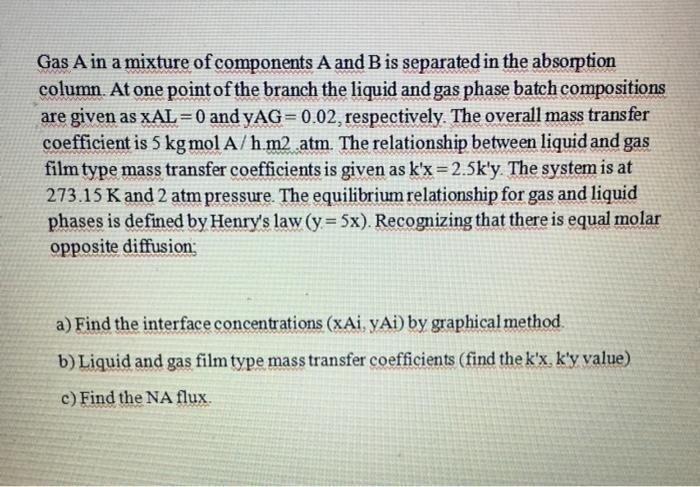
Give step-by-step solution with explanation and final answer:Gas A in a mixture of components A and B is separated in the absorption :
column. At one pointof the branch the liquid and gas phase batch compositions
are given as XAL = 0 and yAG = 0.02, respectively. The overall mass transfer E
coefficients 5 kgmol A/h.m2 atm. The relationship between liquid and gas
film type mass transfer coefficients is given as k'x = 2.5k'y. The system is at 3
273.15 K and 2 atm pressure. The equilibrium relationship for gas and liquid :
phases is defined by Henry's law (y = 5x). Recognizing that there is equal molar ~~
opposite diffusion:
: a) Find the interface concentrations (xAi, yAi) by graphical method
* b)Liquid and gas film type mass transfer coefficients (find the k'x. K'y value)
~ OFindtheNAflux. =
= =
= fe
Question:
Give step-by-step solution with explanation and final answer:Gas A in a mixture of components A and B is separated in the absorption :
column. At one pointof the branch the liquid and gas phase batch compositions
are given as XAL = 0 and yAG = 0.02, respectively. The overall mass transfer E
coefficients 5 kgmol A/h.m2 atm. The relationship between liquid and gas
film type mass transfer coefficients is given as k'x = 2.5k'y. The system is at 3
273.15 K and 2 atm pressure. The equilibrium relationship for gas and liquid :
phases is defined by Henry's law (y = 5x). Recognizing that there is equal molar ~~
opposite diffusion:
: a) Find the interface concentrations (xAi, yAi) by graphical method
* b)Liquid and gas film type mass transfer coefficients (find the k'x. K'y value)
~ OFindtheNAflux. =
= =
= fe
This is AI generated Response.
Asked by: karuna
Created at: 2025-12-15 04:20:43
Final Answer:
RenderedRaw Text
Did you like this answer?
Let's solve the problem step by step:
---
## **Given Data**
- \( x_{AL} = \) (Liquid phase bulk mole fraction of A)
- \( y_{AG} = .02 \) (Gas phase bulk mole fraction of A)
- **Overall mass transfer coefficient:** \( K_y = 5 \) kmol A/(h·m²·atm)
- **Relationship between individual coefficients:** \( k'_x = 2.5 k'_y \)
- **System conditions:** \( T = 273.15 \) K, \( P = 2 \) atm
- **Equilibrium (Henry's Law):** \( y = 5x \)
- **Equal molar counter-diffusion**
---
## **a) Interface Concentrations (\( x_{Ai} \), \( y_{Ai} \))**
### **Mass Transfer Across Gas Film**
\[
N_A = K_y (y_{AG} - y_{Ai}) = K_x (x_{Ai} - x_{AL})
\]
Using Henry's Law at the interface:
\[
y_{Ai} = 5 x_{Ai}
\]
---
### **Set up the two-film theory:**
\[
\frac{1}{K_y} = \frac{1}{k'_y} + \frac{m}{k'_x}
\]
where \( m \) is the slope from Henry's Law: \( m = 5 \).
Given:
\[
k'_x = 2.5 k'_y \implies k'_y = \frac{k'_x}{2.5}
\]
---
#### **Graphical Solution Method:**
1. **Draw the lines:**
- Bulk values: \( x_{AL} = \), \( y_{AG} = .02 \)
- Equilibrium: \( y = 5x \)
2. **Plot operating line:**
- From \( (x_{AL}, y_{AG}) = (, .02) \) to \( (x_{Ai}, y_{Ai}) \), and at the interface, \( y_{Ai} = 5 x_{Ai} \).
3. **Set up the flux equations for both films:**
\[
N_A = k'_y (y_{AG} - y_{Ai}) = k'_x (x_{Ai} - x_{AL})
\]
\[
k'_y (.02 - y_{Ai}) = k'_x (x_{Ai} - )
\]
Since \( y_{Ai} = 5 x_{Ai} \) and \( k'_x = 2.5 k'_y \):
\[
k'_y (.02 - 5 x_{Ai}) = 2.5 k'_y x_{Ai}
\]
\[
.02 - 5 x_{Ai} = 2.5 x_{Ai}
\]
\[
.02 = 7.5 x_{Ai}
\]
\[
x_{Ai} = \frac{.02}{7.5} = .00267
\]
\[
y_{Ai} = 5 x_{Ai} = .0133
\]
---
### **Interface Concentrations:**
- \( \boxed{x_{Ai} = .00267} \)
- \( \boxed{y_{Ai} = .0133} \)
---
## **b) Liquid and Gas Film Mass Transfer Coefficients (\( k'_x, k'_y \))**
Given:
- \( K_y = 5 \) kmol/(h·m²·atm)
- \( k'_x = 2.5 k'_y \)
- Use the resistance-in-series equation:
\[
\frac{1}{K_y} = \frac{1}{k'_y} + \frac{m}{k'_x}
\]
Substitute \( k'_x = 2.5 k'_y \), \( m = 5 \):
\[
\frac{1}{K_y} = \frac{1}{k'_y} + \frac{5}{2.5 k'_y}
\]
\[
\frac{1}{K_y} = \frac{1}{k'_y} + \frac{2}{k'_y}
\]
\[
\frac{1}{K_y} = \frac{3}{k'_y}
\]
\[
k'_y = 3 K_y = 3 \times 5 = 15\ \text{kmol}/(\text{h} \cdot \text{m}^2 \cdot \text{atm})
\]
\[
k'_x = 2.5 k'_y = 2.5 \times 15 = 37.5\ \text{kmol}/(\text{h} \cdot \text{m}^2 \cdot \text{atm})
\]
---
### **Film Mass Transfer Coefficients:**
- \( \boxed{k'_y = 15\ \text{kmol}/(\text{h} \cdot \text{m}^2 \cdot \text{atm})} \)
- \( \boxed{k'_x = 37.5\ \text{kmol}/(\text{h} \cdot \text{m}^2 \cdot \text{atm})} \)
---
## **c) Flux (\( N_A \))**
Use:
\[
N_A = K_y (y_{AG} - y_{Ai}) = 5 \times (.02 - .0133) = 5 \times .0067 = .0335\ \text{kmol}/(\text{h} \cdot \text{m}^2)
\]
---
### **Final Answers**
1. **Interface concentrations:**
- \( x_{Ai} = .00267 \)
- \( y_{Ai} = .0133 \)
2. **Film coefficients:**
- \( k'_x = 37.5\ \text{kmol}/(\text{h} \cdot \text{m}^2 \cdot \text{atm}) \)
- \( k'_y = 15\ \text{kmol}/(\text{h} \cdot \text{m}^2 \cdot \text{atm}) \)
3. **Flux:**
- \( N_A = .0335\ \text{kmol}/(\text{h} \cdot \text{m}^2) \)
---
**Let me know if you need a diagram or more details on any step!**
VIPSolutions focuses on clear, step‑by‑step explanations so you can learn quickly. Whether you need an AI‑generated walkthrough or a short hint to get unstuck, each solution is organized for fast reading and easy review later.
Search similar questions, compare approaches, and bookmark the best answers for revision. Our goal is simple: quick, reliable study help that feels natural—not noisy.
 VIPSolutions
 Gas A in a mixture of components A and B is separated in the absorption :
column. At one pointof the branch the liquid and gas phase batch compositions
are given as XAL = 0 and yAG = 0.02, respectively. The overall mass transfer E
coefficients 5 kgmol A/h.m2 atm. The relationship between liquid and gas
film type mass transfer coefficients is given as k'x = 2.5k'y. The system is at 3
273.15 K and 2 atm pressure. The equilibrium relationship for gas and liquid :
phases is defined by Henry's law (y = 5x). Recognizing that there is equal molar ~~
opposite diffusion:
: a) Find the interface concentrations (xAi, yAi) by graphical method
* b)Liquid and gas film type mass transfer coefficients (find the k'x. K'y value)
~ OFindtheNAflux. =
= =
= fe