 VIPSolutions
Give step-by-step solution with explanation and final answer:SER faa Lo ol Ho SN 2 3 g 3 1i¢ gli EF at qf = 183 Eg E EG 2 3 : 2 ER Hl Gi $38 3 : it CLE i Er rs Ny Ne Hep LE [0 be | ifiE ilk fa it MEA = BE sg a 2
Question:
Give step-by-step solution with explanation and final answer: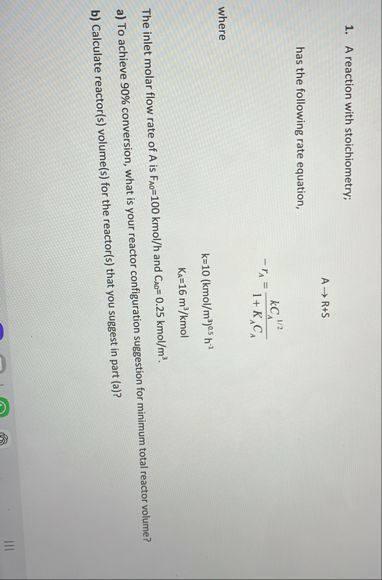 SER faa
Lo ol Ho
SN 2 3 g
3 1i¢ gli
EF at qf
= 183 Eg
E EG 2 3
: 2 ER Hl
Gi $38 3
: it
CLE
i Er rs Ny
Ne Hep LE [0 be
| ifiE ilk
fa it
MEA =
BE sg
a 2
This is AI generated Response.
Asked by: karuna
Created at: 2025-12-15 03:35:00
Asked by: karuna
Created at: 2025-12-15 03:35:00
Final Answer:
Rendered
Raw Text
Did you like this answer?
Let's solve the problem step by step.
---
# **Given Data**
- **Stoichiometry:** \( A \rightarrow pS \)
- **Rate equation:** \[ -r_A = \frac{kC_A^{1/2}}{1 + K C_A} \]
- **Feed molar flow of A:** \( F_{A} = 100 \) kmol/hr
- **Feed concentration of A:** \( C_{A} = .25 \) kmol/m³
- **Rate constant:** \( k = 10 \) (kmol/m³)\(^{1/2}\)/hr
- **Equilibrium constant:** \( K = 6 \) (m³/kmol)
---
# **(a) Reactor configuration for minimum total reactor volume (90% conversion)**
**Let's analyze options:**
- For a first-order or complex rate law like here, **a plug flow reactor (PFR) or a series of PFR + CSTR** often gives minimal volume.
- For rate laws where the rate decreases with decreasing concentration, the CSTR is less efficient.
- Let's check which to use by comparing reactor volumes.
## **Step 1: Find required conversion**
\[
X = .90
\]
## **Step 2: Calculate final concentration \(C_A\)**
\[
\text{Conversion:} \quad X = \frac{F_{A} - F_A}{F_{A}}
\]
Assuming constant volumetric flow rate (liquid phase, no change in total moles):
\[
C_A = C_{A}(1 - X) = .25 \times (1 - .9) = .025 \text{ kmol/m}^3
\]
---
## **Step 3: PFR Volume Calculation**
For a **PFR**:
\[
F_{A} \int_{X_}^{X_f} \frac{dX}{-r_A} = V
\]
\[
-r_A = \frac{k C_A^{1/2}}{1 + K C_A}
\]
But \(C_A = C_{A} (1-X)\):
\[
-r_A = \frac{k [C_{A}(1-X)]^{1/2}}{1 + K C_{A}(1-X)}
\]
So,
\[
V = F_{A} \int_{}^{.9} \frac{dX}{\frac{k [C_{A}(1-X)]^{1/2}}{1 + K C_{A}(1-X)}}
\]
\[
= F_{A} \int_{}^{.9} \frac{1 + K C_{A}(1-X)}{k [C_{A}(1-X)]^{1/2}} dX
\]
Insert values:
- \( F_{A} = 100 \) kmol/hr
- \( k = 10 \) (kmol/m³)\(^{1/2}\)/hr
- \( C_{A} = .25 \) kmol/m³
- \( K = 6 \) m³/kmol
\[
V = 100 \int_{}^{.9} \frac{1 + 6 \times .25 \times (1-X)}{10 \times [.25 \times (1-X)]^{1/2}} dX
\]
\[
= 100 \int_{}^{.9} \frac{1 + 1.5(1-X)}{10 \times (.25)^{1/2} \times (1-X)^{1/2}} dX
\]
\[
(.25)^{1/2} = .5
\]
\[
= 100 \int_{}^{.9} \frac{1 + 1.5(1-X)}{10 \times .5 \times (1-X)^{1/2}} dX
\]
\[
= 100 \int_{}^{.9} \frac{1 + 1.5(1-X)}{5 (1-X)^{1/2}} dX
\]
\[
= 20 \int_{}^{.9} \frac{1 + 1.5(1-X)}{(1-X)^{1/2}} dX
\]
\[
= 20 \int_{}^{.9} \left[ \frac{1}{(1-X)^{1/2}} + \frac{1.5(1-X)}{(1-X)^{1/2}} \right] dX
\]
\[
= 20 \int_{}^{.9} \left[ (1-X)^{-1/2} + 1.5(1-X)^{1/2} \right] dX
\]
Let's integrate both terms:
\[
\int (1-X)^{-1/2} dX = -2(1-X)^{1/2}
\]
\[
\int (1-X)^{1/2} dX = -\frac{2}{3}(1-X)^{3/2}
\]
So,
\[
V = 20 \left\{ -2(1-X)^{1/2} - 1.(1-X)^{3/2} \right\} \Big|_{}^{.9}
\]
Insert the limits:
- At \(X=\): \((1-X)^{1/2} = 1\), \((1-X)^{3/2} = 1\)
- At \(X=.9\): \((1-X)^{1/2} = (.1)^{1/2} = .3162\), \((1-X)^{3/2} = (.1)^{1.5} = .03162\)
\[
V = 20 \left\{ [-2(.3162) - 1(.03162)] - [-2(1) - 1(1)] \right\}
\]
\[
= 20 \left\{ [-.6324 - .03162] - [-2 - 1] \right\}
\]
\[
= 20 \left\{ -.66402 + 3 \right\}
\]
\[
= 20 \times 2.33598 = 46.7196 \text{ m}^3
\]
So, **PFR volume required for 90% conversion is about \(\boxed{46.7 \text{ m}^3}\)**
---
## **Step 4: CSTR Volume Check (for comparison)**
For a **CSTR**:
\[
V = \frac{F_{A} X}{-r_A}
\]
At the outlet (\(X=.9\)), \(C_A = .025\) kmol/m³:
\[
-r_A = \frac{10 \times (.025)^{1/2}}{1 + 6 \times .025} = \frac{10 \times .1581}{1 + .15} = \frac{1.5811}{1.15} = 1.3749 \text{ kmol/(m}^3\cdot\text{hr)}
\]
\[
V = \frac{100 \times .9}{1.3749} = \frac{90}{1.3749} = 65.5 \text{ m}^3
\]
So, **CSTR volume is larger than PFR**.
---
## **Conclusion for Part (a):**
**A single PFR gives the minimum volume.**
---
# **(b) Calculate the reactor(s) volume(s) for your suggestion in (a)**
From above, **the required PFR volume is:**
\[
\boxed{46.7\ \text{m}^3}
\]
---
# **Summary Table**
| Reactor Type | Volume (m³) |
|--------------|-------------|
| PFR | 46.7 |
| CSTR | 65.5 |
---
## **Final Answers**
### **a) Reactor configuration:**
- **A single Plug Flow Reactor (PFR) yields the minimum total reactor volume.**
### **b) Reactor volume(s):**
- **Required PFR volume: \(\boxed{46.7\ \text{m}^3}\)**
---
**If you have more parts or need a breakdown for multiple reactors in series, let me know!**
📢 Instructions:
- Ask anything relatd to above question only.
- For new Question goto :