 VIPSolutions
Give step-by-step solution with explanation and final answer:1 (30/100): Pure water at 25°C is flowing at a velocity of 0.8 m/s in a tube having an inside diameter of 10 mm. The tube is 5 m long with 1.8 m walls coated with acetic acid. The solubility of acetic acid in water is 2.5 kg mol/m?. The viscosity of water is 8.71x10" Pas and the density of water is 997 kg/m’. Diffusion coefficient of acetic acid in water (Dp) is 1.24x10° m?/s. Assuming that the velocity profile is fully developed, answer the following questions. a) Determine the flow type. b) Calculate the mass-transfer coefficient (ky) ¢) Calculate the flux of Na.
Question:
Give step-by-step solution with explanation and final answer: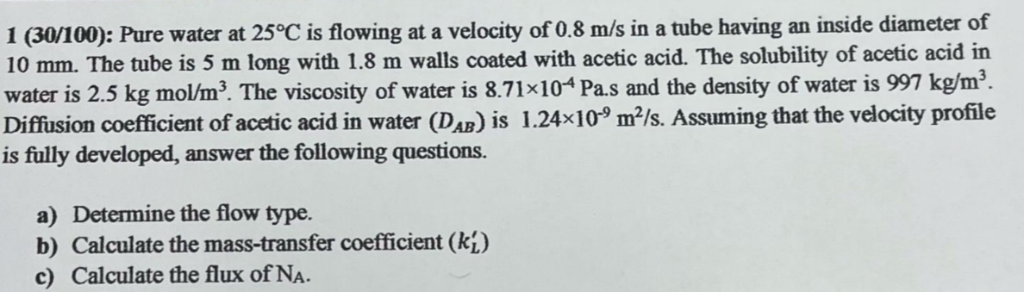 1 (30/100): Pure water at 25°C is flowing at a velocity of 0.8 m/s in a tube having an inside diameter of
10 mm. The tube is 5 m long with 1.8 m walls coated with acetic acid. The solubility of acetic acid in
water is 2.5 kg mol/m?. The viscosity of water is 8.71x10" Pas and the density of water is 997 kg/m’.
Diffusion coefficient of acetic acid in water (Dp) is 1.24x10° m?/s. Assuming that the velocity profile
is fully developed, answer the following questions.
a) Determine the flow type.
b) Calculate the mass-transfer coefficient (ky)
¢) Calculate the flux of Na.
This is AI generated Response.
Asked by: francis
Created at: 2025-12-14 23:13:00
Asked by: francis
Created at: 2025-12-14 23:13:00
Final Answer:
Rendered
Raw Text
Did you like this answer?
Let's solve the problem step by step:
---
## **Given Data**
- **Velocity (\( u \))**: .8 m/s
- **Tube diameter (\( d \))**: 10 mm = .01 m
- **Tube length (\( L \))**: 5 m
- **Wall length coated (\( L_{\text{wall}} \))**: 1.8 m
- **Solubility of acetic acid (\( C_{A,sat} \))**: 2.5 kg mol/m³
- **Viscosity of water (\( \mu \))**: \( 8.71 \times 10^{-4} \) Pa·s
- **Density of water (\( \rho \))**: 997 kg/m³
- **Diffusion coefficient (\( D_{AB} \))**: \( 1.24 \times 10^{-9} \) m²/s
---
## **a) Determine the flow type**
Use the **Reynolds number**:
\[
\text{Re} = \frac{\rho u d}{\mu}
\]
Plug in the values:
\[
\text{Re} = \frac{997 \times .8 \times .01}{8.71 \times 10^{-4}}
\]
\[
\text{Re} = \frac{7.976}{8.71 \times 10^{-4}}
\]
\[
\text{Re} \approx 9155
\]
**Interpretation:**
- Laminar: Re < 210
- Transitional: 210 < Re < 400
- Turbulent: Re > 400
**Answer:** The flow is **turbulent**.
---
## **b) Calculate the mass-transfer coefficient (\( k_L' \))**
For turbulent flow inside a tube, use the **Dittus-Boelter correlation** (for analogy between heat and mass transfer):
\[
\frac{Sh}{.023} = \text{Re}^{.8} \text{Sc}^{.33}
\]
\[
Sh = \frac{k_L' d}{D_{AB}}
\]
\[
Sc = \frac{\mu}{\rho D_{AB}}
\]
Let's calculate each:
### 1. **Schmidt number (Sc):**
\[
Sc = \frac{\mu}{\rho D_{AB}}
\]
\[
Sc = \frac{8.71 \times 10^{-4}}{997 \times 1.24 \times 10^{-9}}
\]
\[
Sc = \frac{8.71 \times 10^{-4}}{1.236 \times 10^{-6}}
\]
\[
Sc \approx 705
\]
### 2. **Sherwood number (Sh):**
\[
Sh = .023 \cdot Re^{.83} \cdot Sc^{.44}
\]
But for Dittus-Boelter: \( Sh = .023 Re^{.8} Sc^{.33} \)
\[
Sh = .023 \times 9155^{.8} \times 705^{.33}
\]
Calculate each term:
- \( 9155^{.8} \approx 1461 \)
- \( 705^{.33} \approx 8.54 \)
\[
Sh = .023 \times 1461 \times 8.54 \approx 287
\]
### 3. **Find \( k_L' \):**
\[
Sh = \frac{k_L' d}{D_{AB}}
\implies k_L' = \frac{Sh \cdot D_{AB}}{d}
\]
\[
k_L' = \frac{287 \times 1.24 \times 10^{-9}}{.01}
\]
\[
k_L' = \frac{355.88 \times 10^{-9}}{.01}
\]
\[
k_L' = 35.6 \times 10^{-6}~\text{m/s}
\]
\[
k_L' = 3.56 \times 10^{-5}~\text{m/s}
\]
---
## **c) Calculate the flux of \( N_A \)**
Assume dilute solution, so \( C_{A,\text{bulk}} \approx \):
\[
N_A = k_L' (C_{A,sat} - C_{A,bulk})
\]
\[
N_A = 3.56 \times 10^{-5} \times (2.5 - )
\]
\[
N_A = 8.9 \times 10^{-5}~\text{kg mol}/(\text{m}^2\cdot\text{s})
\]
---
## **Summary of Answers**
### a) **Flow type**
- **Turbulent** (Re = 9155)
### b) **Mass-transfer coefficient (\( k_L' \))**
- \( \boxed{3.56 \times 10^{-5}~\text{m/s}} \)
### c) **Flux of \( N_A \)**
- \( \boxed{8.9 \times 10^{-5}~\text{kg mol}/(\text{m}^2\cdot\text{s})} \)
📢 Instructions:
- Ask anything relatd to above question only.
- For new Question goto :