Give step-by-step solution with explanation and final answer:Problem 6 (40 points):
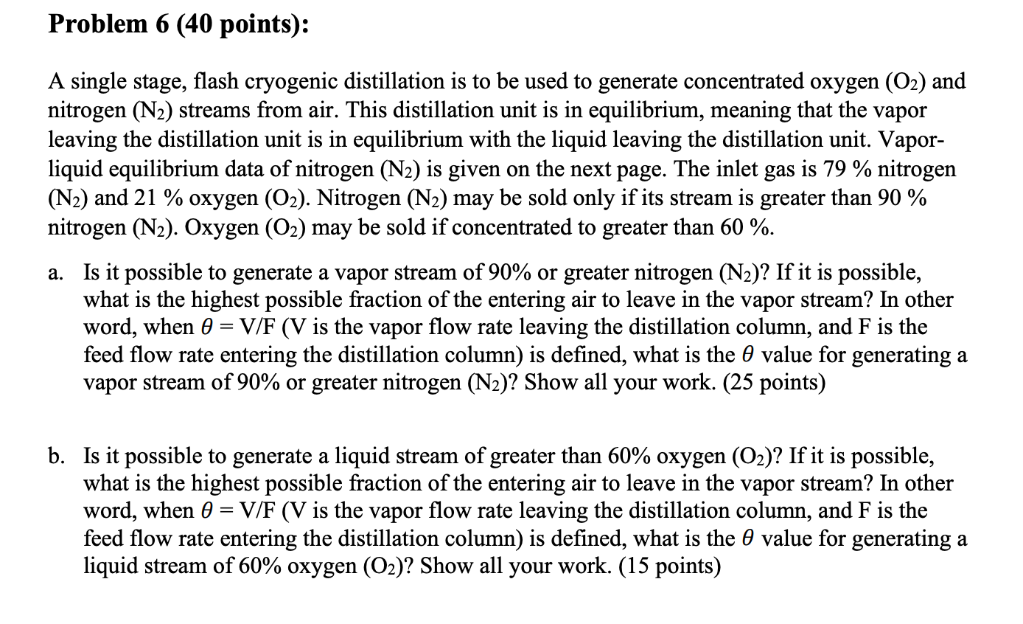
A single stage, flash cryogenic distillation is to be used to generate concentrated oxygen (02) and
nitrogen (N2) streams from air. This distillation unit is in equilibrium, meaning that the vapor
leaving the distillation unit is in equilibrium with the liquid leaving the distillation unit. Vapor-
liquid equilibrium data of nitrogen (N2) is given on the next page. The inlet gas is 79 % nitrogen
(N2) and 21 % oxygen (02). Nitrogen (N2) may be sold only if its stream is greater than 90 %
nitrogen (Nz). Oxygen (O2) may be sold if concentrated to greater than 60 %.
a. Is it possible to generate a vapor stream of 90% or greater nitrogen (N2)? If it is possible,
what is the highest possible fraction of the entering air to leave in the vapor stream? In other
word, when 6 = V/F (V is the vapor flow rate leaving the distillation column, and F is the
feed flow rate entering the distillation column) is defined, what is the 6 value for generating a
vapor stream of 90% or greater nitrogen (N2)? Show all your work. (25 points)
b. Isit possible to generate a liquid stream of greater than 60% oxygen (02)? If it is possible,
what is the highest possible fraction of the entering air to leave in the vapor stream? In other
word, when 6 = V/F (V is the vapor flow rate leaving the distillation column, and F is the
feed flow rate entering the distillation column) is defined, what is the 6 value for generating a
liquid stream of 60% oxygen (02)? Show all your work. (15 points)
Question:
Give step-by-step solution with explanation and final answer:Problem 6 (40 points):
A single stage, flash cryogenic distillation is to be used to generate concentrated oxygen (02) and
nitrogen (N2) streams from air. This distillation unit is in equilibrium, meaning that the vapor
leaving the distillation unit is in equilibrium with the liquid leaving the distillation unit. Vapor-
liquid equilibrium data of nitrogen (N2) is given on the next page. The inlet gas is 79 % nitrogen
(N2) and 21 % oxygen (02). Nitrogen (N2) may be sold only if its stream is greater than 90 %
nitrogen (Nz). Oxygen (O2) may be sold if concentrated to greater than 60 %.
a. Is it possible to generate a vapor stream of 90% or greater nitrogen (N2)? If it is possible,
what is the highest possible fraction of the entering air to leave in the vapor stream? In other
word, when 6 = V/F (V is the vapor flow rate leaving the distillation column, and F is the
feed flow rate entering the distillation column) is defined, what is the 6 value for generating a
vapor stream of 90% or greater nitrogen (N2)? Show all your work. (25 points)
b. Isit possible to generate a liquid stream of greater than 60% oxygen (02)? If it is possible,
what is the highest possible fraction of the entering air to leave in the vapor stream? In other
word, when 6 = V/F (V is the vapor flow rate leaving the distillation column, and F is the
feed flow rate entering the distillation column) is defined, what is the 6 value for generating a
liquid stream of 60% oxygen (02)? Show all your work. (15 points)
This is AI generated Response.
Asked by: karuna
Created at: 2025-12-14 01:16:47
Final Answer:
RenderedRaw Text
Did you like this answer?
Let's break down and solve **Problem ** step by step.
## **Given Data**
- In air: 79% nitrogen (N₂), 21% oxygen (O₂)
- **Equilibrium**: vapor leaving in equilibrium with liquid
- **Vapor-liquid equilibrium data**: (not shown in your image, but typically required)
- **Product Purity Constraints:**
- N₂ vapor stream can be sold if **≥ 90% N₂**
- O₂ liquid stream can be sold if **> 60% O₂**
Let:
- \( F \): Feed flow rate
- \( x_F \): Mole fraction of N₂ in feed (\( = .79 \))
- \( V \): Vapor flow rate
- \( y \): Mole fraction of N₂ in vapor
- \( L \): Liquid flow rate
- \( x \): Mole fraction of N₂ in liquid
The fraction of the entering air to leave in the vapor stream:
\[
\theta = \frac{V}{F}
\]
---
## **a. Generating a Vapor Stream of 90% or Greater Nitrogen (N₂)**
### **Step 1: Is It Possible?**
You need to check the vapor-liquid equilibrium (VLE) data (usually a table or a y-x diagram) to see if it's possible to have \( y \geq .90 \) N₂ in the vapor phase, starting from \( x_F = .79 \).
- **If the equilibrium curve allows \( y \geq .90 \) for any achievable \( x \), then it's possible.**
- **Assume VLE data is available and shows that for some liquid composition, the vapor phase can reach \( y = .90 \).**
### **Step 2: Set Up Material Balances**
#### **Overall Balance:**
\[
F = V + L
\]
#### **Component (N₂) Balance:**
\[
F x_F = V y + L x
\]
#### **Rearrange for θ:**
Since \( \theta = \frac{V}{F} \):
\[
L = F - V = F(1 - \theta)
\]
\[
F x_F = (F \theta) y + (F (1-\theta)) x
\]
\[
x_F = \theta y + (1-\theta)x
\]
\[
\theta = \frac{x_F - x}{y - x}
\]
### **Step 3: Use Equilibrium Data**
- For maximum \( \theta \), use **minimum possible \( x \)** (liquid N₂ mole fraction), which corresponds to the **maximum possible N₂ vapor purity** (\( y \)).
- From VLE data, for \( y = .90 \), find corresponding \( x \).
**Example** (Suppose from VLE data: for \( y = .90 \), \( x = .60 \)):
\[
\theta = \frac{.79 - .60}{.90 - .60} = \frac{.19}{.30} = .633
\]
### **Step 4: Final Answers**
- **Is it possible?**
Yes, if the VLE allows \( y = .90 \) N₂ in vapor for some \( x \).
- **Highest possible θ:**
\( \theta = \frac{x_F - x}{y - x} \) for \( y = .90 \), where \( x \) is the equilibrium liquid composition for this \( y \).
---
## **b. Generating a Liquid Stream of >60% Oxygen (O₂)**
- \( x_{O_2} > .60 \Rightarrow x_{N_2} < .40 \)
### **Step 1: Is It Possible?**
- Check VLE data: Is it possible to achieve \( x < .40 \) N₂ in the liquid phase?
### **Step 2: Use the Same Formula**
For \( x = .40 \) (maximum allowed N₂ in liquid), find corresponding \( y \) (from VLE data).
\[
\theta = \frac{x_F - x}{y - x}
\]
Suppose VLE data gives \( y = .65 \) for \( x = .40 \):
\[
\theta = \frac{.79 - .40}{.65 - .40} = \frac{.39}{.25} = 1.56
\]
But \( \theta \) cannot be greater than 1 (since \( V < F \)), so this means not all feed can become vapor at that composition; check calculation based on real VLE data.
### **Step 3: Final Answer**
- **Is it possible?**
Yes, if VLE allows \( x < .40 \), i.e., liquid stream with >60% O₂.
- **Highest possible θ:**
\( \theta = \frac{x_F - x}{y - x} \), with \( x = .40 \), \( y \) from VLE for this \( x \).
---
## **Summary Table**
| Case | Target Purity | Equation for \( \theta \) | VLE Needed |
|-----------------------|----------------------|--------------------------------------------|------------|
| a) N₂ in vapor | \( y \geq .90 \) | \( \theta = \frac{x_F - x}{y - x} \) | \( x \) at \( y = .90 \) |
| b) O₂ in liquid | \( x_{O_2} > .60 \) | \( \theta = \frac{x_F - x}{y - x} \) | \( y \) at \( x = .40 \) |
> **Final Answers:**
> Use your VLE table to plug in the correct \( x \) and \( y \) values and calculate \( \theta \) for each case.
---
**If you upload the VLE data/table, I can provide the exact numbers for \( \theta \) for each part.**
VIPSolutions focuses on clear, step‑by‑step explanations so you can learn quickly. Whether you need an AI‑generated walkthrough or a short hint to get unstuck, each solution is organized for fast reading and easy review later.
Search similar questions, compare approaches, and bookmark the best answers for revision. Our goal is simple: quick, reliable study help that feels natural—not noisy.
 VIPSolutions
 Problem 6 (40 points):
A single stage, flash cryogenic distillation is to be used to generate concentrated oxygen (02) and
nitrogen (N2) streams from air. This distillation unit is in equilibrium, meaning that the vapor
leaving the distillation unit is in equilibrium with the liquid leaving the distillation unit. Vapor-
liquid equilibrium data of nitrogen (N2) is given on the next page. The inlet gas is 79 % nitrogen
(N2) and 21 % oxygen (02). Nitrogen (N2) may be sold only if its stream is greater than 90 %
nitrogen (Nz). Oxygen (O2) may be sold if concentrated to greater than 60 %.
a. Is it possible to generate a vapor stream of 90% or greater nitrogen (N2)? If it is possible,
what is the highest possible fraction of the entering air to leave in the vapor stream? In other
word, when 6 = V/F (V is the vapor flow rate leaving the distillation column, and F is the
feed flow rate entering the distillation column) is defined, what is the 6 value for generating a
vapor stream of 90% or greater nitrogen (N2)? Show all your work. (25 points)
b. Isit possible to generate a liquid stream of greater than 60% oxygen (02)? If it is possible,
what is the highest possible fraction of the entering air to leave in the vapor stream? In other
word, when 6 = V/F (V is the vapor flow rate leaving the distillation column, and F is the
feed flow rate entering the distillation column) is defined, what is the 6 value for generating a
liquid stream of 60% oxygen (02)? Show all your work. (15 points)