 VIPSolutions
Give step-by-step solution with explanation and final answer:e. OTs Me OTs KOH eS AN A Me Me H,S enantiomerically pure
Question:
Give step-by-step solution with explanation and final answer: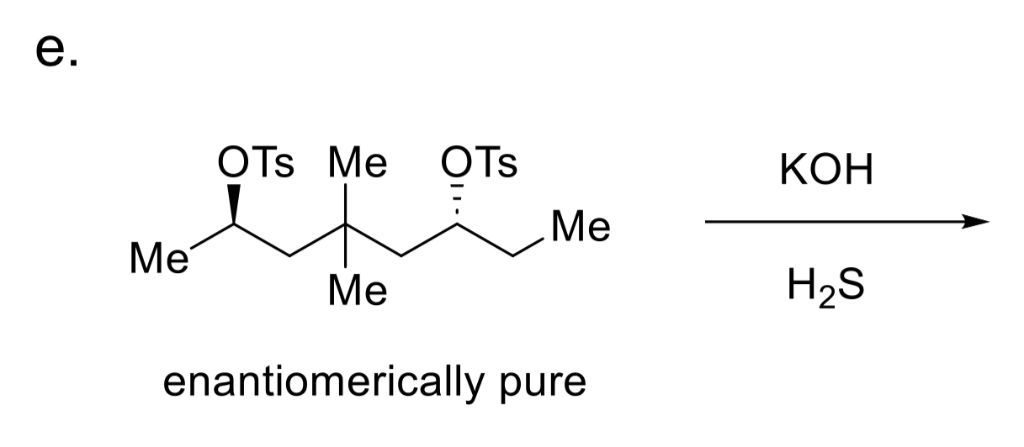 e.
OTs Me OTs KOH
eS AN A Me
Me H,S
enantiomerically pure
This is AI generated Response.
Asked by: francis
Created at: 2025-12-13 23:11:52
Asked by: francis
Created at: 2025-12-13 23:11:52
Final Answer:
Rendered
Raw Text
Did you like this answer?
Let's break down this reaction step by step:
---
## **Step 1: Analyzing the Starting Material**
- The molecule is enantiomerically pure and contains two **tosylate (OTs)** leaving groups on adjacent stereocenters.
- The groups are:
- **Left**: OTs (wedge) and (wedge)
- **Right**: OTs (dash) and Me (dash)
- Both tosylates are on secondary carbons.
- The reaction conditions: **KOH** (strong base) and **H₂S** (nucleophile).
---
## **Step 2: Predicting the Reaction Type**
- **KOH** is a strong base, can deprotonate H₂S to HS⁻ (a good nucleophile).
- **OTs** is an excellent leaving group, so **substitution (S<sub>N</sub>2)** is likely.
- S<sub>N</sub>2 reactions on secondary carbons are possible, especially with strong nucleophiles and good leaving groups.
---
## **Step 3: Mechanism**
### **a. Generation of HS⁻**
- KOH deprotonates H₂S:
\[
\text{H}_2\text{S} + \text{KOH} \rightarrow \text{HS}^- + \text{H}_2\text{O} + \text{K}^+
\]
### **b. S<sub>N</sub>2 Substitution on Both Centers**
- Both tosylate groups are replaced by HS⁻ via backside attack, **inverting stereochemistry** at each center.
---
## **Step 4: Drawing the Product**
- **Original stereochemistry:** Both OTs are on opposite faces (one wedge, one dash).
- **After inversion:** Both HS groups will be on the **opposite faces** compared to OTs.
So:
- On the left carbon: OTs (wedge) → HS (dash)
- On the right carbon: OTs (dash) → HS (wedge)
The methyl groups' stereochemistry will remain the same as originally drawn.
---
## **Step 5: Final Product**
**The product is:**
- 2,4-dimethyl-2,4-dihydrothiopyran (a six-membered ring is NOT formed; chain is kept).
- The correct structure: both OTs replaced with SH, with stereochemistry inverted at each center.
### **Drawn Structure:**
**(2R, 4S)-2,4-dimethyl-2,4-butanedithiol** (assuming original centers are R and S):
```
Me—CH(SH)—CH₂—CH(SH)—Me
(dash) (wedge)
```
### **Summary Table**
| Step | Result |
|---------------------------|---------------------------------------|
| OTs replaced by HS⁻ | Inversion at both stereocenters |
| Stereochemistry | Opposite of starting material |
| Product | Enantiomerically pure dithiol |
---
## **Final Answer**
The product is **enantiomerically pure 2,4-dimethyl-2,4-butanedithiol** with both stereocenters inverted:
**Structure:**
```
Me
|
HS–C–C–C–C–SH
| |
Me Me
```
- Left SH (dash), right SH (wedge)
**Mechanism:** Two S<sub>N</sub>2 substitutions, both invert stereochemistry at each center. The product remains enantiomerically pure but is the enantiomer of the starting material.
---
**If you want a drawn structure, let me know!**
📢 Instructions:
- Ask anything relatd to above question only.
- For new Question goto :