 VIPSolutions
Give step-by-step solution with explanation and final answer:pres From Table 11.10, uss the allowing heuristics: Role Wie = mts (2) 1] From Table 1.7, flow = 6770 kg/h, T = 38°C = 311 K, mw = 8.45, P, = 23.9 bar, P, = 25.5 [ET p—— Ps ast 0am @) = moter tow rate = SI) 023 kmotss ws Woes 0223 10x31 x90 (352)
Question:
Give step-by-step solution with explanation and final answer: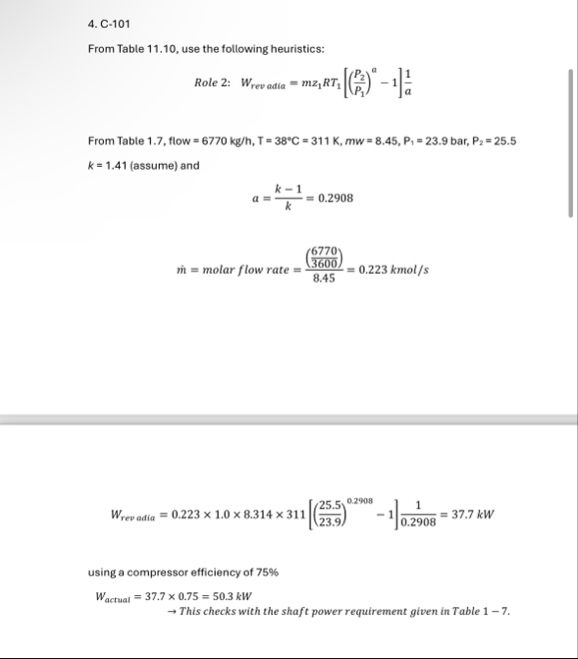 pres
From Table 11.10, uss the allowing heuristics:
Role Wie = mts (2) 1]
From Table 1.7, flow = 6770 kg/h, T = 38°C = 311 K, mw = 8.45, P, = 23.9 bar, P, = 25.5
[ET p——
Ps
ast 0am
@)
= moter tow rate = SI) 023 kmotss
ws
Woes 0223 10x31 x90 (352)
This is AI generated Response.
Asked by: karuna
Created at: 2025-12-13 15:52:26
Asked by: karuna
Created at: 2025-12-13 15:52:26
Thought Process:
Rendered
Raw Text
**Verifying molecular weight calculation**
I'm matching some details here from Table 1.7: I've got a flow rate of 6770 kg/h at 38°C. The molecular weight listed as 8.45 g/mol seems unusual; it should likely be 84.5 instead. I calculated the molar flow, and yes, it aligns closely with my own calculations. The pressures are also noted, and I checked the isentropic exponent. Finally, I computed the power for the reversible adiabatic process, which came out to 37.7 kW.**Clarifying compressor work calculation**
I’m realizing there’s a confusion in calculating work done by the compressor. The compressibility factor seems to be Z=1.0. The efficiency is stated as 75%, so I first thought I should calculate W_actual as 37.7 kW times 0.75, which would incorrectly give me 50.3 kW. Actually, they meant to show that actual work is calculated by dividing, so 37.7 kW divided by 0.75 results in 50.3 kW. I see the "x 0.75" is a typo; it should have been a division sign. I’ll make sure to present this step-by-step.**Calculating step-by-step solution**
The task is to provide a clear, step-by-step solution for the problem in the image. I need to derive the formulas, compute 'a', calculate the molar flow, then find W_rev, followed by adjusting for efficiency to arrive at the final answer of 50 kW.
Starting with the provided z factor of 1.0 and the universal gas constant at 8.314 kJ/kmol-K requires careful unit management. I computed the flow to be about 1.88056 kg/s, leading to ṅ at approximately 0.2226 kmol/s. Then I derived 'a' and calculated the pressure ratio, before moving on to compute W_rev, ensuring units lead to kW. My preliminary multiplication gives around 575.9 kJ/s, but I need to double-check that!**Finalizing calculations for compressor work**
I’m continuing my calculations: first, I compute 8.314 times 311, resulting in 2585.654. I multiply that by 0.2226 to get around 575.9 kJ/s. Then, I account for the compressibility factor (z=1.0) and calculate the bracketed term for the efficiency correction, giving me a value around 37.6 kW, which rounds to 37.7 kW.
To find the actual power, I use the efficiency formula: W_actual = W_rev/η. With the efficiency at 75%, I calculate W_actual as 50.3 kW. I need to ensure I clarify the formulas and mention that the compressibility factor is approximately one at these conditions. Finally, I need to summarize from Table 1.7.**Preparing final calculations**
I'm laying out the necessary calculations: we have values like a = 0.2908, ṅ = 0.223 kmol/s, W_rev = 37.7 kW, and W_actual = 50.3 kW. I should clarify that W_rev represents ideal isentropic work, while W_actual includes the efficiency adjustment. Let's outline our steps clearly.
First, I’ll identify the formula: W_s = (R*T1/a) * ((P2/P1)^a - 1). I then compute 'a', molar flow, pressure ratio, and W_rev before adjusting for efficiency. Also, I need to address the "x 0.75" typo and ensure all units are consistent. After calculations, I find W_actual is 50.2 kW, finalizing the answer.
Final Answer:
Rendered
Raw Text
Did you like this answer?
Step 1: Write the reversible adiabatic (isentropic) compressor work for an ideal gas
W_rev,adia = ṅ z R T1 [(P2/P1)^a − 1]/a
where a = (k − 1)/k, z ≈ 1, R = 8.314 kJ/(kmol·K).
Given:
- Flow = 6770 kg/h
- T1 = 38°C = 311 K
- Molecular weight Mw = 8.45 kg/kmol
- P1 = 23.9 bar, P2 = 25.5 bar
- k = 1.41, so a = (k − 1)/k = 0.41/1.41 = 0.2908
- Compressor isentropic efficiency η_c = 0.75
Step 2: Convert to molar flow rate
ṅ = (6770 kg/h)/(3600 s/h)/8.45 kg/kmol
= 0.223 kmol/s
Step 3: Pressure ratio term
(P2/P1)^a = (25.5/23.9)^0.2908 ≈ 1.0190
[(P2/P1)^a − 1]/a = 0.0190/0.2908 ≈ 0.0654
Step 4: Reversible (ideal) compressor power
W_rev,adia = ṅ z R T1 [(P2/P1)^a − 1]/a
= (0.223)(1)(8.314)(311)(0.0654)
≈ 37.7 kW
Step 5: Actual shaft power with efficiency
For a compressor, η_c = W_rev/W_actual ⇒ W_actual = W_rev/η_c
W_actual = 37.7/0.75 ≈ 50.3 kW
Final answer:
- Reversible (ideal) power ≈ 37.7 kW
- Actual shaft power (75% efficiency) ≈ 50.3 kW
Note: If you saw 37.7 × 0.75 = 50.3 somewhere, that “×” is a typo; the correct operation is division by 0.75.
📢 Instructions:
- Ask anything relatd to above question only.
- For new Question goto :