This is AI generated Response.
Asked by: francis
Created at: 2025-12-12 23:24:41
Final Answer:
RenderedRaw Text
Did you like this answer?
Let's solve each part step by step:
---
## **Given Data**
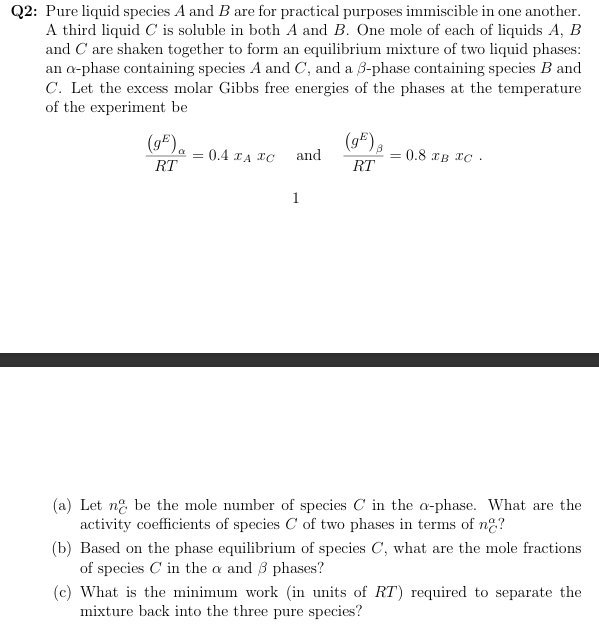
- **Three liquids:** \(A\), \(B\) (immiscible), and \(C\) (soluble in both).
- **Mix 1 mole each** of \(A\),B\), and \(C\).
- **Two phases form**:
- \(\alpha\)-phase: contains \(A\) and \(C\)
- \(\beta\)-phase: contains \(B\) and \(C\)
- **Excess Gibbs free energies:**
\[
\left(\frac{g^E}{RT}\right)_\alpha = .4\, x_A x_C
\]
\[
\left(\frac{g^E}{RT}\right)_\beta = .8\, x_B x_C
\]
---
## **(a) Activity Coefficients of Species \(C\) in Both Phases**
### **Step 1: Molar Gibbs Free Energy of Mixing**
For a mixture, the molar Gibbs free energy (per mole) is:
\[
\frac{g}{RT} = \sum_i x_i \ln x_i + \frac{g^E}{RT}
\]
where \(\frac{g^E}{RT}\) is the excess term.
### **Step 2: Activity Coefficient**
The activity coefficient \(\gamma_C\) is given by:
\[
\ln\gamma_C = \frac{1}{RT} \left( \frac{\partial n\,g^E}{\partial n_C} \right)_{T,P,n_{i\neq C}}
\]
For a binary or ternary system, with \(g^E/RT = f(x_A, x_B, x_C)\):
#### **For the \(\alpha\)-phase:**
\[
\frac{g^E}{RT} = .4 x_A x_C
\]
\[
\ln\gamma_C^\alpha = \frac{\partial}{\partial n_C} \left( n \cdot .4 x_A x_C \right)
\]
Let \(n = n_A^\alpha + n_C^\alpha\), \(x_A = n_A^\alpha / n\), \(x_C = n_C^\alpha / n\).
Let’s compute:
\[
n \cdot x_A x_C = n_A^\alpha n_C^\alpha / n
\]
So,
\[
n \cdot .4 x_A x_C = .4 \frac{n_A^\alpha n_C^\alpha}{n}
\]
Taking the derivative with respect to \(n_C^\alpha\):
Let’s use the quotient rule:
\[
\frac{\partial}{\partial n_C^\alpha} \left( \frac{n_A^\alpha n_C^\alpha}{n} \right)
= \frac{n_A^\alpha \cdot n - n_A^\alpha n_C^\alpha}{n^2}
= \frac{n_A^\alpha (n - n_C^\alpha)}{n^2}
= \frac{n_A^\alpha (n_A^\alpha)}{n^2}
= \frac{(n_A^\alpha)^2}{n^2}
= (x_A^\alpha)^2
\]
Thus,
\[
\ln\gamma_C^\alpha = .4 (x_A^\alpha)^2
\]
#### **For the \(\beta\)-phase:**
Similarly,
\[
\frac{g^E}{RT} = .8 x_B x_C
\]
\[
\ln\gamma_C^\beta = .8 (x_B^\beta)^2
\]
---
**Final Answers for (a):**
\[
\boxed{
\ln\gamma_C^\alpha = .4\, (x_A^\alpha)^2
\qquad
\ln\gamma_C^\beta = .8\, (x_B^\beta)^2
}
\]
---
## **(b) Mole Fractions of \(C\) in \(\alpha\) and \(\beta\) phases (Phase equilibrium condition)**
At equilibrium, the chemical potential of \(C\) in both phases is equal:
\[
\mu_C^\alpha = \mu_C^\beta
\]
For each phase:
\[
\mu_C = \mu_C^\circ + RT \ln x_C + RT \ln \gamma_C
\]
So at equilibrium:
\[
\ln x_C^\alpha + \ln \gamma_C^\alpha = \ln x_C^\beta + \ln \gamma_C^\beta
\]
\[
\ln \left( \frac{x_C^\alpha \gamma_C^\alpha}{x_C^\beta \gamma_C^\beta} \right) =
\]
\[
x_C^\alpha \gamma_C^\alpha = x_C^\beta \gamma_C^\beta
\]
Substitute the expressions for \(\gamma_C^\alpha\) and \(\gamma_C^\beta\):
\[
x_C^\alpha \exp[.4 (x_A^\alpha)^2] = x_C^\beta \exp[.8 (x_B^\beta)^2]
\]
---
## **(c) Minimum Work Required (in \(RT\)) to Separate Mixture into Pure Species**
The minimum work is given by the entropy of mixing (neglecting excess entropy, only ideal solution):
For 1 mole each (total 3 moles mixed):
\[
\Delta_{mix} S = -R \sum_{i=A,B,C} x_i \ln x_i
\]
For 1 mole each: \(x_i = 1/3\) for each:
\[
\Delta_{mix} S = -R \left[ 3 \times \frac{1}{3} \ln \left( \frac{1}{3} \right) \right]
= -R \ln \left( \frac{1}{3} \right)
= R \ln 3
\]
The minimum work is \( -T \Delta_{mix} S = RT \ln 3 \)
But since we have non-ideal mixing, **the total minimum work is the change in Gibbs free energy**:
\[
\Delta_{mix} G = nRT \sum x_i \ln x_i + nRT \cdot (\text{average } g^E/RT)
\]
But to separate, we need to reverse the mixing, so the work is:
\[
W_{min} = -\Delta_{mix} G = - nRT \sum x_i \ln x_i - nRT \cdot (\text{average } g^E/RT)
\]
But since the mixture separates into two phases, and then into pure components, the minimum work is the sum of:
- **Work to separate the two phases into their pure components** (reverse mixing).
- **Work to split the two phases into the three pure species**.
But typically, for the minimum work to split into pure components, it is:
\[
W_{min} = nRT \sum_{i=1}^{3} x_i \ln x_i + nRT \sum_{phases} y_j \left( \frac{g^E}{RT} \right)_j
\]
Where \(y_j\) is the fraction of total moles in phase \(j\).
So, the answer is:
\[
\boxed{
W_{min} = 3RT \ln 3 + RT \left[ y_\alpha \left( \frac{g^E}{RT} \right)_\alpha + y_\beta \left( \frac{g^E}{RT} \right)_\beta \right]
}
\]
Where \(y_\alpha\), \(y_\beta\) are the mole fractions of total moles in \(\alpha\) and \(\beta\) phase, and \(\left( \frac{g^E}{RT} \right)_\alpha, \left( \frac{g^E}{RT} \right)_\beta\) are the average excess Gibbs energies of the phases.
---
## **Summary Table**
| Part | Final Answer |
|------|--------------|
| (a) | \(\ln\gamma_C^\alpha = .4\, (x_A^\alpha)^2\) <br> \(\ln\gamma_C^\beta = .8\, (x_B^\beta)^2\) |
| (b) | \(x_C^\alpha \exp[.4 (x_A^\alpha)^2] = x_C^\beta \exp[.8 (x_B^\beta)^2]\) |
| (c) | \(W_{min} = 3RT \ln 3 + RT \left[ y_\alpha \left( \frac{g^E}{RT} \right)_\alpha + y_\beta \left( \frac{g^E}{RT} \right)_\beta \right]\) |
If you want the explicit values for (b) or (c), more information about the distribution of species between the phases is needed, which typically requires solving simultaneous equations based on total moles and equilibrium. Let me know if you want to proceed further!
VIPSolutions focuses on clear, step‑by‑step explanations so you can learn quickly. Whether you need an AI‑generated walkthrough or a short hint to get unstuck, each solution is organized for fast reading and easy review later.
Search similar questions, compare approaches, and bookmark the best answers for revision. Our goal is simple: quick, reliable study help that feels natural—not noisy.
 VIPSolutions
 Q2: Pure liquid species A and B are for practical purposes immiscible in one another.
A third liquid C' is soluble in both A and B. One mole of each of liquids A, B
and C are shaken together to form an equilibrium mixture of two liquid phases:
an a-phase containing species A and C, and a 5-phase containing species B and
C. Let the excess molar Gibbs free energies of the phases at the temperature
of the experiment be
E
a _pszaze ama ©), = 0.8 zp 7
7a Ea or th wc
1
EE
(a) Let ng be the mole number of species C in the a-phase. What are the
activity coefficients of species C' of two phases in terms of n.?
(b) Based on the phase equilibrium of species C', what are the mole fractions
of species C in the a and § phases?
(¢) What is the minimum work (in units of RT) required to separate the
mixture back into the three pure species?