 VIPSolutions
Give step-by-step solution with explanation and final answer:3) Convolution: a) [Optional] Use direct integration of the convolution integral/graphical convolution to determine the convolution y(£) = x(£) * h(t) if x(t) = cos(t) u(t) and h(t) = “2. b) Use direct integration of the convolution integral/graphical convolution to determine the convolution y(t) = x(t) * h(t) if: x(t) = —u(t) + u(t — 1) and h(t) = 2u(t) — 2u(t — 1).
Question:
Give step-by-step solution with explanation and final answer: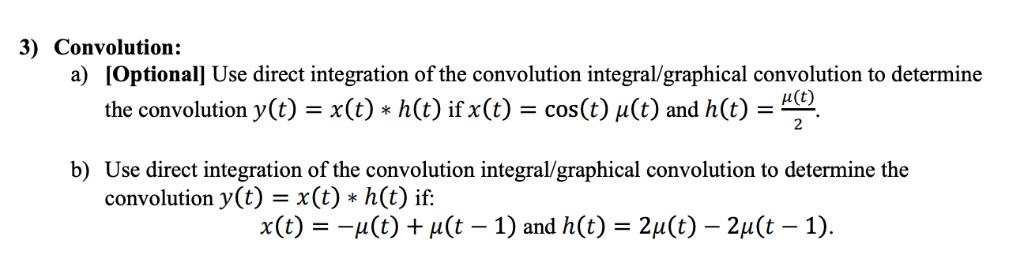 3) Convolution:
a) [Optional] Use direct integration of the convolution integral/graphical convolution to determine
the convolution y(£) = x(£) * h(t) if x(t) = cos(t) u(t) and h(t) = “2.
b) Use direct integration of the convolution integral/graphical convolution to determine the
convolution y(t) = x(t) * h(t) if:
x(t) = —u(t) + u(t — 1) and h(t) = 2u(t) — 2u(t — 1).
This is AI generated Response.
Asked by: Aman
Created at: 2025-12-10 22:30:19
Asked by: Aman
Created at: 2025-12-10 22:30:19
Final Answer:
Rendered
Raw Text
Did you like this answer?
Let's solve **3b** step by step using the **convolution integral**.
---
## **Step 1: Write Given Functions**
**Given:**
- \( x(t) = -\mu(t) + \mu(t-1) \)
- \( h(t) = 2\mu(t) - 2\mu(t-1) \)
Where \( \mu(t) \) is the **unit step function**.
---
## **Step 2: Interpret the Functions**
Let's rewrite these in a more intuitive form:
### **For \( x(t) \):**
\[
x(t) =
\begin{cases}
& t < \\
-1 & \leq t < 1 \\
& t \geq 1
\end{cases}
\]
This is a pulse from \( t= \) to \( t=1 \), with value \(-1\).
### **For \( h(t) \):**
\[
h(t) =
\begin{cases}
& t < \\
2 & \leq t < 1 \\
& t \geq 1
\end{cases}
\]
This is a pulse from \( t= \) to \( t=1 \), with value \(2\).
---
## **Step 3: Write the Convolution Integral**
\[
y(t) = (x * h)(t) = \int_{-\infty}^{\infty} x(\tau) h(t-\tau) d\tau
\]
---
## **Step 4: Find the Limits of Integration**
Both \( x(\tau) \) and \( h(t-\tau) \) are only nonzero for \( \leq \tau < 1 \) and \( \leq t-\tau < 1 \):
- For \( x(\tau) \neq \), \( \leq \tau < 1 \)
- For \( h(t-\tau) \neq \), \( \leq t-\tau < 1 \implies t-1 < \tau \leq t \)
So, the effective limits are:
\[
\tau \in [\max(, t-1), \min(1, t)]
\]
and \( x(\tau) = -1 \), \( h(t-\tau) = 2 \) in this interval.
---
## **Step 5: Write the Integral**
\[
y(t) = \int_{\max(, t-1)}^{\min(1, t)} (-1) \cdot 2 \; d\tau = -2 \int_{\max(, t-1)}^{\min(1, t)} d\tau
\]
\[
y(t) = -2 \left[ \min(1, t) - \max(, t-1) \right]
\]
---
## **Step 6: Piecewise Solution**
Let's break it into cases for \( t \):
### **Case 1: \( t < \)**
- The interval is empty.
- \( y(t) = \)
### **Case 2: \( \leq t < 1 \)**
- \( \max(, t-1) = \)
- \( \min(1, t) = t \)
- \( y(t) = -2 [ t - ] = -2t \)
### **Case 3: \( 1 \leq t < 2 \)**
- \( \max(, t-1) = t-1 \)
- \( \min(1, t) = 1 \)
- \( y(t) = -2 [ 1 - (t-1) ] = -2 [2 - t] = -4 + 2t \)
### **Case 4: \( t \geq 2 \)**
- The interval is empty.
- \( y(t) = \)
---
## **Step 7: Final Answer**
\[
\boxed{
y(t) =
\begin{cases}
& t < \\
-2t & \leq t < 1 \\
-4 + 2t & 1 \leq t < 2 \\
& t \geq 2
\end{cases}
}
\]
---
### **Summary Table**
| \( t \) range | \( y(t) \) |
|---------------------|--------------------|
| \( t < \) | |
| \( \leq t < 1 \) | \(-2t\) |
| \( 1 \leq t < 2 \) | \(-4 + 2t\) |
| \( t \geq 2 \) | |
---
**This is the convolution result!**
📢 Instructions:
- Ask anything relatd to above question only.
- For new Question goto :