 VIPSolutions
Give step-by-step solution with explanation and final answer:Be eee th blanc ccuaion or complete combs il Di | JE 0 cin patel pi nim fi ee a WE fn
Question:
Give step-by-step solution with explanation and final answer: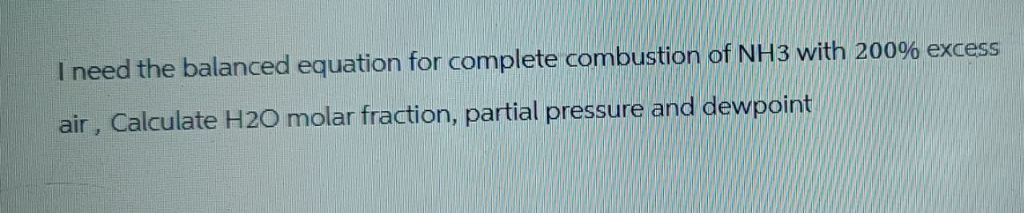 Be eee
th blanc ccuaion or complete combs il Di |
JE 0 cin patel pi nim fi
ee
a WE fn
This is AI generated Response.
Asked by: francis
Created at: 2025-12-08 23:04:42
Asked by: francis
Created at: 2025-12-08 23:04:42
Final Answer:
Rendered
Raw Text
Did you like this answer?
Let's solve the problem step by step.
---
## 1. **Balanced Equation for Complete Combustion of NH₃**
The complete combustion of ammonia (NH₃) with oxygen (O₂) produces nitrogen (N₂) and water (H₂O):
\[
4\text{NH}_3 + 3\text{O}_2 \rightarrow 2\text{N}_2 + 6\text{H}_2\text{O}
\]
---
## 2. **Stoichiometric Oxygen and Air Requirement**
### a. **Oxygen Required (Stoichiometric)**
From the balanced equation:
- 4 moles NH₃ require 3 moles O₂
- 1 mole NH₃ requires \( \frac{3}{4} = .75 \) moles O₂
### b. **Air Required**
Air is ~21% O₂ by mole, so:
\[
\text{Moles air required per mole NH}_3 = \frac{.75}{.21} = 3.57\ \text{moles air}
\]
---
## 3. **Excess Air Calculation (200% Excess)**
- **200% excess air** means total air supplied is **3 times** the stoichiometric amount:
\[
\text{Total air supplied} = 3 \times 3.57 = 10.71\ \text{moles air per mole NH}_3
\]
---
## 4. **Product Gas Composition (per 1 mole NH₃)**
Let's base the calculation on **1 mole NH₃**:
### a. **Reactants:**
- NH₃: 1 mole
- O₂ supplied: \( 10.71 \times .21 = 2.25 \) moles
- N₂ supplied: \( 10.71 \times .79 = 8.46 \) moles
### b. **O₂ Consumed:**
- .75 moles O₂ consumed (stoichiometrically)
- Excess O₂ remaining: \( 2.25 - .75 = 1.50 \) moles
### c. **N₂ in Product:**
- N₂ from air: 8.46 moles
- N₂ from reaction: \( \frac{2}{4} = .5 \) moles per 1 mole NH₃
### d. **H₂O Produced:**
- \( \frac{6}{4} = 1.5 \) moles per 1 mole NH₃
#### **Summary Table:**
| Component | Amount (mol) |
|-----------|--------------|
| N₂ (from air) | 8.46 |
| N₂ (from reaction) | .5 |
| O₂ (excess) | 1.50 |
| H₂O | 1.5 |
| **Total** | **11.96** |
---
## 5. **Mole Fraction of H₂O**
\[
\text{Mole fraction of } \text{H}_2\text{O} = \frac{1.5}{11.96} = .125
\]
---
## 6. **Partial Pressure of H₂O**
Let total pressure \( P_{total} = 1 \) atm (unless stated otherwise):
\[
P_{\text{H}_2\text{O}} = y_{\text{H}_2\text{O}} \cdot P_{total} = .125 \times 1 = .125\ \text{atm}
\]
---
## 7. **Dew Point Calculation**
- Dew point: The temperature at which water vapor starts to condense (saturated vapor pressure equals partial pressure).
- Use steam tables or Antoine equation for \( P_{\text{H}_2\text{O}} = .125 \) atm.
At \( P_{\text{H}_2\text{O}} = .125 \) atm:
- \( .125 \) atm \( = 95 \) mmHg
From steam tables, the temperature at which vapor pressure of water is \( 95 \) mmHg is approximately **49°C**.
---
## **Summary Table**
| Quantity | Value |
|---------------------|--------------|
| Balanced Equation | \(4\text{NH}_3 + 3\text{O}_2 \rightarrow 2\text{N}_2 + 6\text{H}_2\text{O}\) |
| H₂O Mole Fraction | .125 |
| H₂O Partial Pressure| .125 atm |
| Dew Point | 49°C |
---
### **Final Answers**
- **Balanced Equation:** \(4\text{NH}_3 + 3\text{O}_2 \rightarrow 2\text{N}_2 + 6\text{H}_2\text{O}\)
- **H₂O Mole Fraction:** .125
- **H₂O Partial Pressure:** .125 atm
- **Dew Point:** 49°C
If you need calculations for a different basis (e.g., 100 mol NH₃), just multiply accordingly!
📢 Instructions:
- Ask anything relatd to above question only.
- For new Question goto :