 VIPSolutions
Give step-by-step solution with explaConsider the example earlier where the rate of job finding is 3 8 percent per month and the rate of job separation is 2 percent per month. Suppose that the government believes that the unemployment rate is too high, so to lower the unemployment rate, they make it more difficult for firms to fire workers by moving from at - will employment contracts to contracts which only allow firms to fire workers with a documented and justified cause. As a result, the rate of job separation decreases from 2 percent per month to 1 . 8 percent per month. However, because it is now more difficult to fire workers, firms are now more reluctant to hire workers, so the rate of job finding also decreases from 3 8 percent per month to 2 8 . 2 percent per month. What happens to the natural rate of unemployment? Did the policy accomplish its stated goal nation and final answer:Consider the example earlier where the rate of job finding is 38 percent per month and the rate of job separation is 2 rent per month. Suppose that the goverment believes Frat the unemployment rate is too high, so to lower the unemployment rate, they make it more difficult for firms to fire workers by moving from at-will employment contracts to contracts which ant allow firms to fire workers with a documented and justified cause. As a result, the rate of job separation decreases from 2 percent per month to 1.8 percent per month. However, because it is now more difficult to fire workers, firms are now more reluctant to hire workers, so the rate of id finding also decreases from 38 percent per month to 28: percent per month. What fiabpens to the natural rate of une; ment? Did the policy accomplish its stated goa]
Question:
Give step-by-step solution with explaConsider the example earlier where the rate of job finding is
3
8
percent per month and the rate of job separation is
2
percent per month. Suppose that the government believes that the unemployment rate is too high, so to lower the unemployment rate, they make it more difficult for firms to fire workers by moving from at
-
will employment contracts to contracts which only allow firms to fire workers with a documented and justified cause. As a result, the rate of job separation decreases from
2
percent per month to
1
.
8
percent per month. However, because it is now more difficult to fire workers, firms are now more reluctant to hire workers, so the rate of job finding also decreases from
3
8
percent per month to
2
8
.
2
percent per month. What happens to the natural rate of unemployment? Did the policy accomplish its stated goal
nation and final answer: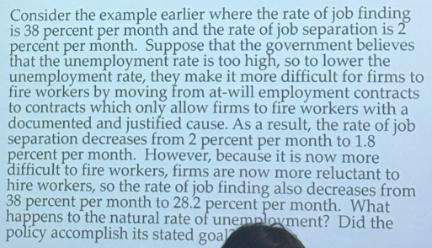 Consider the example earlier where the rate of job finding
is 38 percent per month and the rate of job separation is 2
rent per month. Suppose that the goverment believes
Frat the unemployment rate is too high, so to lower the
unemployment rate, they make it more difficult for firms to
fire workers by moving from at-will employment contracts
to contracts which ant allow firms to fire workers with a
documented and justified cause. As a result, the rate of job
separation decreases from 2 percent per month to 1.8
percent per month. However, because it is now more
difficult to fire workers, firms are now more reluctant to
hire workers, so the rate of id finding also decreases from
38 percent per month to 28: percent per month. What
fiabpens to the natural rate of une; ment? Did the
policy accomplish its stated goa]
Asked by: ramanujan
Created at: 2025-11-06 05:36:09
Final Answer:
Question:
the Natural Rate of Unemployment,and this quetion micro economic or macre and Initial Natural Rate of Unemployment defination
Asked by: ramanujan
Created at: 2025-11-06 05:42:32
Final Answer:
📢 Instructions:
- Ask anything relatd to above question only.
- For new Question goto :