 VIPSolutions
Give step-by-step solution with add explanation also final answer:7. The following vector field is conservative in R For F(z,y,2) = (32% + 25)i + (2 — Ayz?)j + (—6yPz + Br? + 22)k. (a) Find the values of the constants A and B. (b) Find a potential function ¢ such that F(z,y,2) = V¢ in B® and ¢(1,1,1) = 5. (c) For the curve C parametrized by 7 (t) = (5cost,4sin3t,¢), 0 < t < 2m, compute the line integral J, F -d7.
Question:
Give step-by-step solution with add explanation also final answer: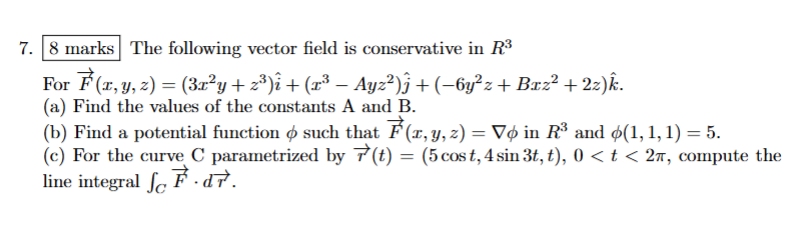 7. The following vector field is conservative in R
For F(z,y,2) = (32% + 25)i + (2 — Ayz?)j + (—6yPz + Br? + 22)k.
(a) Find the values of the constants A and B.
(b) Find a potential function ¢ such that F(z,y,2) = V¢ in B® and ¢(1,1,1) = 5.
(c) For the curve C parametrized by 7 (t) = (5cost,4sin3t,¢), 0 < t < 2m, compute the
line integral J, F -d7.
This is AI generated Response.
Asked by: Sunil kumar
Created at: 2025-07-22 11:23:13
Asked by: Sunil kumar
Created at: 2025-07-22 11:23:13
Final Answer:
Rendered
Raw Text
Did you like this answer?
Let's solve the problem step by step:
---
## **Given:**
\[
\vec{F}(x, y, z) = (3x^2y + z^3)\hat{i} + (x^3 - Ayz^2)\hat{j} + (-6y^2z + Bxz^2 + 2z)\hat{k}
\]
---
### **(a) Find the values of the constants \( A \) and \( B \).**
Since the field is **conservative**,
\(\vec{F} = \nabla \phi\)
So, the curl must be zero:
\[
\nabla \times \vec{F} = 0
\]
Let's compute the components:
#### **1. \( \frac{\partial F_2}{\partial x} - \frac{\partial F_1}{\partial y} \):**
- \( F_1 = 3x^2y + z^3 \)
- \( F_2 = x^3 - Ayz^2 \)
\[
\frac{\partial F_2}{\partial x} = 3x^2
\]
\[
\frac{\partial F_1}{\partial y} = 3x^2
\]
\[
\frac{\partial F_2}{\partial x} - \frac{\partial F_1}{\partial y} = 3x^2 - 3x^2 = 0
\]
#### **2. \( \frac{\partial F_3}{\partial y} - \frac{\partial F_2}{\partial z} \):**
- \( F_3 = -6y^2z + Bxz^2 + 2z \)
\[
\frac{\partial F_3}{\partial y} = -12yz
\]
\[
\frac{\partial F_2}{\partial z} = -A y \cdot 2z = -2A y z
\]
\[
\frac{\partial F_3}{\partial y} - \frac{\partial F_2}{\partial z} = -12 y z - (-2A y z) = (-12 + 2A) y z
\]
Set this to zero for all \( y, z \):
\[
-12 + 2A = 0 \implies 2A = 12 \implies \boxed{A = 6}
\]
#### **3. \( \frac{\partial F_1}{\partial z} - \frac{\partial F_3}{\partial x} \):**
\[
\frac{\partial F_1}{\partial z} = 3z^2
\]
\[
\frac{\partial F_3}{\partial x} = Bz^2
\]
\[
\frac{\partial F_1}{\partial z} - \frac{\partial F_3}{\partial x} = 3z^2 - Bz^2 = (3 - B)z^2
\]
Set to zero for all \( z \):
\[
3 - B = 0 \implies \boxed{B = 3}
\]
---
### **(b) Find a potential function \( \phi \) such that \( \vec{F} = \nabla \phi \), and \( \phi(1,1,1) = 5 \).**
Now with \(A = 6\), \(B = 3\):
\[
\vec{F} = (3x^2y + z^3)\hat{i} + (x^3 - 6y z^2)\hat{j} + (-6y^2z + 3x z^2 + 2z)\hat{k}
\]
We want to find \( \phi \) such that:
\[
\frac{\partial \phi}{\partial x} = 3x^2y + z^3 \\
\frac{\partial \phi}{\partial y} = x^3 - 6y z^2 \\
\frac{\partial \phi}{\partial z} = -6y^2z + 3x z^2 + 2z
\]
#### **Step 1: Integrate w.r.t. \( x \):**
\[
\phi(x, y, z) = \int (3x^2y + z^3) dx = x^3y + xz^3 + g(y, z)
\]
#### **Step 2: Differentiate w.r.t. \( y \):**
\[
\frac{\partial \phi}{\partial y} = x^3 + \frac{\partial g}{\partial y}
\]
Set equal to given \( F_2 \):
\[
x^3 + \frac{\partial g}{\partial y} = x^3 - 6y z^2 \implies \frac{\partial g}{\partial y} = -6y z^2
\]
Integrate w.r.t. \( y \):
\[
g(y, z) = -3y^2 z^2 + h(z)
\]
So,
\[
\phi(x, y, z) = x^3y + xz^3 - 3y^2z^2 + h(z)
\]
#### **Step 3: Differentiate w.r.t. \( z \):**
\[
\frac{\partial \phi}{\partial z} = 3xz^2 + x^3 \cdot 0 + x \cdot 3z^2 + (-3y^2)(2z) + h'(z)
= 3x z^2 - 6y^2 z + h'(z)
\]
Set equal to \( F_3 \):
\[
3x z^2 - 6y^2 z + h'(z) = -6y^2z + 3x z^2 + 2z
\]
So,
\[
h'(z) = 2z
\implies h(z) = z^2 + C
\]
So the potential function is:
\[
\phi(x, y, z) = x^3y + xz^3 - 3y^2z^2 + z^2 + C
\]
Now, use \( \phi(1, 1, 1) = 5 \):
\[
\phi(1, 1, 1) = (1)(1) + (1)(1) - 3(1)(1) + 1 + C = 1 + 1 - 3 + 1 + C = 0 + C = 5
\implies C = 5
\]
**Final potential function:**
\[
\boxed{
\phi(x, y, z) = x^3y + xz^3 - 3y^2z^2 + z^2 + 5
}
\]
---
### **(c) For the curve \( C \) parametrized by \( \vec{r}(t) = (5\cos t, 4\sin 3t, t) \), \( 0 < t < 2\pi \), compute the line integral \( \int_C \vec{F} \cdot d\vec{r} \).**
For a conservative field, the line integral from point \( A \) to \( B \) is \( \phi(B) - \phi(A) \).
Curve \( C \) goes from \( t=0 \) to \( t=2\pi \):
\[
\vec{r}(0) = (5, 0, 0) \\
\vec{r}(2\pi) = (5, 0, 2\pi)
\]
So,
\[
\int_C \vec{F} \cdot d\vec{r} = \phi(5, 0, 2\pi) - \phi(5, 0, 0)
\]
Calculate:
#### **At \( (5, 0, 2\pi) \):**
\[
\phi(5, 0, 2\pi) = (5)^3(0) + 5(2\pi)^3 - 3(0)^2(2\pi)^2 + (2\pi)^2 + 5
= 0 + 5 \cdot 8\pi^3 + 0 + 4\pi^2 + 5 = 40\pi^3 + 4\pi^2 + 5
\]
#### **At \( (5, 0, 0) \):**
\[
\phi(5, 0, 0) = (5)^3(0) + 5(0)^3 - 3(0)^2(0)^2 + 0^2 + 5 = 0 + 0 + 0 + 0 + 5 = 5
\]
#### **Integral:**
\[
\int_C \vec{F} \cdot d\vec{r} = (40\pi^3 + 4\pi^2 + 5) - 5 = \boxed{40\pi^3 + 4\pi^2}
\]
---
## **Final Answers**
---
**(a)** \( \boxed{A = 6, \quad B = 3} \)
**(b)** \( \boxed{\phi(x, y, z) = x^3y + xz^3 - 3y^2z^2 + z^2 + 5} \)
**(c)** \( \boxed{\int_C \vec{F} \cdot d\vec{r} = 40\pi^3 + 4\pi^2} \)
📢 Instructions:
- Ask anything relatd to above question only.
- For new Question goto :