 VIPSolutions
Give step-by-step explanation WITH INTRODUCTIONQuestion 14 Complete the following table of positions on the ecliptic using either of the Sky Map Explorers. Position Approximate Date Right Ascension Declination - a LL ] pm Famer oo a rr Format your answer like: Vernal Equinox ; March 21 ; [answer] ; [answer] [answer] ; June 21; [answer] ; [answer] Autumnal Equinox ; [answer] ; [answer] ; [answer] Winter Solstice ; [answer] ; [answer] ; [answer] Use the editor to format your answer
Question:
Give step-by-step explanation WITH INTRODUCTION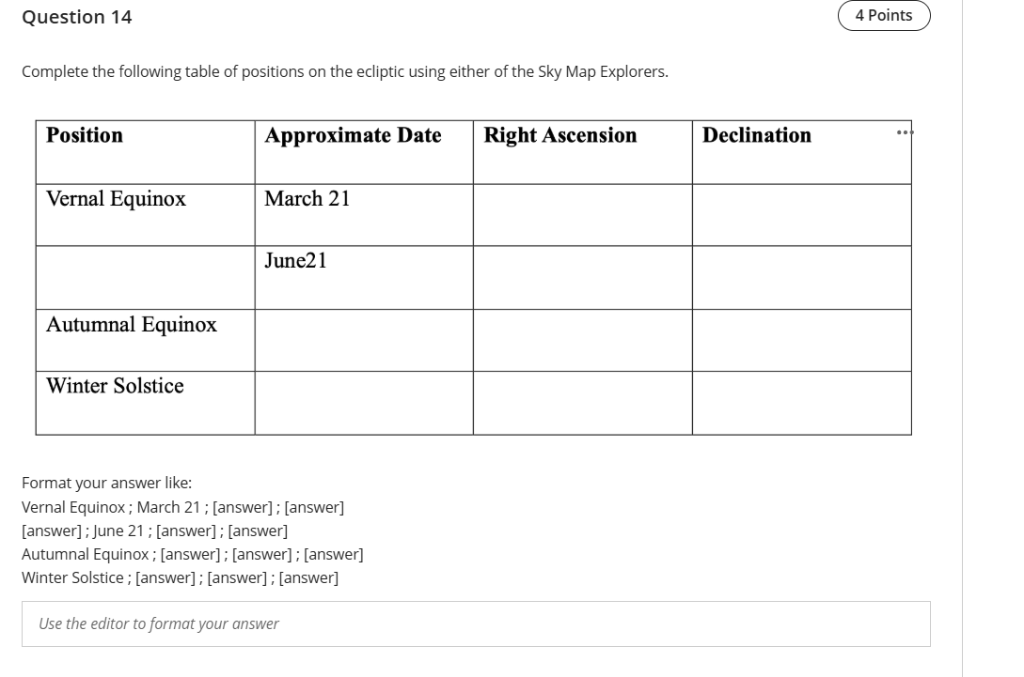 Question 14
Complete the following table of positions on the ecliptic using either of the Sky Map Explorers.
Position Approximate Date Right Ascension Declination -
a LL ]
pm Famer oo
a rr
Format your answer like:
Vernal Equinox ; March 21 ; [answer] ; [answer]
[answer] ; June 21; [answer] ; [answer]
Autumnal Equinox ; [answer] ; [answer] ; [answer]
Winter Solstice ; [answer] ; [answer] ; [answer]
Use the editor to format your answer
This is AI generated Response.
Asked by: coochbehar
Created at: 2025-08-29 22:45:40
Asked by: coochbehar
Created at: 2025-08-29 22:45:40
Final Answer:
Rendered
Raw Text
Did you like this answer?
### **Introduction**
The positions of the Sun on the ecliptic at different times of the year are key markers in astronomy. These positions—Vernal Equinox, Summer Solstice, Autumnal Equinox, and Winter Solstice—are defined by specific values of right ascension (RA) and declination (Dec). Here’s how to fill out the table step-by-step:
#### **Step-by-Step Explanation**
1. **Vernal Equinox (March 21)**
- **Right Ascension:** 0 hours (h)
- **Declination:** 0°
- **Reason:** The Sun crosses the celestial equator moving northward; this point is defined as 0h RA and 0° Dec.
2. **Summer Solstice (June 21)**
- **Right Ascension:** 6 hours (h)
- **Declination:** +23.5°
- **Reason:** The Sun is at its northernmost point above the celestial equator. RA is 6h, Dec is +23.5° (Earth's axial tilt).
3. **Autumnal Equinox (September 23, usually)**
- **Right Ascension:** 12 hours (h)
- **Declination:** 0°
- **Reason:** The Sun crosses the celestial equator moving southward; RA is 12h, Dec is 0°.
4. **Winter Solstice (December 21)**
- **Right Ascension:** 18 hours (h)
- **Declination:** -23.5°
- **Reason:** The Sun is at its southernmost point below the celestial equator. RA is 18h, Dec is -23.5°.
---
### **Formatted Answer**
Vernal Equinox ; March 21 ; 0h ; 0°
June 21 ; 6h ; +23.5°
Autumnal Equinox ; September 23 ; 12h ; 0°
Winter Solstice ; December 21 ; 18h ; -23.5°
---
**Feel free to copy and paste this answer into your assignment! If you need more explanation about equinoxes, solstices, right ascension, or declination, let me know!**
📢 Instructions:
- Ask anything relatd to above question only.
- For new Question goto :