 VIPSolutions
Give step-by-step explanationGeneral Motor Company produced a lightweight, all-terrain vehicle named as Terrain-2000 for military use. The company is now planning to sell the vehicle to public. It has five plants that ‘manufacture the vehicle and four regional distribution centres. The company is unsure of public demand for the Terrain-2000, so it is considering reducing its fixed operating costs by closing one or more plants, even though it would incur an increase in transportation costs. The relevant costs for the problem are provided in the following table (Table 1). Each of the transportation costs is the shipping cost per vehicle; for example, the cost of shipping 1.000 vehicles from plant A to warehouse W_3 is $30,000. The annual demand from each warehouse of W_1, W_2, W_3 and W_4 is 13,000, 12,000, 9.000 and 11,000, respectively. The annual production capacity and annual fixed operating costs of each plant are given in the table; for example, the annual production capacity and annual fixed operating costs for Plant A is 12,000 and § 1,500,000, respectively. Table 1 Data for Question 4 Transportation Costs to Warchouse Annual Annual Fixed From Plant Production Operating WI w_2 w_3 wd Capacity Costs ($) A $42. $20 $30 $50 12,000 1,500,000 B $16 $45 sil $32. 15,000 950,000 c $20 $50 $35 $45 13,000 1,300,000 D $28 $22 $50 $25 10,000 1,000,000 E $42. $48 $24 $30 14,000 900,000 Tasks: a) Formulate a linear programming model for this problem b) Solve this model by using the computer. ©) Interpret the solution obtained in b) to assist the company in determining which plants should remain open and which should be closed and the number of vehicles that should be shipped from each plant to each warehouse to minimize the total cost. -_—_
Question:
Give step-by-step explanation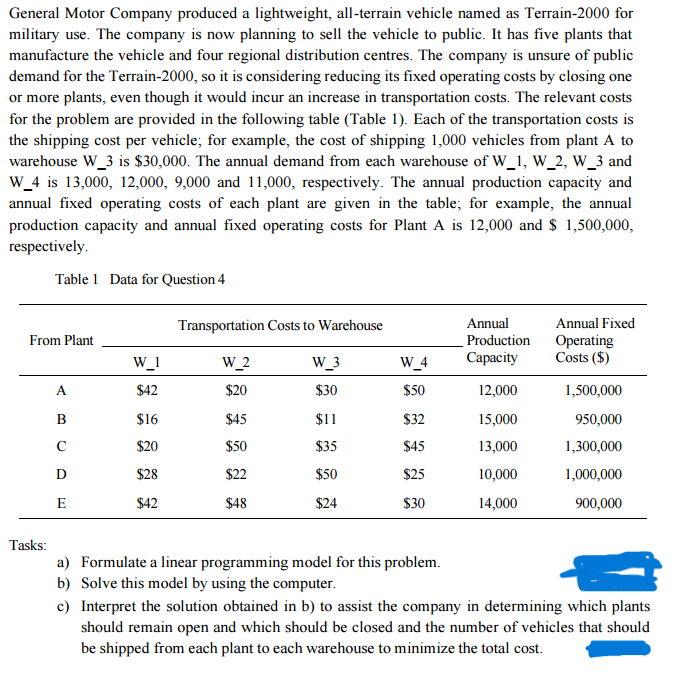 General Motor Company produced a lightweight, all-terrain vehicle named as Terrain-2000 for
military use. The company is now planning to sell the vehicle to public. It has five plants that
‘manufacture the vehicle and four regional distribution centres. The company is unsure of public
demand for the Terrain-2000, so it is considering reducing its fixed operating costs by closing one
or more plants, even though it would incur an increase in transportation costs. The relevant costs
for the problem are provided in the following table (Table 1). Each of the transportation costs is
the shipping cost per vehicle; for example, the cost of shipping 1.000 vehicles from plant A to
warehouse W_3 is $30,000. The annual demand from each warehouse of W_1, W_2, W_3 and
W_4 is 13,000, 12,000, 9.000 and 11,000, respectively. The annual production capacity and
annual fixed operating costs of each plant are given in the table; for example, the annual
production capacity and annual fixed operating costs for Plant A is 12,000 and § 1,500,000,
respectively.
Table 1 Data for Question 4
Transportation Costs to Warchouse Annual Annual Fixed
From Plant Production Operating
WI w_2 w_3 wd Capacity Costs ($)
A $42. $20 $30 $50 12,000 1,500,000
B $16 $45 sil $32. 15,000 950,000
c $20 $50 $35 $45 13,000 1,300,000
D $28 $22 $50 $25 10,000 1,000,000
E $42. $48 $24 $30 14,000 900,000
Tasks:
a) Formulate a linear programming model for this problem
b) Solve this model by using the computer.
©) Interpret the solution obtained in b) to assist the company in determining which plants
should remain open and which should be closed and the number of vehicles that should
be shipped from each plant to each warehouse to minimize the total cost. -_—_
Asked by: coochbehar
Created at: 2025-09-07 22:45:14
Final Answer:
📢 Instructions:
- Ask anything relatd to above question only.
- For new Question goto :