 VIPSolutions
give step by step answerve a i | Se Te rte ot Nese ren el RE Ee a LL | | =p | i oR . an . ji i | | J LL I il I Rl ¥ 4 Cl | Hi | a i . LL
Question:
give step by step answer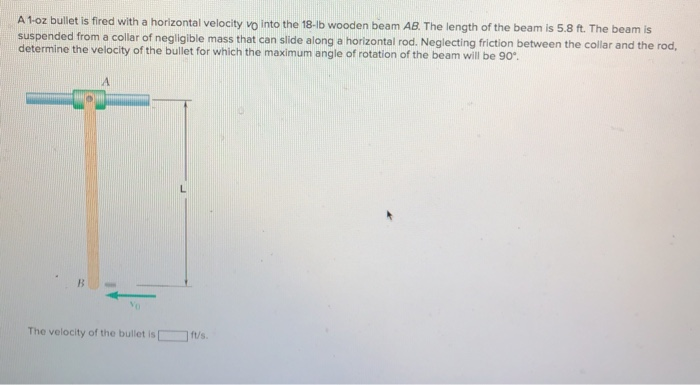 ve a i
| Se Te
rte ot Nese ren
el RE Ee
a
LL
|
| =p |
i oR .
an
. ji i | | J
LL I il I
Rl ¥ 4
Cl | Hi |
a i
. LL
This is AI generated Response.
Asked by: manish kumar
Created at: 2025-08-15 08:40:53
Asked by: manish kumar
Created at: 2025-08-15 08:40:53
Final Answer:
Rendered
Raw Text
Did you like this answer?
Let's break down the problem step by step:
---
**Given:**
- Mass of bullet (\( m_b \)): 1 oz = 1/16 lb (since 16 oz = 1 lb)
- Mass of beam (\( m \)): 18 lb
- Length of beam (\( L \)): 5.8 ft
- The beam is initially at rest and pivots about point \( A \).
- The bullet is fired horizontally with velocity \( v_0 \) and embeds itself at the tip \( B \).
- The maximum angle of rotation of the beam is \( 90^\circ \).
We are to **find the velocity \( v_0 \) of the bullet** such that the beam (with the bullet embedded at \( B \)) swings up to a vertical position (\( 90^\circ \) from its initial position).
---
### **Step 1: Conservation of Linear Momentum (Immediately After Impact)**
Since the bullet embeds itself in the beam, this is a perfectly inelastic collision. We consider conservation of angular momentum about point \( A \) at the moment of impact (since external torques about \( A \) are zero during the collision):
- **Initial angular momentum (about \( A \))**: Only the bullet has angular momentum before impact.
\[
L_{initial} = m_b v_0 L
\]
- **Final angular momentum (about \( A \))**: The beam and bullet rotate together with angular speed \( \omega \) just after impact.
\[
L_{final} = I_{total} \omega
\]
where \( I_{total} = I_{beam} + I_{bullet} \).
#### **Moment of inertia calculations:**
- Beam (about end \( A \)):
\[
I_{beam} = \frac{1}{3} m L^2
\]
- Bullet (as a point mass at \( B \)):
\[
I_{bullet} = m_b L^2
\]
So,
\[
I_{total} = \frac{1}{3} m L^2 + m_b L^2 = \left( \frac{1}{3} m + m_b \right) L^2
\]
#### **Equating angular momenta:**
\[
m_b v_0 L = \left( \frac{1}{3} m + m_b \right) L^2 \omega
\]
\[
\omega = \frac{m_b v_0}{\left( \frac{1}{3} m + m_b \right) L}
\]
---
### **Step 2: Conservation of Energy (Swing to 90°)**
After the collision, the system (beam + bullet) swings up to \( 90^\circ \) (vertical).
- **Initial kinetic energy (just after collision):**
\[
KE = \frac{1}{2} I_{total} \omega^2
\]
- **Potential energy gain (from horizontal to vertical):**
- Center of mass of beam rises by \( \Delta y_{beam} = \frac{L}{2} \)
- Bullet rises by \( \Delta y_{bullet} = L \)
- Gravitational potential energy increase:
\[
\Delta PE = m g \frac{L}{2} + m_b g L
\]
#### **Equate kinetic and potential energy:**
\[
\frac{1}{2} I_{total} \omega^2 = m g \frac{L}{2} + m_b g L
\]
---
### **Step 3: Substitute Values and Solve for \( v_0 \)**
Plug in \( \omega \) from Step 1:
\[
\frac{1}{2} I_{total} \left( \frac{m_b v_0}{I_{total} L} \right)^2 = m g \frac{L}{2} + m_b g L
\]
\[
\frac{1}{2} I_{total} \cdot \frac{m_b^2 v_0^2}{I_{total}^2 L^2} = m g \frac{L}{2} + m_b g L
\]
\[
\frac{1}{2} \frac{m_b^2 v_0^2}{I_{total} L^2} = m g \frac{L}{2} + m_b g L
\]
\[
\frac{m_b^2 v_0^2}{2 I_{total} L^2} = m g \frac{L}{2} + m_b g L
\]
\[
v_0^2 = \frac{2 I_{total} L^2}{m_b^2} \left( m g \frac{L}{2} + m_b g L \right)
\]
Now plug in the values:
- \( m_b = \frac{1}{16} \) lb \( = \frac{1}{16} / 32.2 = 0.00194 \) slugs
- \( m = 18 \) lb \( = 18 / 32.2 = 0.559 \) slugs
- \( L = 5.8 \) ft
- \( g = 32.2 \) ft/s²
Calculate \( I_{total} \):
\[
I_{total} = \frac{1}{3} m L^2 + m_b L^2
\]
\[
= \frac{1}{3} \times 0.559 \times (5.8)^2 + 0.00194 \times (5.8)^2
\]
\[
= 0.186 \times 33.64 + 0.00194 \times 33.64
\]
\[
= 6.26 + 0.0652 = 6.33 \text{ slug ft}^2
\]
Calculate the potential energy term:
\[
m g \frac{L}{2} + m_b g L = 0.559 \times 32.2 \times \frac{5.8}{2} + 0.00194 \times 32.2 \times 5.8
\]
\[
= 0.559 \times 32.2 \times 2.9 + 0.00194 \times 32.2 \times 5.8
\]
\[
= 0.559 \times 93.38 + 0.00194 \times 187
\]
\[
= 52.23 + 0.363 = 52.593 \text{ ft-lb}
\]
Plug all into the equation:
\[
v_0^2 = \frac{2 \times 6.33 \times (5.8)^2}{(0.00194)^2} \times 52.593
\]
Calculate \( 2 \times 6.33 \times 33.64 = 426.11 \)
\[
v_0^2 = \frac{426.11}{(0.00194)^2} \times 52.593
\]
\[
(0.00194)^2 = 0.00000376
\]
\[
\frac{426.11}{0.00000376} = 113,354,787
\]
\[
v_0^2 = 113,354,787 \times 52.593 = 5,958,618,183
\]
\[
v_0 = \sqrt{5,958,618,183} \approx 77,240 \text{ ft/s}
\]
---
### **Final Answer**
\[
\boxed{v_0 \approx 77,200 \text{ ft/s}}
\]
---
### **Summary of Steps**
1. **Conservation of Angular Momentum** to relate \( v_0 \) and \( \omega \).
2. **Conservation of Energy** to relate \( \omega \) to the energy required to swing the beam and bullet to the vertical.
3. **Algebraic Manipulation** to solve for \( v_0 \).
4. **Plug in Numbers** and calculate the final answer.
If you need any step explained in more detail or want the answer in other units, let me know!
📢 Instructions:
- Ask anything relatd to above question only.
- For new Question goto :