 VIPSolutions
Give step by step answerFor two n-dimensional real vectors P and Q, the operation s(P, Q) is defined as follows: o(P,Q) = X(Pli- Qi) Let L be a set of 10-dimensional non-zero real vectors such that for every pair of distinct vectors P, @ € Ly s(P, Q) 0. What i the maximum cardinality possible for the set L2 Q Q- Q" Q- Engineering Mathematics Calculus Ouastion 38
Question:
Give step by step answer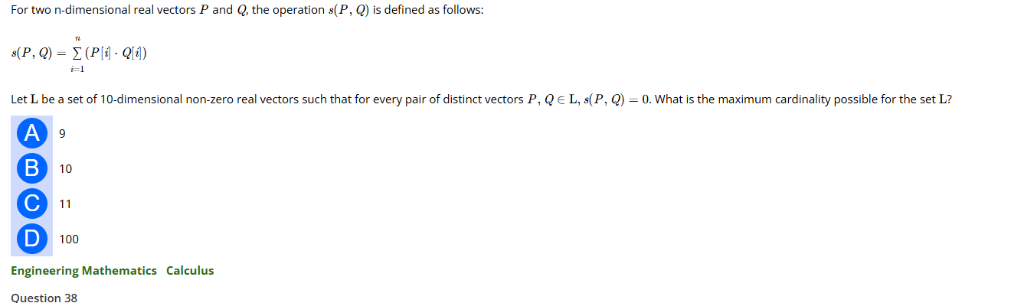 For two n-dimensional real vectors P and Q, the operation s(P, Q) is defined as follows:
o(P,Q) = X(Pli- Qi)
Let L be a set of 10-dimensional non-zero real vectors such that for every pair of distinct vectors P, @ € Ly s(P, Q) 0. What i the maximum cardinality possible for the set L2
Q
Q-
Q"
Q-
Engineering Mathematics Calculus
Ouastion 38
This is AI generated Response.
Asked by: Vishal
Created at: 2026-02-04 13:28:29
Asked by: Vishal
Created at: 2026-02-04 13:28:29
Final Answer:
Rendered
Raw Text
Did you like this answer?
Let's break down the problem step-by-step:
---
## **Step 1: Understand the Question**
Given:
- **n = 10**, i.e., vectors are in 10-dimensional space.
- **s(P, Q)** is the **dot product** of vectors **P** and **Q**.
- **L** is a set of non-zero vectors in \(\mathbb{R}^{10}\) such that for every **distinct pair** \(P, Q \in L\), \(s(P, Q) = \).
**Goal:**
Find the **maximum cardinality** (maximum number of vectors) possible for the set \(L\).
---
## **Step 2: Rephrase Mathematically**
We want the largest set of non-zero vectors in \(\mathbb{R}^{10}\) such that **any two distinct vectors are orthogonal**.
---
## **Step 3: Use Linear Algebra Facts**
- In an **n-dimensional real vector space**, the **maximum number of mutually orthogonal, non-zero vectors** is **n**.
- This is because the set of mutually orthogonal vectors forms an **orthonormal basis**, and the dimension of the space is the maximum number of linearly independent vectors.
---
## **Step 4: Apply to the Problem**
- Here, \(n = 10\).
- So, the **maximum number of mutually orthogonal non-zero vectors** in \(\mathbb{R}^{10}\) is **10**.
---
## **Step 5: Choose the Answer**
The correct answer is:
**B. 10**
---
### **Summary Table**
| Option | Value | Explanation |
|--------|-------|--------------------------------------------------|
| A | 9 | Less than possible |
| B | 10 | **Maximum possible in 10D space** |
| C | 11 | More than possible, not allowed |
| D | 100 | More than possible, not allowed |
---
### **Final Answer**
\[
\boxed{10}
\]
The maximum cardinality possible for the set \(L\) is **10**.
📢 Instructions:
- Ask anything relatd to above question only.
- For new Question goto :