 VIPSolutions
Give step by step answerFor a statement S in a program, in the context of liveness analysis, the following sets are defined: USE(S): the set of variables used in § INS): the set of variables that are Ive at the entry of S OUT(S): the set of variables that are live at the exit of 5 Consider a basic block that consists of two statements, 51 followed by 52. Which one of the following statements is correct? (A) OUTISN =IN (52) © orerneome © orev Compiler Design Runtime Environment
Question:
Give step by step answer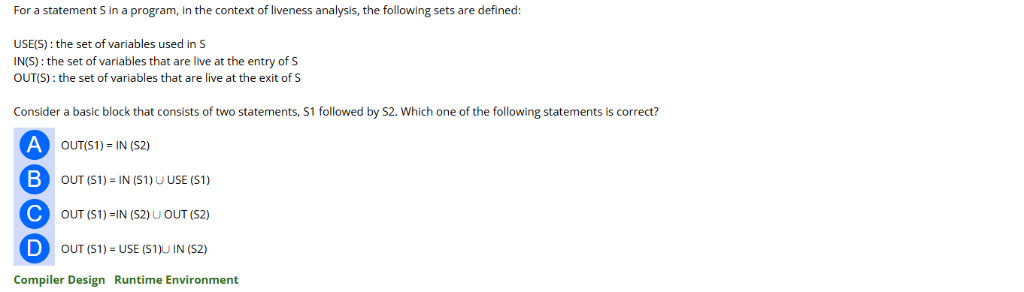 For a statement S in a program, in the context of liveness analysis, the following sets are defined:
USE(S): the set of variables used in §
INS): the set of variables that are Ive at the entry of S
OUT(S): the set of variables that are live at the exit of 5
Consider a basic block that consists of two statements, 51 followed by 52. Which one of the following statements is correct?
(A) OUTISN =IN (52)
© orerneome
© orev
Compiler Design Runtime Environment
This is AI generated Response.
Asked by: Vishal
Created at: 2026-02-04 13:29:38
Asked by: Vishal
Created at: 2026-02-04 13:29:38
Final Answer:
Rendered
Raw Text
Did you like this answer?
Let's break down the problem step by step.
### **Given Definitions**
- **USE(S):** Variables used in statement S.
- **IN(S):** Variables that are live at the entry of S.
- **OUT(S):** Variables that are live at the exit of S.
### **Liveness Analysis Equations**
For a statement S:
- \(\text{IN}(S) = \text{USE}(S) \cup (\text{OUT}(S) - \text{DEF}(S))\)
- \(\text{OUT}(S)\) for a statement is the set of variables live at entry of its successor.
### **For Two Statements: S1 followed by S2**
- S1 is followed by S2, so the successor of S1 is S2.
- Thus, **OUT(S1) = IN(S2)**
### **Matching with Options**
Let's check each option:
- **A: OUT(S1) = IN(S2)**
This matches our conclusion above.
- **B: OUT(S1) = IN(S1) ∪ USE(S1)**
This is not a standard liveness equation.
- **C: OUT(S1) = IN(S2) ∪ OUT(S2)**
This is not correct.
- **D: OUT(S1) = USE(S1) ∪ IN(S2)**
This is not correct.
---
## **Final Answer**
### **The correct answer is:**
> **A. OUT(S1) = IN(S2)**
---
#### **Reasoning**
In a basic block, the OUT set of a statement is the IN set of its immediate successor. So for S1 followed by S2:
**OUT(S1) = IN(S2)**
---
**Reference: Compiler Design, Liveness Analysis (Data Flow Analysis)**
📢 Instructions:
- Ask anything relatd to above question only.
- For new Question goto :