 VIPSolutions
give solution first write given information4. (Markov Chains - Tough) A Markov chain has transition matrix 0 1 0 1 1 P=|4 0} 010 1. Is the chain irreducible? 2. Find the stationary distribution, f it exists. 3. Is the chain ergodic?
Question:
give solution first write given information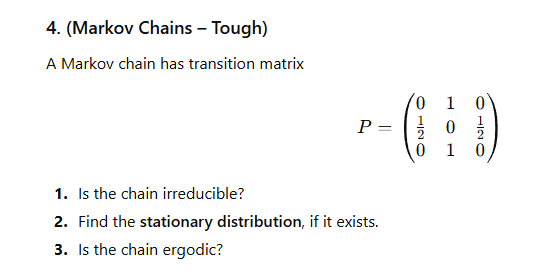 4. (Markov Chains - Tough)
A Markov chain has transition matrix
0 1 0
1 1
P=|4 0}
010
1. Is the chain irreducible?
2. Find the stationary distribution, f it exists.
3. Is the chain ergodic?
This is AI generated Response.
Asked by: nayan
Created at: 2026-02-02 12:39:32
Asked by: nayan
Created at: 2026-02-02 12:39:32
Final Answer:
Rendered
Raw Text
Did you like this answer?
## Given Information
A Markov chain has transition matrix:
\[
P = \begin{pmatrix}
& 1 & \\
\frac{1}{2} & & \frac{1}{2} \\
& 1 &
\end{pmatrix}
\]
---
## Solution
### 1. **Is the chain irreducible?**
**Irreducible:** A Markov chain is irreducible if it's possible to get from any state to any other state (possibly in multiple steps).
- From state 1: can go to state 2 in 1 step.
- From state 2: can go to states 1 and 3 in 1 step.
- From state 3: can go to state 2 in 1 step.
**Check all pairs:**
- 1 → 3: 1 → 2 → 3 (possible in 2 steps, since 1→2, 2→3)
- 3 → 1: 3 → 2 → 1 (possible in 2 steps, since 3→2, 2→1)
**Conclusion:**
**Yes, the chain is irreducible.**
---
### 2. **Find the stationary distribution, if it exists.**
Let stationary distribution be \(\pi = (\pi_1, \pi_2, \pi_3)\).
We want \(\pi P = \pi\), i.e.,
\[
\begin{cases}
\pi_1 = \cdot \pi_1 + \frac{1}{2} \pi_2 + \cdot \pi_3 = \frac{1}{2}\pi_2 \\
\pi_2 = 1 \cdot \pi_1 + \cdot \pi_2 + 1 \cdot \pi_3 = \pi_1 + \pi_3 \\
\pi_3 = \cdot \pi_1 + \frac{1}{2} \pi_2 + \cdot \pi_3 = \frac{1}{2}\pi_2
\end{cases}
\]
with \(\pi_1 + \pi_2 + \pi_3 = 1\).
From the first and third equations:
\(\pi_1 = \pi_3 = \frac{1}{2}\pi_2\)
Therefore, \(\pi_1 = \pi_3\).
Let \(\pi_1 = \pi_3 = x\), \(\pi_2 = y\).
Then:
- \(x + y + x = 1 \implies 2x + y = 1\)
- From above, \(x = \frac{1}{2}y\)
Substitute:
- \(2\left(\frac{1}{2}y\right) + y = 1 \implies y + y = 1 \implies y = \frac{1}{2}\)
- So, \(x = \frac{1}{2} \cdot \frac{1}{2} = \frac{1}{4}\)
**Stationary distribution:**
\[
\boxed{
\pi = \left(\frac{1}{4}, \frac{1}{2}, \frac{1}{4}\right)
}
\]
---
### 3. **Is the chain ergodic?**
A chain is **ergodic** if it is irreducible, aperiodic, and positive recurrent.
- **Irreducible:** Yes (shown above).
- **Aperiodic:**
Let's check the period of each state:
- State 2 can only return to itself in even steps (since 2→1/3→2), so period is 2.
- All states have period 2.
**Conclusion:**
**The chain is not ergodic** (since it is not aperiodic; period is 2).
---
## **Summary**
1. **Irreducible:** Yes
2. **Stationary distribution:** \( \left(\frac{1}{4}, \frac{1}{2}, \frac{1}{4}\right) \)
3. **Ergodic:** No (periodic, not aperiodic)
📢 Instructions:
- Ask anything relatd to above question only.
- For new Question goto :