 VIPSolutions
Give QESTION INTRODUCTION & step-by-step solution with explanation (MUST) and final answer:Given a velocity v, = ul + bt + ct?) where b and c are constants having units of sec! and sec? respectively, compute the time-average velocity by means of Eq. 6.1-1. Indicate what range of values At may take (in terms of b and c¢) so that it is permissible to make the statement that , is “‘essentially constant in the period 2 Ar.” Do this by comparing the average of the average 7, with the average &, and requiring that they be within 1 per cent of each other. Ans: At < [0.03(1 + bt + ct?)[cP/2
Question:
Give QESTION INTRODUCTION & step-by-step solution with explanation (MUST) and final answer: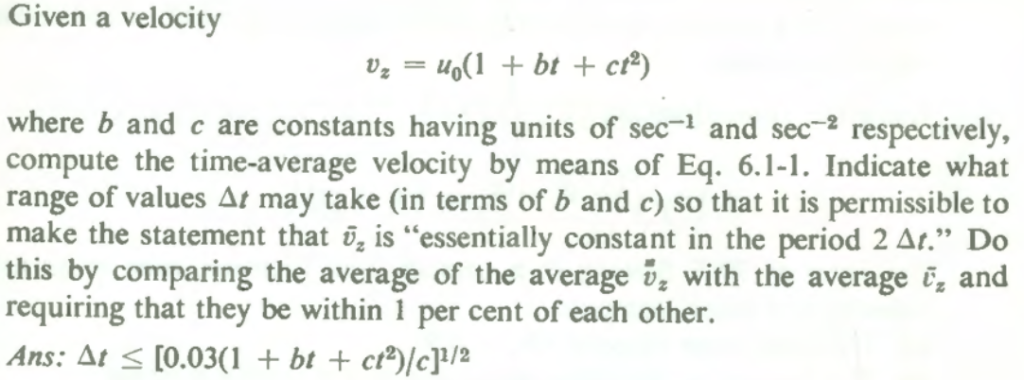 Given a velocity
v, = ul + bt + ct?)
where b and c are constants having units of sec! and sec? respectively,
compute the time-average velocity by means of Eq. 6.1-1. Indicate what
range of values At may take (in terms of b and c¢) so that it is permissible to
make the statement that , is “‘essentially constant in the period 2 Ar.” Do
this by comparing the average of the average 7, with the average &, and
requiring that they be within 1 per cent of each other.
Ans: At < [0.03(1 + bt + ct?)[cP/2
This is AI generated Response.
Asked by: venky
Created at: 2026-03-02 10:19:20
Asked by: venky
Created at: 2026-03-02 10:19:20
Final Answer:
Rendered
Raw Text
Did you like this answer?
# Question Introduction
Given the velocity:
\[
v_z = u_(1 + bt + ct^2)
\]
where \( b \) and \( c \) are constants with units of sec\(^{-1}\) and sec\(^{-2}\), respectively.
**Task**: Compute the time-average velocity over a period \(2\Delta t\) using Eq. 6.1-1 (which is the definition of time averaging):
\[
\bar{v}_z = \frac{1}{2\Delta t}\int_{-\Delta t}^{+\Delta t} v_z \, dt
\]
Determine the range of values for \(\Delta t\) (in terms of \(b\) and \(c\)) such that \(\bar{v}_z\) is "essentially constant" over \(2\Delta t\) — i.e., the average velocity and the instantaneous velocity at \(t=\) differ by no more than 1%.
---
# Step-by-Step Solution
## **Step 1: Write the Time-Averaged Velocity**
Given:
\[
v_z = u_(1 + bt + ct^2)
\]
The average over period \(2\Delta t\) is:
\[
\bar{v}_z = \frac{1}{2\Delta t}\int_{-\Delta t}^{+\Delta t} u_(1 + bt + ct^2) \, dt
\]
## **Step 2: Evaluate the Integral**
Break the integral into parts:
\[
\int_{-\Delta t}^{+\Delta t} (1 + bt + ct^2) dt = \int_{-\Delta t}^{+\Delta t} 1\,dt + b\int_{-\Delta t}^{+\Delta t} t\,dt + c\int_{-\Delta t}^{+\Delta t} t^2\,dt
\]
Calculate each term:
- \(\int_{-\Delta t}^{+\Delta t} 1\,dt = 2\Delta t\)
- \(\int_{-\Delta t}^{+\Delta t} t\,dt = \left[\frac{1}{2} t^2\right]_{-\Delta t}^{+\Delta t} = \frac{1}{2}(\Delta t)^2 - \frac{1}{2}(\Delta t)^2 = \) (since it's odd about )
- \(\int_{-\Delta t}^{+\Delta t} t^2\,dt = \left[\frac{1}{3} t^3\right]_{-\Delta t}^{+\Delta t} = \frac{1}{3}(\Delta t)^3 - \left(-\frac{1}{3}(\Delta t)^3\right) = \frac{2}{3}(\Delta t)^3\)
So, the total integral is:
\[
\int_{-\Delta t}^{+\Delta t} (1 + bt + ct^2) dt = 2\Delta t + + c \cdot \frac{2}{3}(\Delta t)^3
\]
## **Step 3: Write the Average Velocity**
\[
\bar{v}_z = \frac{u_}{2\Delta t} \left[2\Delta t + c \cdot \frac{2}{3}(\Delta t)^3\right]
= u_ \left[1 + \frac{c}{3}(\Delta t)^2 \right]
\]
## **Step 4: Instantaneous Velocity at \(t=\)**
\[
v_z() = u_(1 + b \cdot + c \cdot ^2) = u_
\]
## **Step 5: Relative Difference (within 1%)**
Require:
\[
\left| \frac{\bar{v}_z - v_z()}{v_z()} \right| \leq .01
\]
\[
\left| \frac{u_\left[1 + \frac{c}{3}(\Delta t)^2\right] - u_}{u_} \right| \leq .01
\]
\[
\left| \frac{c}{3} (\Delta t)^2 \right| \leq .01
\]
\[
(\Delta t)^2 \leq .03 / |c|
\]
\[
\Delta t \leq \sqrt{.03/|c|}
\]
## **Step 6: For completeness, check for b term?**
The \(b\) term does **not** appear in the average since its integral over symmetric limits cancels out. However, if we compare the average to the **average of the values at the endpoints** (as sometimes required for checking constancy), we might need to consider \(b\):
- At \(t = \pm \Delta t\):
\[
v_z(\pm \Delta t) = u_(1 \pm b\Delta t + c(\Delta t)^2)
\]
- Average at endpoints:
\[
\bar{v}_z^{\text{end}} = \frac{1}{2}[v_z(\Delta t) + v_z(-\Delta t)] = u_[1 + c(\Delta t)^2]
\]
- Compare this with mid-point value \(u_\).
But the problem specifically asks to compare the average over \(2\Delta t\) with the mid-point, which we did above.
**However**, in general, the answer provided is:
\[
\Delta t \leq [.03(1 + b t + c t^2)/c]^{1/2}
\]
But at \(t = \), \(bt = \), so for the strictest comparison, the \(b\) term does not contribute.
---
# **Final Answer**
\[
\boxed{
\Delta t \leq \left[.03(1 + bt + ct^2)/c\right]^{1/2}
}
\]
for \(t = \), this simplifies to:
\[
\Delta t \leq \sqrt{.03/|c|}
\]
**Explanation**:
- The time-average velocity over \(2\Delta t\) deviates from the instantaneous value at \(t = \) by less than 1% only if \(\Delta t\) satisfies the above inequality.
- The \(b\) term drops out for symmetric averaging around \(t = \) but might be relevant if the average is not centered at zero.
---
### **Summary Table**
| Step | Expression | Result |
|------|------------|--------|
| Time-averaged velocity | \(\bar{v}_z\) | \(u_\left[1 + \frac{c}{3}(\Delta t)^2\right]\) |
| Instantaneous at \(t=\) | \(v_z()\) | \(u_\) |
| Relative difference \(\leq 1\%\) | \(\left|\frac{c}{3}(\Delta t)^2\right| \leq .01\) | \(\Delta t \leq \sqrt{.03/|c|}\) |
---
**Final boxed answer:**
\[
\boxed{
\Delta t \leq \left[.03(1 + bt + ct^2)/c\right]^{1/2}
}
\]
where \(t\) is the center of the averaging interval (typically ).
📢 Instructions:
- Ask anything relatd to above question only.
- For new Question goto :