 VIPSolutions
Give step-by-step solution with explanation and final answer: (give me complete answer without using bullet-points)In the example problem 4.1-1, we have defined a dimensionless variable n = y/vV4vt and obtained the velocity profile as > =1- erf(2=). Is there any benefit of using n = y/V4vt, o rather than y = y//vt? Show your work.
Question:
Give step-by-step solution with explanation and final answer:
(give me complete answer without using bullet-points)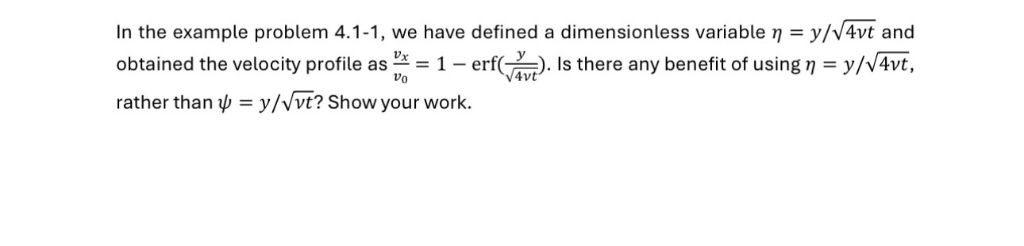 In the example problem 4.1-1, we have defined a dimensionless variable n = y/vV4vt and
obtained the velocity profile as > =1- erf(2=). Is there any benefit of using n = y/V4vt,
o
rather than y = y//vt? Show your work.
This is AI generated Response.
Asked by: francis
Created at: 2026-03-02 03:01:49
Asked by: francis
Created at: 2026-03-02 03:01:49
Final Answer:
Rendered
Raw Text
Did you like this answer?
Let's analyze the problem step by step:
We are given the dimensionless variable \(\eta = \frac{y}{\sqrt{4\nu t}}\ and the velocity profile:
\[
\frac{v_x}{v_} = 1 - \text{erf}\left(\frac{y}{\sqrt{4\nu t}}\right) = 1 - \text{erf}(\eta)
\]
The question asks whether there is any benefit to using \(\eta = \frac{y}{\sqrt{4\nu t}}\) rather than \(\psi = \frac{y}{\sqrt{\nu t}}\).
First, let's rewrite the velocity profile using \(\psi\):
Since \(\psi = \frac{y}{\sqrt{\nu t}}\), we can relate \(\eta\) and \(\psi\):
\[
\eta = \frac{y}{\sqrt{4\nu t}} = \frac{y}{2\sqrt{\nu t}} = \frac{\psi}{2}
\]
So, substituting into the original velocity profile:
\[
\frac{v_x}{v_} = 1 - \text{erf}(\eta) = 1 - \text{erf}\left(\frac{\psi}{2}\right)
\]
If we had used \(\psi\) as the dimensionless variable, the velocity profile would be:
\[
\frac{v_x}{v_} = 1 - \text{erf}\left(\frac{\psi}{2}\right)
\]
Now, let's consider the benefit of using \(\eta\) instead of \(\psi\).
The argument of the error function in the solution to the diffusion equation (which governs this type of velocity profile) conventionally appears as \(y/\sqrt{4\nu t}\) in mathematical tables and textbooks. The reason is that the fundamental solution (Green's function) for the diffusion equation is:
\[
G(y, t) = \frac{1}{\sqrt{4\pi \nu t}} \exp\left(-\frac{y^2}{4\nu t}\right)
\]
and the cumulative integral of this Gaussian (which leads to the error function) uses \(y/\sqrt{4\nu t}\) as the natural similarity variable.
If you use \(\eta = y/\sqrt{4\nu t}\), the velocity profile simplifies to:
\[
\frac{v_x}{v_} = 1 - \text{erf}(\eta)
\]
which is the standard form found in tables and references for error functions.
If you instead use \(\psi = y/\sqrt{\nu t}\), you must always write the argument as \(\psi/2\) in the error function, which is less convenient and not standard. This could lead to confusion or extra work when comparing your solution to standard references or using tabulated values of the error function.
**Final Answer:**
There is a clear benefit to using \(\eta = \frac{y}{\sqrt{4\nu t}}\) instead of \(\psi = \frac{y}{\sqrt{\nu t}}\). The form \(\eta\) matches the conventional argument for the error function in diffusion problems, aligns with standard mathematical tables, and makes the solution easier to use and compare with standard results. Using \(\psi\) would always require an additional factor in the error function argument, adding unnecessary complexity. Thus, using \(\eta\) is more standard and convenient.
Question:
give me step by step complete answer in simple way
This is AI generated Response.
Asked by: francis
Created at: 2026-03-02 03:12:19
Asked by: francis
Created at: 2026-03-02 03:12:19
Final Answer:
Rendered
Raw Text
Did you like this answer?
# Step-by-Step Solution to the Problem
## Given Information
We have defined a dimensionless variable:
\[
\eta = \frac{y}{\sqrt{4\nu t}}
\]
The velocity profile is given by:
\[
\frac{v_x}{v} = 1 - \text{erf}(\eta)
\]
## Comparison of Variables
We want to compare the dimensionless variable \(\eta\) with another variable \(\psi\):
\[
\psi = \frac{y}{\sqrt{\nu t}}
\]
### Relating \(\eta\) and \(\psi\)
To express \(\eta\) in terms of \(\psi\), we can rewrite \(\eta\):
\[
\eta = \frac{y}{\sqrt{4\nu t}} = \frac{y}{2\sqrt{\nu t}} = \frac{\psi}{2}
\]
### Velocity Profile Using \(\psi\)
Now, substituting \(\psi\) into the original velocity profile:
\[
\frac{v_x}{v} = 1 - \text{erf}(\eta) = 1 - \text{erf}\left(\frac{\psi}{2}\right)
\]
## Benefits of Using \(\eta\)
1. **Standardization**: The standard form of the error function in diffusion problems is typically expressed with the argument \(\frac{y}{\sqrt{4\nu t}}\). Using \(\eta\) aligns with this standard form.
2. **Simplification**: By using \(\eta\), the velocity profile becomes:
\[
\frac{v_x}{v} = 1 - \text{erf}(\eta)
\]
This is a straightforward expression that does not require any additional factors.
3. **Ease of Reference**: Many mathematical tables and literature provide values for \(\text{erf}\) based on the argument \(\frac{y}{\sqrt{4\nu t}}\). Using \(\eta\) allows for easier reference to these values without modification.
4. **Less Complexity**: If \(\psi\) is used, the error function argument becomes \(\frac{\psi}{2}\), introducing additional complexity and potential confusion when comparing results.
## Final Conclusion
Using the dimensionless variable \(\eta = \frac{y}{\sqrt{4\nu t}}\) is advantageous because it aligns with standard practices in the field of diffusion, simplifies the expression of the velocity profile, and reduces complexity when referencing mathematical tables. Therefore, \(\eta\) is the preferred variable in this context.
📢 Instructions:
- Ask anything relatd to above question only.
- For new Question goto :