Question:
Give me step by step answer in tutor mode
Did you like this answer?
👍 0
👎 0
# Step-by-Step Tutor Guide
Let's solve each together, step by step!
---
## **Equations Provided**
1. NH₄Cr₂O₄ → Cr₂O₃ + N₂ + H₂O
2. FeCl₂ + Fe₂O₃ → FeCl₃ + O₂
3. S²⁻ + Na₂Cr₂O₇ + H₂O → S + NO₂ + Cr(OH)₂ + NaOH
4. LiOH + MgCl₂ → LiCl + Mg(OH)₂
---
## **a) Are there any noticeable errors in the equations? (2 marks)**
Let's check each equation for errors (balancing, chemical logic):
### **Equation 1:**
NH₄Cr₂O₄ → Cr₂O₃ + N₂ + H₂O
- **Check:** Let's balance N, H, Cr, O.
- NH₄Cr₂O₄ contains NH₄⁺ and Cr₂O₄²⁻. Decomposition commonly gives N₂, H₂O, and Cr₂O₃.
- **Possible issue:** Check balancing—let's write atoms on both sides:
- **N:** 1×NH₄ = 1 N (as NH₄), but produces N₂ (2 N atoms).
- **Cr:** 2 Cr both sides.
- **O:** 4 O (left); Cr₂O₃ (3), H₂O (1).
- **H:** 4 H (left), 2 H (right).
- **Conclusion:** Equation is **not balanced**!
### **Equation 2:**
FeCl₂ + Fe₂O₃ → FeCl₃ + O₂
- **Check:**
- Fe: 1 + 2 = 3 (left), 1 (right).
- Cl: 2 (left), 3 (right).
- O: 3 (left), 2 (right).
- **Conclusion:** **Not balanced**.
### **Equation 3:**
S²⁻ + Na₂Cr₂O₇ + H₂O → S + NO₂ + Cr(OH)₂ + NaOH
- **Check:**
- Where does NO₂ come from? No N on the left.
- **Conclusion:** **NO₂ should not be a product**. Likely a typo.
### **Equation 4:**
LiOH + MgCl₂ → LiCl + Mg(OH)₂
- **Check:**
- Li: 1 (left), 1 (right).
- OH: 1 (left), 2 (right).
- Mg: 1 (left), 1 (right).
- Cl: 2 (left), 1 (right).
- **Conclusion:** **Not balanced**.
### **Summary Table**
| Equation | Error? | Description |
|----------|--------|-----------------------------------------------|
| 1 | Yes | Not balanced (N and H mismatch) |
| 2 | Yes | Not balanced (all elements mismatched) |
| 3 | Yes | NO₂ product impossible (no N on reactant side)|
| 4 | Yes | Not balanced (OH and Cl mismatch) |
---
## **b) Name the anions from equation 3. (3 marks)**
From equation 3 (left side):
S²⁻, Na₂Cr₂O₇, H₂O
- **Anions:**
1. **Sulfide** (S²⁻)
2. **Dichromate** (Cr₂O₇²⁻, from Na₂Cr₂O₇)
3. **Hydroxide** (OH⁻, from H₂O, possibly after reaction)
---
## **c) Select an anion from equation 1, pair it with a group 10 metal cation with +3 charge, write formula and IUPAC name. (2 marks)**
- **From equation 1:** Anion is Cr₂O₄²⁻ (**chromate**).
- **Group 10 metals:** Nickel (Ni), Palladium (Pd), Platinum (Pt).
- **Required oxidation state:** +3 (e.g., Ni³⁺).
- **Compound:** Ni₂(Cr₂O₄)₃
**IUPAC name:**
Nickel(III) chromate
---
## **d) Name the products of equation 2. (2 marks)**
Equation 2: FeCl₂ + Fe₂O₃ → FeCl₃ + O₂
- **FeCl₃:** Iron(III) chloride
- **O₂:** Oxygen gas
---
## **e) Write complete ionic and net ionic equation for equation 4. (5 marks)**
**Equation 4:** LiOH + MgCl₂ → LiCl + Mg(OH)₂
### **Step 1: Write the complete ionic equation**
- LiOH (aq) → Li⁺ (aq) + OH⁻ (aq)
- MgCl₂ (aq) → Mg²⁺ (aq) + 2Cl⁻ (aq)
- LiCl (aq) → Li⁺ (aq) + Cl⁻ (aq)
- Mg(OH)₂ (s) is **insoluble (precipitate)**
**Complete ionic equation:**
Li⁺ (aq) + OH⁻ (aq) + Mg²⁺ (aq) + 2Cl⁻ (aq) → Li⁺ (aq) + Cl⁻ (aq) + Mg(OH)₂ (s)
### **Step 2: Cancel spectator ions (Li⁺ and Cl⁻)**
**Net ionic equation:**
Mg²⁺ (aq) + 2OH⁻ (aq) → Mg(OH)₂ (s)
---
## **Summary Table**
| Part | Answer |
|------|--------|
| a | Yes, all equations have errors (balancing or products) |
| b | Anions: Sulfide (S²⁻), Dichromate (Cr₂O₇²⁻), Hydroxide (OH⁻) |
| c | Ni₂(Cr₂O₄)₃, Nickel(III) chromate |
| d | Iron(III) chloride, Oxygen gas |
| e | Complete ionic: Li⁺ + OH⁻ + Mg²⁺ + 2Cl⁻ → Li⁺ + Cl⁻ + Mg(OH)₂; Net ionic: Mg²⁺ + 2OH⁻ → Mg(OH)₂ |
---
If you need any steps explained in more detail, let me know!
 VIPSolutions
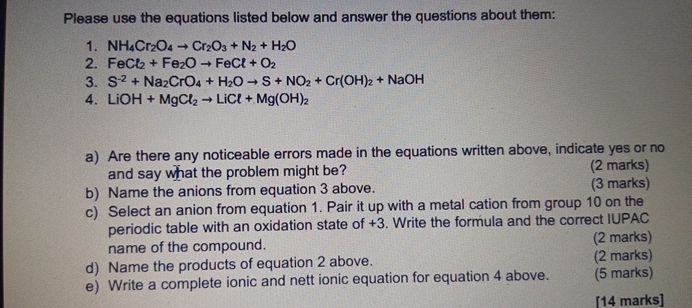 Ee is
use the equations sted below and answer the questions about them:
1. NHiCrz04 — Cr:0s + Na + H:0 Eo
2. FeCt+Fe:0~FeCt+O; =
© 3. 52+ NasCrO4 + Hi0 + 5 + NO; + Gr(OH) + NaOH z
28 4. LOH + MgCl, — LICL + Mg(OH) =
a) Are there any noticeable errors made in the equations written above, indicate ye
and say what the problem might be? (2 mar
b) Name the anions from equation 3 above. (3 marks)
©) Select an anion from equation 1. Pair it up with a metal cation from group 10.08 the
periodic table with an oxidation state of +3. Wie the formula and the correct IUPAC
name of the compound. (2m: rks)
d) Name the products of equation 2 above. (2 mark
I & &) Write a complete ionic and nett ionic equation for equation 4 above. 5 marks