 VIPSolutions
Give me step by step answer along with final answer.If you want to produce ammonia using a batch reactor (BR), what is the most suitable reactor to use? State the advantages or disadvantages of using a batch reactor in this reaction and what needs to be done to obtain optimal results? Sketch and label.
Question:
Give me step by step answer along with final answer.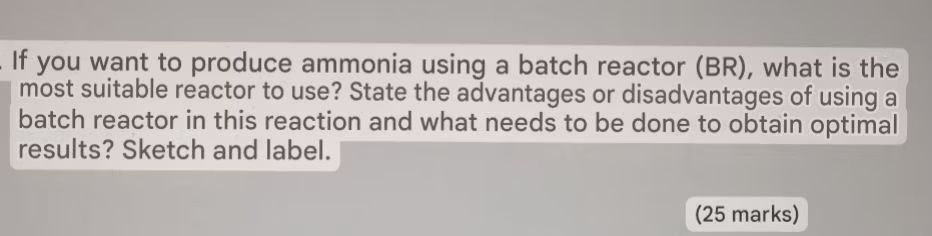 If you want to produce ammonia using a batch reactor (BR), what is the
most suitable reactor to use? State the advantages or disadvantages of using a
batch reactor in this reaction and what needs to be done to obtain optimal
results? Sketch and label.
This is AI generated Response.
Asked by: Francis
Created at: 2025-10-20 20:20:52
Asked by: Francis
Created at: 2025-10-20 20:20:52
Final Answer:
Rendered
Raw Text
Did you like this answer?
# Step-by-step Answer
## 1. Understanding the Question
The question asks:
**"If you want to produce ammonia using a batch reactor (BR), what is the most suitable reactor to use? State the advantages or disadvantages of using a batch reactor in this reaction and what needs to be done to obtain optimal results? Sketch and label."**
## 2. Selection of Reactor
- **Most suitable reactor:**
For ammonia synthesis, the most common reactor used is a **Continuous Stirred Tank Reactor (CSTR)** or **Fixed-bed catalytic reactor**.
However, since the question specifically asks about **batch reactors**, the answer is **Batch Reactor (BR)**.
- **Note:**
In industrial ammonia production, **continuous reactors** are preferred for large-scale synthesis, but for experimental or small-scale production, a **batch reactor** can be used.
## 3. Advantages of Using a Batch Reactor
- Flexibility to produce different quantities.
- Easy to control and monitor reaction conditions.
- Suitable for small-scale production or experimental purposes.
- Good for reactions requiring careful control of temperature, pressure, or other parameters.
## 4. Disadvantages of Using a Batch Reactor
- Not suitable for large-scale continuous production.
- Longer cycle times and lower productivity.
- More labor-intensive and less efficient for large-scale operations.
- Difficult to maintain consistent conditions over long periods.
## 5. Requirements for Optimal Results
- Proper temperature and pressure control (e.g., high pressure, moderate temperature for ammonia synthesis).
- Adequate mixing to ensure uniform reactant distribution.
- Catalyst addition and activation.
- Efficient removal of produced ammonia to shift equilibrium toward product formation.
## 6. Sketch and Label
- The sketch should show a simple **batch reactor** vessel with:
- Reactant inlet (N₂ and H₂ gases)
- Reactor vessel
- Stirrer or agitator
- Temperature and pressure control systems
- Outlet for ammonia and unreacted gases
---
# Final Answer
**Most Suitable Reactor:**
A **Batch Reactor** can be used for small-scale ammonia synthesis, especially in experimental settings.
**Advantages:**
- Flexibility in production size
- Good control over reaction conditions
- Suitable for small-scale or research purposes
**Disadvantages:**
- Not ideal for large-scale continuous production
- Time-consuming and labor-intensive
- Less efficient at high throughput
**Requirements for Optimal Results:**
- Maintain high pressure (~200 atm) and moderate temperature (~400-500°C)
- Use a suitable catalyst (e.g., iron-based catalyst)
- Ensure thorough mixing and proper heat removal
- Remove ammonia continuously to shift equilibrium
**Sketch (Description):**
A vessel labeled "Batch Reactor" with inlets for N₂ and H₂ gases, an agitator for mixing, temperature and pressure controls, and an outlet for ammonia and unreacted gases.
📢 Instructions:
- Ask anything relatd to above question only.
- For new Question goto :