 VIPSolutions
Give step-by-step solution with explanation and final answer: (Give me answer without using bullet points).2. Discuss the following questions: a. Define a separable kinetics and provide the reaction rate expression in terms of time, 7. Suggest two types of decay. (2 marks) b. Explain diffusion in terms of molar flux, for the case of: i. Equimolar counter diffusion (2 marks) ii. Diffusion through stagnant film. (2 marks) c. Provide two conditions where space-time, 7 and mean residence time, x would be equal. Suggest a residence time distribution function for the molecules leaving a plug flow reactor (PFR). (4 marks)
Question:
Give step-by-step solution with explanation and final answer:
(Give me answer without using bullet points).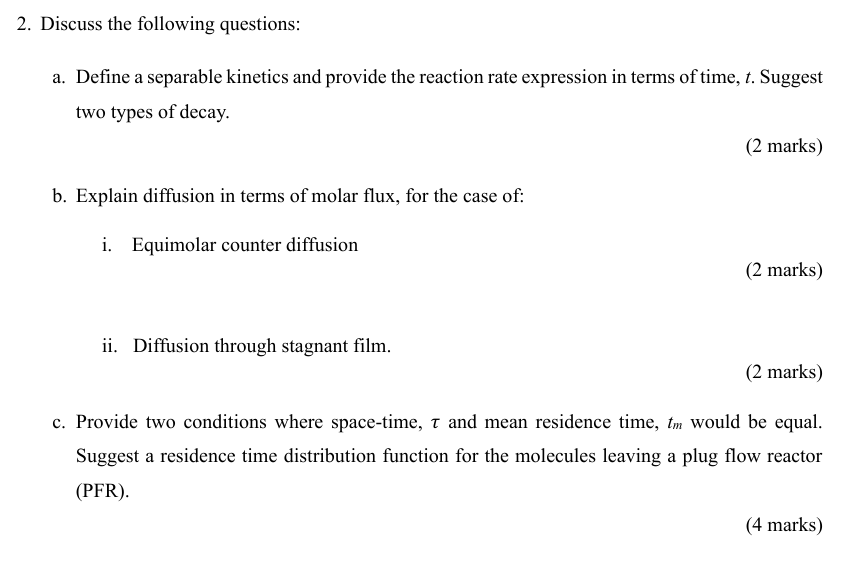 2. Discuss the following questions:
a. Define a separable kinetics and provide the reaction rate expression in terms of time, 7. Suggest
two types of decay.
(2 marks)
b. Explain diffusion in terms of molar flux, for the case of:
i. Equimolar counter diffusion
(2 marks)
ii. Diffusion through stagnant film.
(2 marks)
c. Provide two conditions where space-time, 7 and mean residence time, x would be equal.
Suggest a residence time distribution function for the molecules leaving a plug flow reactor
(PFR).
(4 marks)
This is AI generated Response.
Asked by: Francis
Created at: 2026-01-26 18:58:57
Asked by: Francis
Created at: 2026-01-26 18:58:57
Final Answer:
Rendered
Raw Text
Did you like this answer?
# Step-by-Step Solution
## a. Separable Kinetics and Types of Decay
Separable kinetics refers to a reaction rate law where the rate of reaction can be expressed as a product of a function of concentration and a function of time, i.e., \( r = f(C)g(t) \). For many reactions, especially first-order decay, the rate law can be written as \( \frac{dC}{dt} = -kC \), where \( k \) is the rate constant. Solving this differential equation gives \( C(t) = C_ e^{-kt} \), where \( C_ \) is the initial concentration. Two types of decay commonly encountered are first-order decay (as above) and zero-order decay, where \( \frac{dC}{dt} = -k \), which leads to \( C(t) = C_ - kt \).
## b. Diffusion and Molar Flux
For equimolar counter diffusion, two species A and B diffuse in opposite directions with equal molar flux but opposite signs, so the net total molar flux is zero. The molar flux of A, \( N_A \), can be given by Fick's law as \( N_A = -D_{AB} \frac{dC_A}{dz} \), where \( D_{AB} \) is the diffusion coefficient, and \( \frac{dC_A}{dz} \) is the concentration gradient of A.
For diffusion through a stagnant film, one component (say, B) is non-diffusing or stagnant, and only A diffuses through the film. The molar flux of A, \( N_A \), is given by \( N_A = -D_{AB} \frac{dC_A}{dz} \). However, the total flux now is not zero because B does not counter-diffuse, so the movement of A is through a stationary medium.
## c. Conditions for Equality of Space-Time and Mean Residence Time, and RTD for PFR
The space-time, \( \tau \), is defined as the reactor volume divided by the volumetric flow rate (\( \tau = V/Q \)). The mean residence time, \( t_m \), is the average time that a molecule spends in the reactor. \( \tau \) and \( t_m \) are equal under the following conditions: (1) the flow is steady and there is no dead volume or bypassing, and (2) the density and volumetric flow rate are constant throughout the reactor (e.g., for incompressible fluids). For a plug flow reactor (PFR), the residence time distribution (RTD) function is a Dirac delta function: \( E(t) = \delta(t - \tau) \), indicating that all molecules spend exactly the same amount of time (\( \tau \)) in the reactor before exiting.
---
**Final Answers:**
a. Separable kinetics allows the reaction rate to be written as a product of functions of concentration and time; for first-order decay, \( C(t) = C_ e^{-kt} \), and for zero-order decay, \( C(t) = C_ - kt \).
b. In equimolar counter diffusion, \( N_A = -D_{AB} \frac{dC_A}{dz} \) and the net molar flux is zero. In diffusion through a stagnant film, only one component diffuses and \( N_A = -D_{AB} \frac{dC_A}{dz} \).
c. Space-time and mean residence time are equal when there is steady, ideal flow (no bypassing or dead zones) and constant volumetric flow rate. The RTD for a PFR is \( E(t) = \delta(t - \tau) \).
Question:
give me step by step answer along with final answer.
This is AI generated Response.
Asked by: Francis
Created at: 2026-01-26 19:01:49
Asked by: Francis
Created at: 2026-01-26 19:01:49
Final Answer:
Rendered
Raw Text
Did you like this answer?
# Step-by-Step Solution
## a. Separable Kinetics and Types of Decay
Separable kinetics describes a situation where the reaction rate can be expressed as a product of a function of concentration and a function of time. The general form is given by \( r = f(C)g(t) \).
For a first-order reaction, the rate law can be expressed as:
\[
\frac{dC}{dt} = -kC
\]
where \( k \) is the rate constant. Solving this differential equation yields:
\[
C(t) = C_0 e^{-kt}
\]
Here, \( C_0 \) is the initial concentration. Two common types of decay are:
1. **First-order decay**: Characterized by the equation above.
2. **Zero-order decay**: Described by:
\[
\frac{dC}{dt} = -k
\]
This leads to:
\[
C(t) = C_0 - kt
\]
## b. Diffusion and Molar Flux
In the case of **equimolar counter diffusion**, two species, A and B, diffuse in opposite directions with equal molar fluxes, thus the total molar flux is zero. The molar flux of A is given by Fick's law:
\[
N_A = -D_{AB} \frac{dC_A}{dz}
\]
where \( D_{AB} \) is the diffusion coefficient and \( \frac{dC_A}{dz} \) is the concentration gradient of A.
For **diffusion through a stagnant film**, one species (B) remains stationary while A diffuses through the film. The molar flux of A remains the same:
\[
N_A = -D_{AB} \frac{dC_A}{dz}
\]
In this scenario, the total flux is not zero since B is not diffusing, resulting in A moving through a stagnant medium.
## c. Conditions for Equality of Space-Time and Mean Residence Time, and RTD for PFR
Space-time, denoted as \( \tau \), is defined as the reactor volume divided by the volumetric flow rate:
\[
\tau = \frac{V}{Q}
\]
Mean residence time, \( t_m \), is the average time molecules spend in the reactor. The conditions under which \( \tau \) and \( t_m \) are equal include:
1. The flow is steady, with no dead volume or bypassing.
2. The density and volumetric flow rate are constant throughout the reactor, applicable for incompressible fluids.
For a plug flow reactor (PFR), the residence time distribution (RTD) is represented by a Dirac delta function:
\[
E(t) = \delta(t - \tau)
\]
This indicates that all molecules exit the reactor after spending exactly the same time \( \tau \).
---
**Final Answers:**
a. Separable kinetics allows the reaction rate to be expressed as a product of functions of concentration and time. The first-order decay is represented by \( C(t) = C_0 e^{-kt} \), and zero-order decay is \( C(t) = C_0 - kt \).
b. In equimolar counter diffusion, the molar flux is \( N_A = -D_{AB} \frac{dC_A}{dz} \) with a net flux of zero. For diffusion through a stagnant film, the molar flux remains \( N_A = -D_{AB} \frac{dC_A}{dz} \), but the total flux is not zero.
c. Space-time and mean residence time are equal under steady flow with no bypassing and constant volumetric flow rates. The RTD for a PFR is given by \( E(t) = \delta(t - \tau) \).
📢 Instructions:
- Ask anything relatd to above question only.
- For new Question goto :