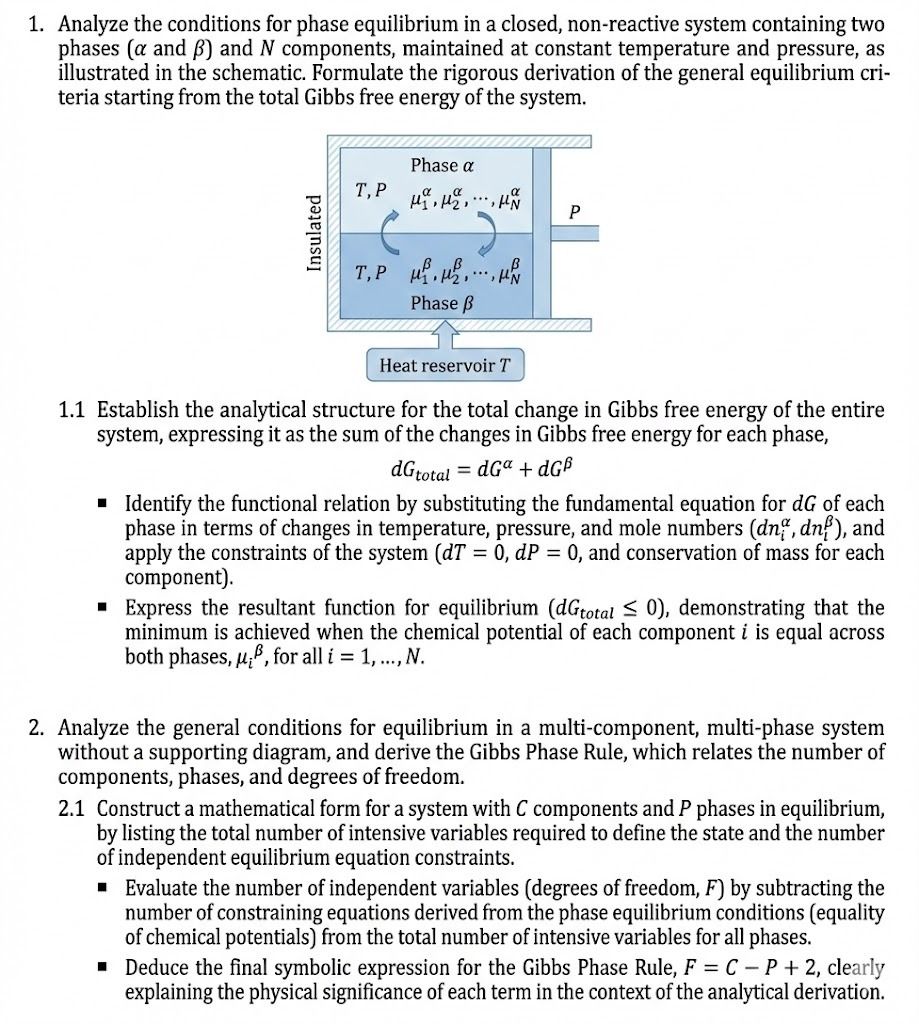
Act like a helpful tutor and exlain step-by-step solution with explanation and final answer:1. Analyze the conditions for phase equilibrium in a closed, non-reactive system containing two
phases (a and 8) and N components, maintained at constant temperature and pressure, as
illustrated in the schematic. Formulate the rigorous derivation of the general equilibrium cri-
teria starting from the total Gibbs free energy of the system.
Phase a
s/f, mse |,
5
2 K ¢
2 b ’
S| np uhh
Phase
Heat reservoir T
1.1 Establish the analytical structure for the total change in Gibbs free energy of the entire
system, expressing it as the sum of the changes in Gibbs free energy for each phase,
dGyorq = dG* + dGP
= Identify the functional relation by substituting the fundamental equation for dG of each
phase in terms of changes in temperature, pressure, and mole numbers (dng, dnf), and
apply the constraints of the system (dT = 0, dP = 0, and conservation of mass for each
component).
= Express the resultant function for equilibrium (dGeorar < 0), demonstrating that the
minimum is achieved when the chemical potential of each component i is equal across
both phases, ;#, forall i = 1, ..., N.
2. Analyze the general conditions for equilibrium in a multi-component, multi-phase system
without a supporting diagram, and derive the Gibbs Phase Rule, which relates the number of
components, phases, and degrees of freedom.
2.1 Construct a mathematical form for a system with C components and P phases in equilibrium,
by listing the total number of intensive variables required to define the state and the number
of independent equilibrium equation constraints.
= Evaluate the number of independent variables (degrees of freedom, F) by subtracting the
number of constraining equations derived from the phase equilibrium conditions (equality
of chemical potentials) from the total number of intensive variables for all phases.
= Deduce the final symbolic expression for the Gibbs Phase Rule, F = C — P + 2, clearly
explaining the physical significance of each term in the context of the analytical derivation.
Question:
Act like a helpful tutor and exlain step-by-step solution with explanation and final answer:1. Analyze the conditions for phase equilibrium in a closed, non-reactive system containing two
phases (a and 8) and N components, maintained at constant temperature and pressure, as
illustrated in the schematic. Formulate the rigorous derivation of the general equilibrium cri-
teria starting from the total Gibbs free energy of the system.
Phase a
s/f, mse |,
5
2 K ¢
2 b ’
S| np uhh
Phase
Heat reservoir T
1.1 Establish the analytical structure for the total change in Gibbs free energy of the entire
system, expressing it as the sum of the changes in Gibbs free energy for each phase,
dGyorq = dG* + dGP
= Identify the functional relation by substituting the fundamental equation for dG of each
phase in terms of changes in temperature, pressure, and mole numbers (dng, dnf), and
apply the constraints of the system (dT = 0, dP = 0, and conservation of mass for each
component).
= Express the resultant function for equilibrium (dGeorar < 0), demonstrating that the
minimum is achieved when the chemical potential of each component i is equal across
both phases, ;#, forall i = 1, ..., N.
2. Analyze the general conditions for equilibrium in a multi-component, multi-phase system
without a supporting diagram, and derive the Gibbs Phase Rule, which relates the number of
components, phases, and degrees of freedom.
2.1 Construct a mathematical form for a system with C components and P phases in equilibrium,
by listing the total number of intensive variables required to define the state and the number
of independent equilibrium equation constraints.
= Evaluate the number of independent variables (degrees of freedom, F) by subtracting the
number of constraining equations derived from the phase equilibrium conditions (equality
of chemical potentials) from the total number of intensive variables for all phases.
= Deduce the final symbolic expression for the Gibbs Phase Rule, F = C — P + 2, clearly
explaining the physical significance of each term in the context of the analytical derivation.
This is AI generated Response.
Asked by: Francis
Created at: 2026-02-12 20:32:55
Final Answer:
RenderedRaw Text
Did you like this answer?
# Step-by-Step Solution
Let's break down the problem and solve it **step by step**.
---
## 1. **Phase Equilibrium in a Closed, Non-Reactive System (Two Phases, N Components)**
### **Step 1: Total Gibbs Free Energy**
For a system with two phases (α and β) and \(N\) components at constant \(T\) and \(P\):
\[
dG_{\text{total}} = dG^\alpha + dG^\beta
\]
### **Step 2: Fundamental Equation for Each Phase**
The differential form of Gibbs free energy for each phase (for phase \(\alpha\)):
\[
dG^\alpha = -S^\alpha dT + V^\alpha dP + \sum_{i=1}^N \mu_i^\alpha dn_i^\alpha
\]
Similarly for phase \(\beta\):
\[
dG^\beta = -S^\beta dT + V^\beta dP + \sum_{i=1}^N \mu_i^\beta dn_i^\beta
\]
#### **Apply Constraints:**
- **Constant T and P:** \(dT = \), \(dP = \)
- **Closed system:** \(dn_i^\alpha + dn_i^\beta = \) (conservation of mass for each component \(i\))
So,
\[
dG_{\text{total}} = \sum_{i=1}^N \mu_i^\alpha dn_i^\alpha + \mu_i^\beta dn_i^\beta
\]
But \(dn_i^\beta = -dn_i^\alpha\):
\[
dG_{\text{total}} = \sum_{i=1}^N (\mu_i^\alpha - \mu_i^\beta) dn_i^\alpha
\]
### **Step 3: Equilibrium Condition**
At equilibrium, the total Gibbs free energy must be at a minimum (or stationary):
\[
dG_{\text{total}} \leq
\]
For arbitrary (virtual) transfers \(dn_i^\alpha\), the only way for this to be true for all components is:
\[
\mu_i^\alpha = \mu_i^\beta \quad \forall i = 1,...,N
\]
**This is the condition for phase equilibrium**:
*The chemical potential of each component must be equal in both phases.*
---
## 2. **Gibbs Phase Rule for Multi-Component, Multi-Phase Systems**
### **Step 1: Count Intensive Variables**
- **C:** Number of components
- **P:** Number of phases
For each phase, each component has a chemical potential \(\mu_i^j\) (where \(i=1,...,C\), \(j=1,...,P\)).
Total number of chemical potentials: \(C \times P\).
Other intensive variables: \(T\) and \(P\).
### **Step 2: Number of Independent Variables**
- Each phase equilibrium condition sets \(\mu_i^1 = \mu_i^2 = ... = \mu_i^P\) for each component.
- For each component, there are \((P-1)\) independent equations (since the chemical potential must be equal across all phases).
Total number of independent equilibrium equations: \(C \times (P-1)\).
### **Step 3: Degrees of Freedom (Gibbs Phase Rule)**
\[
F = \text{Number of intensive variables} - \text{Number of constraints}
\]
\[
F = [C \times P + 2] - [C \times (P-1)]
\]
\[
F = (C \times P + 2) - (C \times P - C)
\]
\[
F = C + 2
\]
But this doesn't look right. Let's correct:
Actually, we should **list the total number of variables for the entire system**:
- For all phases: Each phase has \(C-1\) mole fractions (since sum to 1), so \(P(C-1)\) composition variables.
- Plus \(T\) and \(P\): total \(P(C-1) + 2\).
**Number of constraints:**
- For each component: \(\mu_i^1 = \mu_i^2 = ... = \mu_i^P\) → \((P-1)C\) constraints.
\[
F = P(C-1) + 2 - (P-1)C
\]
\[
F = PC - P + 2 - PC + C
\]
\[
F = C - P + 2
\]
### **Final Symbolic Expression (Gibbs Phase Rule):**
\[
\boxed{F = C - P + 2}
\]
Where:
- \(F\): Degrees of freedom (intensive variables that can be varied independently)
- \(C\): Number of components
- \(P\): Number of phases
**Physical significance:**
- \(F\) tells you how many intensive variables (like temperature, pressure, or composition) you can set independently before the system's state is fully specified.
---
## **Summary Table**
| Step | Key Equation(s) | Explanation |
|---------------------|-------------------------------------------------------|---------------------------------------|
| 1.1 Gibbs energy | \(dG_{total} = \sum_{i=1}^N (\mu_i^\alpha - \mu_i^\beta) dn_i^\alpha\) | Express change in Gibbs energy |
| Equilibrium | \(\mu_i^\alpha = \mu_i^\beta\) | Chemical potentials equal at equilibrium |
| 2.1 Gibbs Phase Rule| \(F = C - P + 2\) | Degrees of freedom in multi-phase systems |
---
## **Final Answers**
### **Phase Equilibrium Condition:**
\[
\boxed{\mu_i^\alpha = \mu_i^\beta \quad \forall i = 1, ..., N}
\]
### **Gibbs Phase Rule:**
\[
\boxed{F = C - P + 2}
\]
Where each term is as defined above.
Question:
give me simple answer (student echinattu).
This is AI generated Response.
Asked by: Francis
Created at: 2026-02-12 20:38:10
Final Answer:
RenderedRaw Text
Did you like this answer?
# Simple Answer
## Phase Equilibrium Condition
At equilibrium in a closed, non-reactive system with two phases (α and β) and \(N\) components, the condition is:
\[
\mu_i^\alpha = \mu_i^\beta \quad \forall i = 1, ..., N
\]
This means the chemical potential of each component must be equal in both phases.
---
## Gibbs Phase Rule
For a system with \(C\) components and \(P\) phases, the degrees of freedom \(F\) can be expressed as:
\[
F = C - P + 2
\]
### Where:
- \(F\): Degrees of freedom (independent intensive variables)
- \(C\): Number of components
- \(P\): Number of phases
This rule helps in understanding how many properties of the system can be varied independently.
VIPSolutions focuses on clear, step‑by‑step explanations so you can learn quickly. Whether you need an AI‑generated walkthrough or a short hint to get unstuck, each solution is organized for fast reading and easy review later.
Search similar questions, compare approaches, and bookmark the best answers for revision. Our goal is simple: quick, reliable study help that feels natural—not noisy.
 VIPSolutions
 1. Analyze the conditions for phase equilibrium in a closed, non-reactive system containing two
phases (a and 8) and N components, maintained at constant temperature and pressure, as
illustrated in the schematic. Formulate the rigorous derivation of the general equilibrium cri-
teria starting from the total Gibbs free energy of the system.
Phase a
s/f, mse |,
5
2 K ¢
2 b ’
S| np uhh
Phase
Heat reservoir T
1.1 Establish the analytical structure for the total change in Gibbs free energy of the entire
system, expressing it as the sum of the changes in Gibbs free energy for each phase,
dGyorq = dG* + dGP
= Identify the functional relation by substituting the fundamental equation for dG of each
phase in terms of changes in temperature, pressure, and mole numbers (dng, dnf), and
apply the constraints of the system (dT = 0, dP = 0, and conservation of mass for each
component).
= Express the resultant function for equilibrium (dGeorar < 0), demonstrating that the
minimum is achieved when the chemical potential of each component i is equal across
both phases, ;#, forall i = 1, ..., N.
2. Analyze the general conditions for equilibrium in a multi-component, multi-phase system
without a supporting diagram, and derive the Gibbs Phase Rule, which relates the number of
components, phases, and degrees of freedom.
2.1 Construct a mathematical form for a system with C components and P phases in equilibrium,
by listing the total number of intensive variables required to define the state and the number
of independent equilibrium equation constraints.
= Evaluate the number of independent variables (degrees of freedom, F) by subtracting the
number of constraining equations derived from the phase equilibrium conditions (equality
of chemical potentials) from the total number of intensive variables for all phases.
= Deduce the final symbolic expression for the Gibbs Phase Rule, F = C — P + 2, clearly
explaining the physical significance of each term in the context of the analytical derivation.