 VIPSolutions
give answer in 2 step with explanation at the end of each step and final answer at the end:(8) Show that (y* + 2zy)dz — 2°dy = 0 is a homogeneous D.E. and then solve. Pap
Question:
give answer in 2 step with explanation at the end of each step and final answer at the end: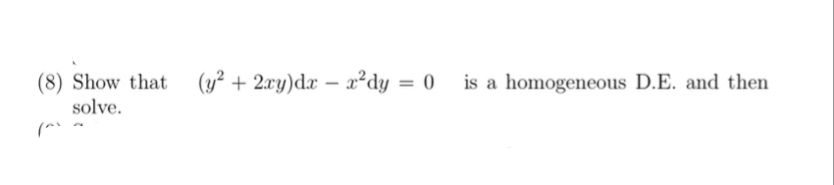 (8) Show that (y* + 2zy)dz — 2°dy = 0 is a homogeneous D.E. and then
solve.
Pap
This is AI generated Response.
Asked by: Pagal
Created at: 2025-07-27 05:43:34
Asked by: Pagal
Created at: 2025-07-27 05:43:34
Final Answer:
Rendered
Raw Text
Did you like this answer?
Let's solve the problem **step by step** as requested:
---
### **Step 1: Show that the equation is homogeneous**
Given Differential Equation:
\[(y^2 + 2xy)dx - x^2dy = 0\]
Rewrite as:
\[\frac{dy}{dx} = \frac{y^2 + 2xy}{x^2}\]
A differential equation is **homogeneous** if the right-hand side is a function of \( \frac{y}{x} \) alone.
Let’s check:
\[
\frac{y^2 + 2xy}{x^2} = \frac{y^2}{x^2} + \frac{2xy}{x^2} = \left(\frac{y}{x}\right)^2 + 2\left(\frac{y}{x}\right)
\]
This is a function of \( \frac{y}{x} \) only.
**Explanation:**
The equation is homogeneous because the right-hand side can be written as a function of \( \frac{y}{x} \) alone.
---
### **Step 2: Solve the homogeneous differential equation**
Let \( v = \frac{y}{x} \implies y = vx \).
Then, \( \frac{dy}{dx} = v + x\frac{dv}{dx} \).
Substitute into the equation:
\[
v + x\frac{dv}{dx} = v^2 + 2v
\]
\[
x\frac{dv}{dx} = v^2 + 2v - v
\]
\[
x\frac{dv}{dx} = v^2 + v
\]
\[
\frac{dv}{v^2 + v} = \frac{dx}{x}
\]
Now, split the left side by partial fractions:
\[
\frac{1}{v^2 + v} = \frac{1}{v(v+1)} = \frac{A}{v} + \frac{B}{v+1}
\]
Solve for A and B:
\[
1 = A(v+1) + Bv \implies
\begin{cases}
A + B = 0 \\
A = 1
\end{cases}
\implies A = 1, B = -1
\]
So,
\[
\frac{1}{v^2 + v} = \frac{1}{v} - \frac{1}{v+1}
\]
Now integrate both sides:
\[
\int \left(\frac{1}{v} - \frac{1}{v+1}\right) dv = \int \frac{dx}{x}
\]
\[
\ln|v| - \ln|v+1| = \ln|x| + C
\]
\[
\ln\left|\frac{v}{v+1}\right| = \ln|x| + C
\]
\[
\left|\frac{v}{v+1}\right| = K|x| \quad \text{where } K = e^C
\]
Recall \( v = \frac{y}{x} \):
\[
\left|\frac{y/x}{y/x + 1}\right| = K|x|
\]
\[
\left|\frac{y}{y + x}\right| = K|x|
\]
---
## **Final Answer:**
**(a) The given equation is homogeneous.**
**(b) The solution is:**
\[
\boxed{\left|\frac{y}{y + x}\right| = K|x|}
\]
Where \( K \) is an arbitrary constant.
Question:
Give me final answer
This is AI generated Response.
Asked by: Pagal
Created at: 2025-07-27 05:44:56
Asked by: Pagal
Created at: 2025-07-27 05:44:56
Final Answer:
Rendered
Raw Text
Did you like this answer?
The differential equation is homogeneous because the right-hand side can be expressed as a function of \( \frac{y}{x} \).
The solution to the equation is:
\[
\boxed{\left|\frac{y}{y + x}\right| = C|x|}
\]
where \( C \) is an arbitrary constant.
📢 Instructions:
- Ask anything relatd to above question only.
- For new Question goto :